College of Sciences News
In the College of Sciences, discovery and education go hand-in-hand to provide innovative and engaging learning environments to enable students to go on to successful careers as researchers, educators, private-industry scientists, and health professionals.
Current Sciences News

Daniel Villanueva returns to the School of Life Sciences to help address challenges facing the endangered Devils Hole pupfish.
Created in honor of longtime staff member, a new geoscience scholarship celebrates 50 years of change while helping the next generation of scientists.

UNLV-led study used long-term health data from nearly 1,000 participants to track relationship between DNA methylation and blood pressure.
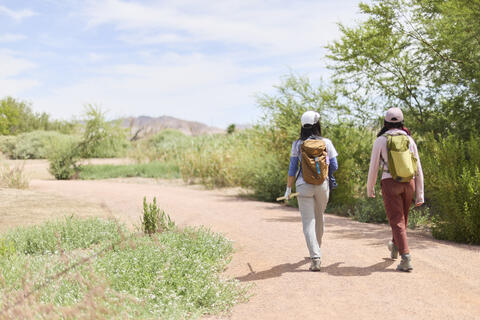
Through field work at the Clark County Wetlands, two UNLV graduate students are providing scientific data to help restore habitats and evaluate the health of its newest trees.
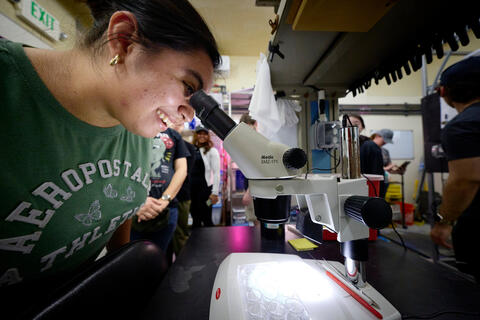
A program in the School of Life Sciences is improving retention and graduation rates through mentoring services and better course design.

A collection of top headlines featuring UNLV faculty and students.
Sciences In The News

A pair of UNLV graduates, Sarah Galera and Sophia Lorenzana, are helping preserve the Wetlands through a tree monitoring project with Clark County.
I’ve picked up a few tips in the restaurants and food service jobs I’ve worked at over the years. One habit that I’ve picked up from restaurant life is that any time I use a dishcloth, it’s getting tossed in the laundry.
Ask people why summer is hot, and a lot of them give the same answer: Earth must be closer to the Sun.The truth runs exactly backwards from the hunch.

When Sophia Lorenzana took an ornithology class at UNLV as an undergraduate student, she never imagined it would spark a love for one of the area’s most underrated natural resources: Wetlands Park.
The new GWTC-5.0 catalog adds 161 black hole collision events, confirming Hawking's theorem and identifying second-generation black holes for the first time.
A LiveScience study says probably not. On the water side of the equation, the U.S. Geological Survey estimates that Earth has about 1.4 billion gigatons of water, including that in oceans, ice caps, glaciers, lakes, rivers, groundwater and vapor.
Sciences Experts