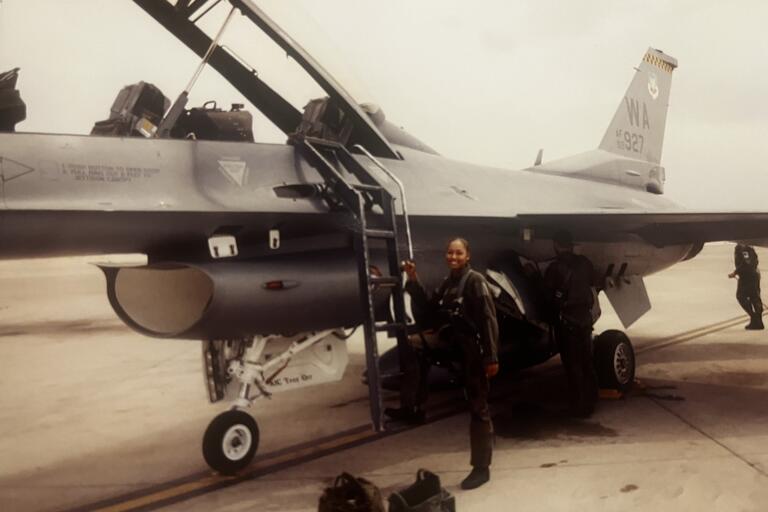
Brooke Conway Kleven always wanted to work with elite populations.
A former high-level gymnast and black belt in taekwondo, she now works with military professionals, including special operations forces, and professional athletes from football players to UFC fighters to examine their brain health after traumatic injuries.
“I've always loved math, and I've always loved the brain,” she said. “Public health was the perfect marriage of being able to look at everything I love, but in a scientific, quantitative way.”
She studied exercise and sports science at the University of San Francisco. She completed both Doctor of Physical Therapy and a PhD in epidemiology and biostatistics at UNLV — all while recovering from a brain tumor and stroke at just 22 years old.
“Physical therapy is a perfect complement to public health,” she said. “They are both about prevention. Both are arguably the underdogs of medicine, because when we do our jobs well, no one really knows. The injury that never happens, the disease that never develops, the disability that never progresses. We don't always get credit for the things we prevent, but I'd argue that's where some of the greatest impact comes from.”
Now an assistant professor in the School of Public Health’s Department of Epidemiology and Biostatistics, Conway Kleven talks about spending more than a decade at UNLV, combining her focus on brain health with public health, and why her research is so personal.

What first interested you about health and healthcare?
I've always said I wanted to be a doctor, probably before I even knew what it meant. As I got older, the brain and how it functions fascinated me. I was pre-med and wanted to be a neurosurgeon. My senior year of college, I got sick and doctors couldn't figure out what was going on. I ended up learning I had a brain tumor, which likely developed due to a birth defect. I had surgery, suffered a stroke afterward, and ended up having three more surgeries. Through the irony of loving the brain and wanting to study it, I realized I didn't want to be a neurosurgeon. I wanted to find a way to help people before it ever got to that point.
How did your experience as an athlete and physical therapy patient shape the way you approach the athletes you work with?
Beyond the physical injuries, the aspect I struggled with most was cognitive rehabilitation. I started the Doctor of Physical Therapy (DPT) program at UNLV 10 weeks after my last brain surgery. The back of my head was still completely bald. I'll never forget our first week. We had to take new student doctoral photos, and I tried to cover my hair as much as I could because the back of my head was a hot mess. I used to joke with my surgeon and tell him not to quit his day job, because he’d never make it as a hairstylist.
Jokes aside, starting a clinical doctorate just weeks after my last surgery was probably the best rehab. It forced me to challenge my brain and get back to functioning at a high level despite the challenges. I struggled at first, and emotionally, that was hard. As an athlete, we know what physical rehabilitation after an injury is like, but no one talks about cognitive rehabilitation.
Even though my research is different from my personal experiences, I think those experiences bring a heightened level of understanding and empathy for our athletes and operators. I know how frustrating it can be when you know your brain should function a certain way and it's not quite there — and that’s not something you can easily put into words.
What kind of patients do you typically work with in your research?
During my DPT program, we had clinical rotations. I was at the Cleveland Clinic Lou Ruvo Center for Brain Health in Las Vegas, where I met neurologist Dr. Charles Bernick, who runs the Professional Athletes Brain Health Study. That longitudinal cohort evaluates brain health in professional athletes, primarily boxers and MMA fighters. I gained experience with Bernick through my clinical doctorate and expressed my interest in a PhD. I worked with him throughout my dissertation, which led to my postdoctoral work at UNLV through the Sports Innovation Institute.
I continued working with Cleveland Clinic during this time, which led to collaborating with Dr. Jeffrey Cummings and Dr. Jefferson Kinney in the UNLV Department of Brain Health. In addition to his world-renowned work in Alzheimer’s, Cummings is a co-investigator of DIAGNOSE CTE, a Boston University-led study evaluating CTE risk in NFL and college football players, and he brought me onto that project.
What initially drew you to work with these elite populations?
First, because I was a high-level athlete, I feel comfortable in that world. Second, from a global health perspective, head injuries are one of the greatest causes of mortality worldwide, especially in underdeveloped countries. Traumatic brain injuries are a huge cause of morbidity, and we don't have a good way of monitoring, assessing, or diagnosing them because right now, the only way we can diagnose is through an MRI or a CT scan. Typically, underdeveloped countries don't have access to advanced imaging.
If we can get better at diagnosing, measuring, and assessing head injuries — especially in populations who experience them most — hopefully we can translate those findings to the general population and better help those who need it, even beyond sports and the military.
Can you tell me more about your current research?
I categorize my research into four main buckets. The first is the long-term brain health of athletes, whether in boxing, martial arts, football, or Cirque du Soleil. We also have a longitudinal military study — the same idea, except rather than looking at repetitive head impacts from sport, we're looking at blunt impact or blast exposure in the military, specifically within special operations forces. Then we have two acute, short-term studies looking at sport or military occupational performance over several weeks. That's where the UFC research comes in.
In addition to Bernick’s longitudinal study, UFC wanted to help its athletes now rather than wait until they're retired. That led to us monitoring brain health in UFC athletes as they train for an upcoming fight. Throughout fight camp, we look at cognition, balance, reaction time, sleep, and recovery — and how those measures relate to changes in certain blood proteins. We also monitor heart rate variability, which gives us an idea of how their bodies respond to the physical stress of training, and may provide insight into how their brains respond to injury.
What's interesting is that we're not just looking at the head impacts they take during sparring. We're trying to understand how the brain responds to everything that comes with preparing for a fight, including intense training, weight cutting, poor sleep, and physical stress. The goal is to better understand what's happening during their careers and optimize performance to protect brain health, rather than waiting until they develop symptoms years down the road.
Our UFC protocol has now translated to working with Green Berets, monitoring them while they train with weapons and breaching exposures.
What are some of the similarities and differences you’ve noticed with these different populations?
What I love about both populations is that they're at the highest level of elite in what they do. If we can identify what is changing in the brain at that elite level, that may help us identify not only the risk associated with more exposure, but also whether something is triggering resilience in that group. We know from the literature that elite athletes and military special operators have a higher risk of long-term neurodegeneration compared to the general population, including Alzheimer’s, Parkinson’s, ALS, and specifically, chronic traumatic encephalopathy (CTE). Knowing that they're at such high risk, can we identify any factors promoting resilience?
The differences between these groups — well, there are many. Even though blast exposure and blunt impact exposure are both repetitive types of brain injury, they affect the brain in different ways. We don't know the details yet, but from a basic perspective — blasts transfer through the inner ear and may be more likely to affect your vestibular system and balance, whereas blunt head impacts associated with sport are more frequent to the frontal regions of the brain.
Beyond the obvious differences, there is much we don't yet know about the long-term changes between those groups. That's what we are trying to identify.
You mentioned identifying what keeps these populations resilient. What are some of those factors?
Just being extremely athletic, in a sense. They're physically fit compared to the general population, especially regarding strength, endurance, and overall performance. In the military, especially with these special operators, they're intelligent. For example, most of the Green Berets I work with are fluent in two, if not three, languages.
Education is one of the biggest preventive factors against brain degeneration. Because these military operators are not only highly educated, but also physically fit, they typically have a much higher level of resilience that helps them combat — no pun intended — the exposures they're experiencing.
What did you know about public health going into completing your doctorate?
I didn't know much going into my clinical doctorate because looking at chronic disease never occurred to me as “public health." I always thought it was more disease outbreak investigation rather than what I consider myself now — a neuroepidemiologist. I study neurodegenerative risk among populations rather than the health of individuals, like we would do in medicine. What I do is different, and I attribute so much to Bernick. I'm beyond grateful for him as a mentor in countless ways. He opened my eyes to that intersection of public health with medicine, and working with him continually shows me how to draw a connection between public health and healthcare.
Funny enough, Dr. Jennifer Pharr — professor and chair of the Department of Environmental and Global Health at the School of Public Health — gave a guest lecture in our physical therapy program. She talked about the Americans with Disabilities Act and how it relates to healthcare settings. It was a great lecture and another turning point when I realized how much public health and healthcare overlap. After her lecture, I reached out to the public health program about applying for the PhD.
What is something you’re excited about with your current research?
One of the things I'm most excited about is learning more about the process of CTE. Right now, CTE can only be diagnosed by pathology after someone dies. There are potential blood biomarkers that may be diagnostic of CTE, which is huge. Kinney runs the blood biomarker lab and repository here on campus.
All four projects I mentioned are grounded in our work with blood biomarkers. That's the aspect I'm most excited about, because if we can identify a blood biomarker that can measure brain inflammation or long-term change associated with repetitive head impact exposure, it would open many treatment opportunities to help athletes, military service members, and even the general population.
Because of recent media on concussions in the NFL and other professional sports, people tend to think of CTE as explosiveness in behavior leading to domestic abuse and suicide risk. However, newer studies from members of our team have found that those explosive behaviors are less likely to be associated with a CTE diagnosis. What we're starting to see is CTE tends to present more like dementia rather than explosiveness. Whether the explosiveness and behavioral changes are an early presentation of the disease — or an entirely different disease altogether — is another exciting opportunity for our team to evaluate.
In summary, we need to find a blood biomarker that can measure these changes, and I think our team can do it.
How would you describe your time at UNLV?
The resources and opportunities I've had through this research — I would never have been able to do this anywhere else. Seeing the growth of the sports industry with UFC, the Raiders, Golden Knights, Aces, and all the other teams is incredible. It provides an amazing opportunity for us here at UNLV.
Most importantly, I love our team. Whether we’re talking about the public health team or the brain health team, I'm beyond grateful for everyone. Having all these collaborations with Lou Ruvo Center, UFC, the military, and research partnerships with other universities such as Boston University and UCSF is beyond any of my expectations. I wouldn't trade what we have here for anything.