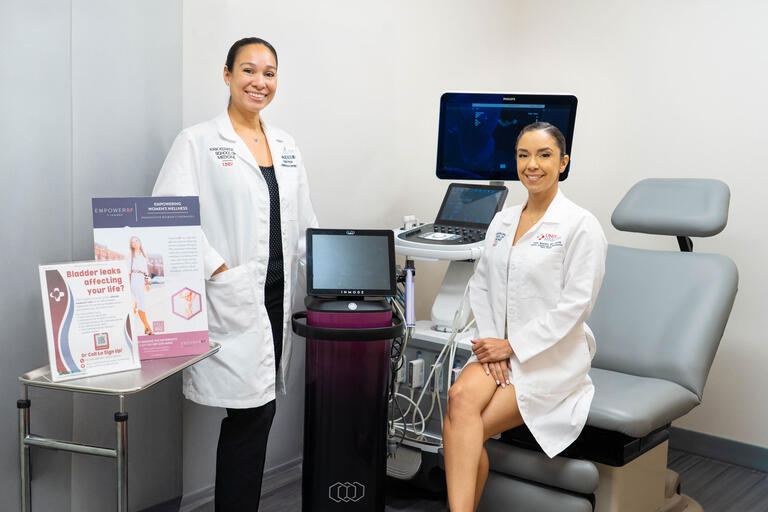
In a labor market driven by supply and demand, logic would suggest workers go where opportunities are greatest. Yet, in Nevada’s health, education, and social service sectors — where shortages are most severe — men remain scarce. UNLV researchers say cultural assumptions, not lack of opportunity, may be keeping them out.
Data from UNLV’s Brookings Mountain West and The Lincy Institute shows just how stark that absence is, with men making up a small fraction of workers in fields like social work, nursing, and counseling. The result is a workforce shaped as much by perception as by need, one that continues to fall short of demand.
But the men working in these fields describe a different, more encouraging reality. Three UNLV alumni say they not only felt welcomed and supported, but also found meaningful, high-demand work that gives their careers real purpose.
Here, they share what it’s really like to build careers in spaces traditionally defined by women and how their time at UNLV helped shape the paths they’re on today.
Better Representation for Today’s Youth Benefits Us All

Brent Florence
’11 BA Sociology, ’14 M.Ed. Counselor Education
For the past six years, Brent Florence has served as a school counselor at Sunrise Mountain High School in Las Vegas. He provides academic and social/emotional counseling, assisting students with choosing classes, exploring careers, and staying on track for graduation. As the school’s Title I HOPE Counselor, he also assists homeless youth with fee waivers, transportation, and other essentials.
Florence always envisioned a career in mental health or a similar field. His own high school counselor encouraged him to attend college and helped him apply for financial aid. [Ultimately, he chose UNLV because of his personal connections. “My father is Bobby Florence, and he’s a part of UNLV’s inaugural Basketball Hall of Fame. It was a no-brainer to attend the school my father is an alumnus from. Funny thing – some of my teachers were classmates of his.”]

Florence started off in UNLV’s clinical mental health program, but switched to school counseling after a particularly impactful practicum experience at Canyon Springs High School. “I found it easy to relate to the students,” he says.
Once in the program, it didn’t take long for Florence to notice that he stood out. He was one of only four men in his cohort — and the only Black man.
Nevada’s need for a larger workforce makes the imbalance significant. The state ranks near the bottom nationally for youth mental health, with a student-to-counselor ratio of 454 to 1.
At UNLV, about 86 percent of school counseling master’s students are women. “I didn’t experience many stereotypes about my gender. In my cohort, being a male meant a lot to the program, because of how rare we are in the field of counseling.”
During internships at schools where the majority of students are minorities, Florence says staff would often try to recruit him before he’d even graduated. They would explain to him how rare it is to have a male counselor – let alone a Black male counselor.
Representation matters, he says, especially for boys who have never worked with a male educator. “Most of those students need to see males, that way they can get different perspectives and grow their knowledge base. They can also get levels of understanding that sometimes can only come from a male.”
Florence believes men need to hear a clearer message that counseling is not about compromising masculinity. “These careers are work — not women’s or men’s work. It is work, and a great profession to be in.”
He also advocates for diversity being pushed to the forefront of recruitment strategies at colleges and universities. “In my experience – not only are there not many men, but there aren't many men from diverse ethnic and racial backgrounds.”
To men considering career paths, he says, “We are needed in these professions. Yes, you have to have empathy working with people, but it isn’t a soft field. There is room for us and our expertise to work with individuals who need us. Understand, we are needed. Working with people is rewarding, but you can make an incredible living doing this, as well."
There’s No ‘Gender’ When It Comes to Caring for Others

Justin LeMay
’19 BSN, ’24 MSN-Ed.
Registered nurse Justin LeMay works at University Medical Center as a program coordinator and previously served as a cardiovascular ICU nurse. His job involves reviewing outcomes, improving workflows, and maintaining accreditations that hospitals must meet to remain operational.
Both nationally and in Nevada, about 12 percent of nurses are men. The state has around 50,495 licensed/certified nursing-role holders, according to the Nevada Health Workforce Research Center. Of that amount, 6,058 are men.

LeMay’s pull toward nursing came from his mother, who worked as a certified nursing assistant. LeMay also took to heart a motto he learned while working for Starbucks: “To inspire and nurture the human spirit — one person, one cup, and one neighborhood at a time.” That gave him the final push to enter a caregiving field, he said in an article when he was honored as one of UNLV's Alumni of the Year.
LeMay enlisted in the U.S. Army National Guard to help cover tuition and still serves as a staff sergeant. After earning his bachelor’s in nursing, he returned for a master’s in nursing education and now teaches part time in the School of Nursing.
As a nursing student, LeMay says he never felt out of place. “ If anything, I only stood out because of how engaged I was in classes. The administration and professors have been nothing but kind to me and wished for nothing but my success.”
LeMay strongly believes men bring value to nursing. He says their presence helps break stereotypes that women are the default caregivers. As more men join nursing and more women become physicians, he believes long-standing assumptions begin to dissolve.
On nursing shortages, he notes the challenges are more systemic than simple supply. Along with strategies to address the workforce pipelines, he hopes to see policymakers address the issues such as unequal access to care and high costs in the U.S. market-driven system that, he says, places corporate profits above healthy communities.
Yet, those challenges shouldn't deter anyone from the field. To other men, he offers this advice: “When it comes to a career, there is no gender role. Do whatever your interests, morals, and ethics compel you to do. We limit ourselves when we use our gender to set boundaries on what we can do as a career.
“Imagine this: Would you turn down an opportunity because you’re too ‘manly’? What if that same opportunity leads to a six-figure salary? I bet you’d sing a different tune; so why limit yourself in the first place?”
Men Bring a Unique Perspective That’s Valuable and Validating

Vincent Delucia
’17 BSW, ’18 MSW
As clinical director and psychotherapist at Healthy Minds, Vincent Delucia oversees treatment for children and families involved in systems such as foster care and juvenile justice. He supervises students, residents, and interns, and ensures young clients receive consistent, high-quality support.
The role aligns with specialized training he received at UNLV through a Health Resources and Service Administration (HRSA) grant focusing on trauma in children and adolescents.
Initially, Delucia had no plans to study social work. He enjoyed the social sciences but did not know anyone in those fields or what those jobs entailed. He found himself frequently switching majors while working various jobs. That changed, however, when he took a support staff position at an inpatient psychiatric hospital. Working directly with children who needed intensive support revealed a direction he hadn’t considered.
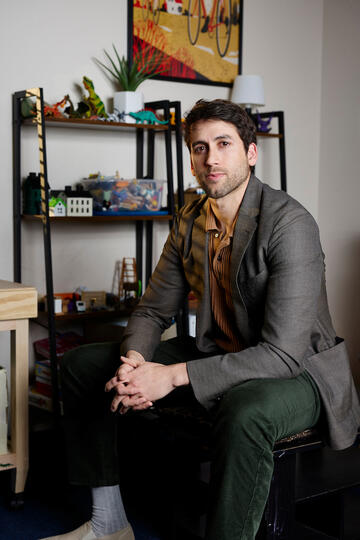
“It was one of those jobs that I have so many fond memories of and, because of that work experience, I ended up switching my major to social work,” Delucia says.
He chose UNLV for its affordability and proximity to his job. A heated class discussion offered Delucia an early glimpse into how gendered communication styles show up in helping professions. “What I viewed as someone having an assertive opinion on a topic was viewed by others as being aggressive, and thus invalidating to others.”
Being a man, he says, was an immediate advantage during job searches. “I was offered jobs with direct statements such as ‘We need more male therapists.’ The scarcity of men in our field only benefited me.”
From 2010 to 2022, Nevada institutions awarded more than 4,000 social work degrees, most earned by women. Delucia says men bring important perspectives, particularly for boys and men who struggle with issues such as incarceration, substance use, and reluctance to seek treatment.
“Many metrics would indicate men are incarcerated at much higher rates than women,” he says. “Men are much more likely to abuse illicit substances than women. Men are also less likely to seek mental health treatment compared to women. The ability of men to mentor and make a difference with other men is profound.”
To bring more men into social work, Delucia encourages practical outreach, such as volunteer programs and shadowing. He also advocates raising awareness of career paths through online marketing and social media aimed specifically at a male audience. “Experience matters, and having more opportunities to engage in the HEAL fields will allow men to experience a career they aren’t socially primed to enter,” he says.
Above all, Delucia wants men to know they don’t have to change who they are to succeed. “You can be masculine, dominant, assertive, and less emotional and still be a great therapist. In fact, those characteristics might allow you to solve some of the complex problems our male youth face today."