
Clark County, Nevada is expected to add 42,000 residents next year and, by 2060, be home to 3.23 million people, according to the Center for Business and Economic Research at UNLV’s November 2025 report.
With a growing population in Southern Nevada alone, the state will require experts who can circumnavigate a myriad of emerging issues. That’s where the Doctorate of Public Policy degree at UNLV comes in.
The degree is for individuals in the middle to executive-level stages of their careers who want to influence policy outcomes. It is ideal for professionals who need the credentials to advance their careers at a higher level.
“Public policy touches nearly every part of our lives — from how cities grow to how communities stay safe,” said Jayce Farmer, interim director of the UNLV School of Public Policy and Leadership. “In today’s complex social, economic, and political landscape, the need for skilled leaders who can design, implement, and evaluate effective policies has never been greater.”
Since the degree began in 2018, 58 students have graduated across five cohorts.
Graduates of the program have already developed policy solutions to pressing issues like educational reform, mental health and wellness, and juvenile justice reform.
A National Curriculum for Public Policy
Students from across the U.S. have enrolled in UNLV’s program because Nevada — with its diverse populations, mix of urban and rural communities, and infrastructure challenges — offers a robust learning ground for future policymakers anywhere, Farmer said.
“Nevada itself is a dynamic living laboratory,” Farmer said. “The demographic makeup of the state is what our country is evolving to become in the near future. So, the policy solutions we develop now can be the model for other communities.”
That’s why the doctorate of public policy curriculum is adaptable for communities around the U.S.
“Our public policy curriculum is a national curriculum,” Farmer said.
Students enrolled in this degree program have at least five years of work experience and bring a wealth of professional and life experience to enrich classroom discussions and applied projects. They are motivated, outcome-focused, and committed to creating meaningful impact within their organizations and the communities in which they serve, Farmer said.
“Students will gain direct access to local governments, state agencies, and community organizations, witnessing firsthand how policy decisions impact people’s lives,” Farmer said.
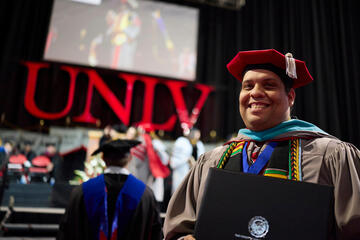
Nathaniel Waugh is director of government relations for the Clark County School District and is on the board of trustees for the Las Vegas Clark-County Library District. He graduated with his doctorate in public policy in 2025. His capstone project involved a policy of automatic record sealing as a means to reduce barriers and increase opportunities for individuals with a criminal background in accessing housing, training, workforce development, and services.
“I personally believe if folks have the capacity to serve and make a difference in their community, they should. I want the society I participate in to be fundamentally fair for everyone,” Waugh said. “Like in the musical and film Wicked, ‘Everyone deserves the chance to fly.’ And from a policy perspective, we should do what we can to allow all of our neighbors to have a fair shot to live the life they want for themselves and their families.”
The degree, Waugh said, “gave me additional tools to put into practice in my day job and allowed me to be a stronger policy advocate, policymaker, and collaborator across sectors and levels of government to achieve lasting positive policy change in our community.”
Doctorate of Public Policy Program Setup
The program was designed with the working professional in mind, Farmer said. Among the benefits of the degree, includes executive coaching. Current policy leaders in the public, private, and nonprofit sectors offer students personal mentorship, career guidance, and strategic policy insight.
It is delivered through a hybrid model of in-person meetings and online coursework with a final capstone project.
Unlike a traditional Ph.D. program in which academic research is conducted, Farmer said the program teaches students practical research methods to shape policy for the public, private, and nonprofit sectors. Individuals interested in running for an elected office can benefit from this program. The program organizes a trip to Washington D.C. where students can network with federal agencies and elected officials.
The Doctorate of Public Policy degree can help students:
- Refine public speaking skills and the ability to communicate policy arguments.
- Use data-driven research and analytical tools to effectively lobby for causes.
- Deliver policy ideas via media including social media platforms.
- Practice their on-camera skills at UNLV-TV studios with mentorship from policy experts.
- Learn how to become a leader in building a resilient community.
Students who have been accepted in the program have worked in fields such as nursing, higher education, media, law, and politics. They also come from diverse communities.
Lisa Pacheco, for example, was the first Native American graduate of the doctorate of public policy program. She was a nurse for 24 years when she decided to return to higher education. She received her doctorate in 2023 and is working to both increase nurses in Nevada and to encourage more Native Americans to pursue nursing education.
Drive Meaningful Change Through Public Policy
Affordable housing was the center of Dorian Stonebarger’s capstone project as a doctorate of public policy student.
Stonebarger graduated in 2023 with her doctorate of public policy and a master’s in urban leadership in 2018. Stonebarger is now a professor of practice in the doctorate program, sharing experiences from her work at the local and state levels.
Her project came to fruition while working as the policy advisor for the Brian Knudsen, the City of Las Vegas’ mayor pro tem. Stonebarger helped develop an ordinance to create bonuses and incentives for the development of affordable housing and an affordable housing trust fund.
“Learning how to define and then re-define a policy problem after taking stock of the issues is how I approach all problem-solving now. Truly understanding the problem enables you to consider alternative solutions and make compromises when appropriate,” said Stonebarger, who is now the deputy director of the Nevada Governor’s Office of Economic Development.
Stonebarger recommends students enroll in the degree because of its relevance to current affairs. Because of her doctorate, she’s able to collaborate with community leaders and government agencies to diversity and strengthen the state’s economy.
“Public policy exists to address our society’s challenges and set collaborative goals for the greater good,” she said.


