
Right before classes ended one Thursday afternoon at CSN High School, an unexpected and intriguing email popped into Robert Lonasco’s inbox: The UNLV College of Engineering sought applicants for its new Las Vegas Scholars Program.
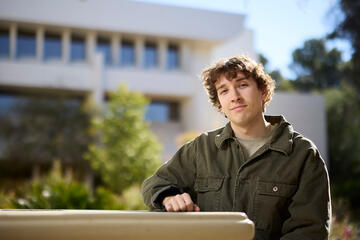
“The deadline for submitting the application was the next day, and you needed three letters of recommendation. I was like, 'There’s no way I can do this, right?'” recalled Lonasco, '23 BS Computer Engineering, now a successful UNLV alumnus.
His guidance counselor at the time gave him measured advice, saying he could pull it off if he asked his teachers for those crucial letters “really, really, nicely.”
His doggedness to submit the application on time paid off. Within a few weeks, he received an email from Sarah Harris, professor of electrical and computer engineering at UNLV, with the update that he was an official candidate for the new program.
Soon after, Lonasco — along with several other top students from across the Valley — was admitted to a program that paired a substantial annual scholarship with a cohort model aimed at helping high-achieving computer engineering and computer science majors graduate successfully.
“The goal was to put a structured system in place to support them throughout their academic career, and to increase their sense of belonging both on campus and within STEM,” said Harris, program director for Las Vegas Scholars. “And, to increase retention and graduation, which we were really very successful at.”
Featuring 23 students over two cohorts, the program is set to have an overall 74% graduation rate after two remaining students graduate this year, with an average time to graduation of 4.3 years. A quarter of the retained students double-majored and 70% of the scholars were from underrepresented groups.
There are more qualitative success points, too. Like, because of the friendship Lonasco built with fellow cohort member Marco Infantado, '22 BS Computer Science, he was more easily able to land a job after graduation at defense contractor, JT4.
Students were required to meet monthly, attend similar classes together, participate in community-building activities, and keep their GPAs above a 3.0, all while being surrounded by a support system of both fellow cohort members and faculty.
Now, with a proven model, the program has entered the “implementation” phase, having received a new round of funding from the National Science Foundation. The $2 million grant will support two new cohorts of nine students each, with the first cohort entering campus in fall 2026.
“It is really great to hear that we were a good example, I suppose, to lead the future generations onward,” said Lonasco. ”I’m glad they’re continuing the program because it’s definitely the kind of experience that everyone should have at UNLV.”
‘It’s Like Magic’: Cohort Building Foundational to Program Success
Backed by the support of their family members, the new cohort of Las Vegas Scholars — many of whom are first-generation — attended a welcome meeting on Feb. 28.
“The family engagement is another definitely unique aspect of the program,” said Harris. “It’s a long-term investment in both the student and their family.”
The new grant will feature some changes, such as requiring weekly cohort meetings instead of monthly check-ins, and will include more workshops on topics like mental health, study habits, nutrition, and budgeting. The scholarship has also more than doubled to cover students’ full yearly tuition and other academic needs at $14,000.
But the program will stay true to its original underpinnings of cohort building, which is what rises to the top for both Lonasco and Infantado.
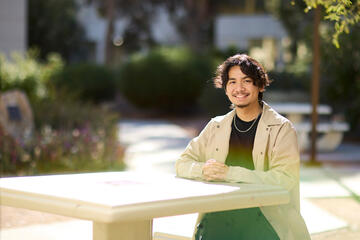
“The cohort model was the best part of it,” said Infantado, who also heard about the program through a trusted high school mentor — his calculus teacher at East Tech, Joshua Wertheimer. “It was nine of us around the same major. We all shared the same classes, and it’s kind of lucky that we also shared the same interests. We all liked playing video games. It became less like a school cohort and more like just an actual group of friends.”
A group of friends — according to Lonasco, Infantado, and Harris — who looked out for each other.
“One of my students, for example, stopped by my office and asked me to check in with another member of the cohort,” Harris recalled. “It wasn’t a student reaching out for their own personal reasons, but a student reaching out on behalf of another student. And to me, that’s like magic.”
Infantado and Lonasco said the friendship among cohort members strengthened over time because of “the room,” a space that was set apart just for them and could only be accessed via key card.
For Lonasco, who struggled in the first semester of college, the room provided “a home away from home” on campus. As commuter students, both Lonasco and Infantado said the room gave them a space to gather, study, and check in with each other in between classes and after school.
Infantado remembers one evening when three of his cohort members were puzzling over a homework assignment for a notoriously difficult course, CS 218. He wasn’t yet in the class, but stayed behind to both get a head start on learning a difficult concept and also to hang out with his friends.
“We helped each other out when classes got hard,” he said.
In addition, Infantado said he built a close mentor relationship with professors like Harris and former computer science professor Ed Jorgensen, and he was more inclined to sign up for extra-curricular and research opportunities, like the NSF-funded Research Experiences for Undergraduates (REU) Smart Cities program at UNLV.
Lonasco agreed. He remembers visiting with Harris frequently throughout the first semester and her advice and guidance helped get him in the right mindset and turn things around for his second semester.
‘Perfect timing’ for the Next Cohort
Both Lonasco and Infantado credit the program to their success at UNLV and post graduation. They both now work at JT4 — Lonasco as an engineer II and Infantado as a computer scientist II. Infantado is also currently in the computer science master’s program at Georgia Tech.
Now the two are considering coming back to campus to speak with the next cohort once they begin their studies.
“I think I’d share with them to be open to hearing different opinions and having your mind changed,” Lonasco said.
“Build connections,” Infantado added. “Anybody can get good grades and make good projects, but if you don’t have people around you who see the work you put in and can vouch for you; it’s like being invisible.”
In fall 2027, it’s possible that Infantado’s advice will take on a more personal nature.
He’s hoping to convince his cousin, an aspiring electrical engineer and high school junior, to apply for the second cohort of the new grant.
“It’s perfect timing,” Infantado said. “I'm hoping that if he applies that he’ll get in and get a similar experience to what I got.”


