As a peer mentor with UNLV’s First-Year Experience program, James Sarmiento often worked with students trying to balance school, work, finances, and uncertainty about what came next. In many ways, the advice he gave students was the same advice he wished he could have given himself a few years earlier.
“At one point, I was working three jobs while going to school full time,” he said. “I knew what it felt like to constantly feel behind.”
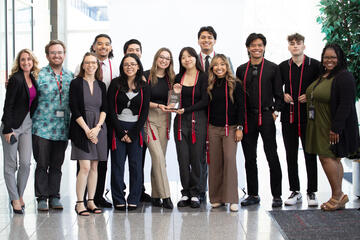
During the week, he worked as a peer mentor at Lee Business School. At night, he worked in the service industry, and when he wasn’t in class, he worked as a client care manager with a local real estate agent — all while carrying a full-time course load.
For a while, he made it work. Then one night, he realized he couldn’t keep going.
The next day, he quit one of his jobs.
“Trying to hold everything at once wasn’t sustainable,” he said.
That period forced him to become more intentional with his time, energy, and goals. Around the same time, he became involved with UNLV’s Kerestesi Center for Insurance and Risk Management, where he found direction in an industry he hadn’t originally planned to pursue. What started as an opportunity to gain experience eventually became a professional pathway.
Through the center, Sarmiento began building relationships with faculty, alumni, and industry leaders while developing skills outside the classroom. One of those opportunities came when John Starkey, associate director of the Kerestesi Center, asked him to help present to the Nevada Surplus Lines Foundation.
It was a room he never imagined himself in when he first started college. The presentation helped secure $650,000 in scholarship funding for students in the insurance and risk management program.
“Scholarships played a big role in my own journey,” Sarmiento said. “I wanted to help create that for someone else.”

His understanding of financial instability started long before college. Sarmiento said his work ethic was shaped in part by his upbringing in the Philippines and by what his family experienced during the 2008 financial crisis.
“My family lost almost everything after the 2008 stock market crash,” he said. “After that, my mom always pushed me to work hard and get good grades so we’d never end up in that situation again."
Financial aid and scholarships helped him remain enrolled during some of his most difficult semesters, which made the work feel personal. “I know what it’s like to need that help,” he said. “If I could be part of making that easier for someone else, I wanted to do it.”
Starkey said one of the biggest changes he saw in Sarmiento was not just how hard he worked, but how he learned to focus his energy. “When I first met James, he was trying to take on as much as he could,” Starkey said. “He didn’t really have a choice. But over time, he became more thoughtful about where he put his energy.”
Those connections eventually carried into his career.
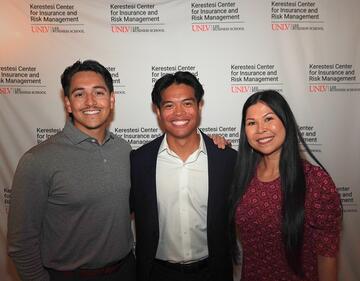
Sarmiento interned at Cragin & Pike, where he worked closely with Lee Business School alumnus Hector Cervantes, ’21 BSBA Finance. Cervantes later connected him with fellow Lee Business School alumna Feada Kakish, ’22 BSBA Finance, at Aon, helping open the door to the next step in his career.
Cervantes said Sarmiento stood out because of his ability to adapt and push himself beyond his comfort zone.
“The insurance industry moves fast, and James was always willing to challenge himself and keep up with the pace,” Cervantes said. “He showed up with a positive attitude, paid attention to details, and handled pressure well. Those are the kinds of skills that translate naturally into client-facing work.”
Cervantes said Sarmiento’s work ethic and willingness to grow professionally made him someone people wanted to invest in.
“A lot of technical skills can be taught,” he said. “What stood out about James was his adaptability, communication skills, and willingness to keep learning.”
This spring, Sarmiento will graduate from Lee Business School with a degree in finance, the Kerestesi Legacy Award, and a full-time offer from Aon in Los Angeles, where he will work as an associate broker.
Looking back, Sarmiento said his younger self probably would not have imagined where he would end up.
“I think 18-year-old me would look at everything I’m doing now and feel overwhelmed,” he said. “But I think he’d be proud.”