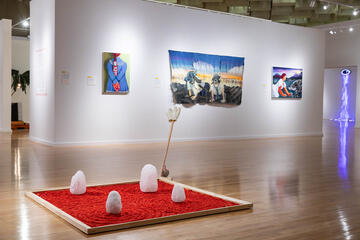
Living Here is a milestone for UNLV’s Marjorie Barrick Museum of Art. It is the largest group exhibition the museum has curated with all Asian American artists.
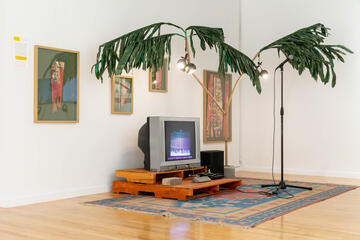
The curation tries to illuminate facets of different Asian American diasporas by drawing attention to objects so intimate and ordinary that they are easy to overlook, such as a birthday cakes, shoes, and childhood movies. How do some products or practices become characteristic of specific communities? How are they shared? How do the things we surround ourselves with help us negotiate between cultures?

The curators knew that treating such a broad subject with sensitivity would be a challenge, so they reached out to the Asian and Asian American Studies program for guidance. Professors Mark Padoongpatt and Constancio Arnaldo Jr. worked with graduate research assistant Jean Munson and the Marjorie Barrick team to set sub-themes for the exhibition and finalize the list of artworks.
The artists include UNLV graduates Quindo Miller, May Nguyen, Ian Racoma, Sush Machida Gaikotsu, and eri king, along with other local artists, and artists from various parts of the United States. Living Here also features listening stations where visitors can hear the voices of Asian American Las Vegans speaking with student historians under the guidance of Stefani Evans from the Oral History Research Center at the Lied Library.
Entry to Living Here is free. The Marjorie Barrick Museum of Art is open from 10 a.m.-5 p.m., Tuesday-Saturday. The exhibition closes on Dec. 20, 2025.
Here, the three collaborators from Asian and Asian American Studies talk about Living Here.
Constancio R. Arnaldo Jr.
Assistant professor, Asian and Asian American Studies
Why this exhibition is important: “Living Here is important to UNLV because it tells many stories of Asian America beyond common understandings of Asian American communities. It demands that we think about the desert in general, and the Las Vegas Valley in particular, as an important site of the Asian American experience. This experience is materialized in everyday objects like karaoke machines, wood carvings, metal, donut boxes, balikbayan boxes, and more. The art and the artists themselves help us imagine Asian American narratives as diverse, multiple, and always evolving.
“I am also reminded of how Asian American studies emerged in tandem with African American, Chicano/Latino, and Indigenous studies and how art was a major aspect of the Civil Rights Movement and the establishment of ethnic studies. Rather than subscribing to the ‘model minority’ myth, Living Here narrates different stories and asks us to imagine how vast and diverse Asian Americans are; what it means to be Asian and American; and how art, and the curation of it, can shape these narratives.”

One piece that resonates: “The one that I have the strongest attachment to is Maria Villote’s High Horse. When I first saw it, it evoked memories of my late father who used to sit on a kudkuran ng niyog (coconut shredder) and shred coconut for his bibingka (a Filipino coconut cake) dish. However, after meeting Maria Villote and hearing her share the ‘high horses’ origin story, I’m reminded of how her piece, and the material that is used to create it, conveys multiple meanings related to the history of colonization, foodways, race, ethnicity, belonging, and more.”
Jean Munson
Graduate research assistant, Asian and Asian American Studies
Why this exhibition is important: “It’s an amalgamation of how complexly our identity, memory, and nostalgia can be expressed through art. Visitors and students who identify with our community [can] not only see themselves, but also how the important stories we pass on from our families hold value, comfort, and nuance. I thought I knew everything there was that encompasses being Filipino, but seeing the Rough Riders piece, Tinikling in sneakers, and the setup for karaoke amidst the memory of a fatal typhoon, I am reminded how vast the well of stories and art that can and should be crafted in our community really is.
The experience as a curator: “I am deeply grateful for the opportunity to work with the Marjorie Barrick Museum on this collaboration, their attention to detail when curating works that represent a spectrum of thought, and a place for Neon Pacific Initiative cohort students to create their own art inspired by these visuals. I look forward to you all reading my entry for this upcoming [Marjorie Barrick Museum of Art publication] Dry Heat in reaction to how brilliant Quindo Miller's work proves to be as someone raised in Guam. I encourage you to visit Living Here soon because you can deepen your perceptions of Asian, Asian American subculture, and the intersections often overlooked.”
Mark Padoongpatt
Associate professor and director of Asian and Asian American Studies
Why this exhibition is important: “It embodies and elevates the best and most vibrant parts of UNLV at a critical moment. We are an Asian American, Native American, and Pacific Islander Serving Institution (AANAPISI) still working to find out exactly what that means. We have a rising Asian and Asian American Studies program (AIS) and Neon Pacific Initiative that is generating more research and stories about AAPI communities in Las Vegas. And we are situated in a city experiencing major racial and ethnic demographic transformation, with AAPIs being the fastest growing population.
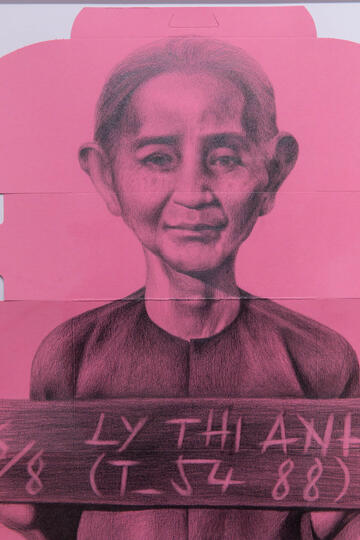
“The exhibition reflects all of these processes beautifully — and in a real, tangible, and inviting way. It makes the AAPI presence in Las Vegas visible, not in a uniform, homogenous kind of way but with great complexity and nuance. And it reveals that AAPIs in Las Vegas, while part of and intimately connected to a larger diaspora, are also deeply rooted here, are made here, not just some exotic elsewhere.”
The experience as a curator: “The artists have shared with us pieces that provoke, and are worthy of, reflection and thought. The Barrick team that made the exhibition happen — Chloe Bernardo, Alisha Kerlin, Deanne Sole, Zida Wang, Higino Abrajano — are brilliant, thoughtful, and intentional. They knew from the get go that this exhibition mattered. When they invited us, the AIS Program, to join them in conceptualizing and executing the project, it was both exciting and validating.
“Personally, as a professor and director of an Asian American Studies program, I’ve been working tirelessly to build a program that is relevant to our students and the wider public, and in the process illustrate the tremendous value of the field of Asian Americans Studies and the humanities and liberal arts for all of us. Living Here encourages me to keep doing this work. It is a model of generative collaboration among artists, curators, and scholars that is grounded in and cultivates mutuality, care, collectivity, and community that should be recognized and repeated.”
Living Here is supported in part by the National Endowment for the Arts, with additional support provided by Evan Louie, Bill Shihara, and the Lieutenant Erik Lloyd Family.