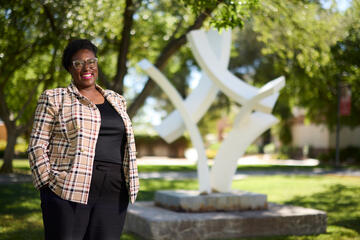
To say Angelique Burton is a people person is an understatement. She’d prefer if you called her the “community auntie.”
A professional programs manager at the UNLV School of Social Work, Burton says her favorite aunt, Brenda, “provided a level of guidance with a tone of realness,” and she has taken that philosophy to heart.
“There was a softness and welcomingness about her. And when I think about being an aunt, I think about somebody who's constantly educating you. Who's constantly making space for you and creating this platform and foundation for you to launch off of. So when I say ‘I'm a community auntie,’ I give unsolicited advice and information,” Burton explains, laughing.
Her work, she says, is rooted in helping people feel seen. She worked with seniors on affordable housing, has started camps for queer teens, and ensures college students know about opportunities in higher education.
This is Burton’s first semester at the UNLV School of Social Work after previously working at the UNLV Office of Admissions. She also teaches a first-year seminar at the Lee Business School. She earned a bachelor’s in African American history from Smith College and a Master of Urban Leadership from the UNLV School of Public Policy. At the 2026 spring Commencement, she will graduate with a Doctorate of Public Policy from UNLV.
Burton talked with us about why she’s drawn to people-centered work.
What does being a Rebel mean to you?
I feel like being a Rebel is having a strong sense of values and direction internally. Sometimes, as you navigate the world externally, people might see you going outside the box. I think when people hear those phrases, it can feel like a lone wolf identity. But you get to build community with folks. You're around so many amazing people who are doing their own thing, but you're still connected and rooted.
Why do you enjoy community building?
I grew up in a community in the heart of the Bay Area — East Palo Alto, California. East Palo Alto and Palo Alto are separated by one freeway.
One side had sidewalks, one didn't. One had a grocery store, one didn't. One had high schools, one didn't. You grow up seeing that and thinking, wait, that doesn't quite seem fair. I can't just work for me, because working for me isn't going to change a community. I have to work to change the conditions. You're connected to the community in that way. You're not meant to live this life alone.
What’s something people would be surprised to learn about you?
I'm an artist. I do acrylic painting, and that's one of the things I focus on when I talk about resting and giving time back to myself. I used to teach basic painting classes to seniors.
My art is typically everyday scenery. I would consider it Black art. Every February, I pick four paintings I've done over the year and put them on postcards. I had a mailing list I sent them to every year, although I haven't done it in the last four years. I was able to keep it up the first year I was in school, but it's definitely something I want to get back into after graduation.
What community capstone project did you focus on during your urban leadership degree?
It was a four-part podcast series about the historic Westside in Las Vegas, specifically its history and revitalization efforts. I recruited people from newer urban leadership cohorts so the podcast could continue after I graduated. We ended up having additional episodes come out afterward, which was really cool.
One of the reasons I love people-centered work is that you get to know people. You get to sit and listen to people's stories so you can effectively help them. I don't go out into communities and think, ‘I know what's best for everybody. I'm just going to tell you this cookie-cutter thing.’ I need to know what's important to you. I need to know your values.
How do you instill community building in your role at the School of Social Work?
What I do in this role is help students feel more prepared to go out into the world. I help them synthesize their professional skills with their academic knowledge so when they enter the workforce, they're ready and confident. They understand how to work with people, regulate themselves in the workplace, and continue learning throughout their lives.
Why is it important for you to ensure students have built relationships inside and outside of the classroom?
It stems from my experience as an undergraduate student, where I felt like college was just going to class, getting grades, and coming home. I could have made better connections. I could have pushed myself outside of my comfort zone, and it was something I didn't do.
I did have people pour into me and readjust the way I think. Since being back at UNLV, I've been really excited to work with students in a population I care deeply about. It feels like giving back full circle.