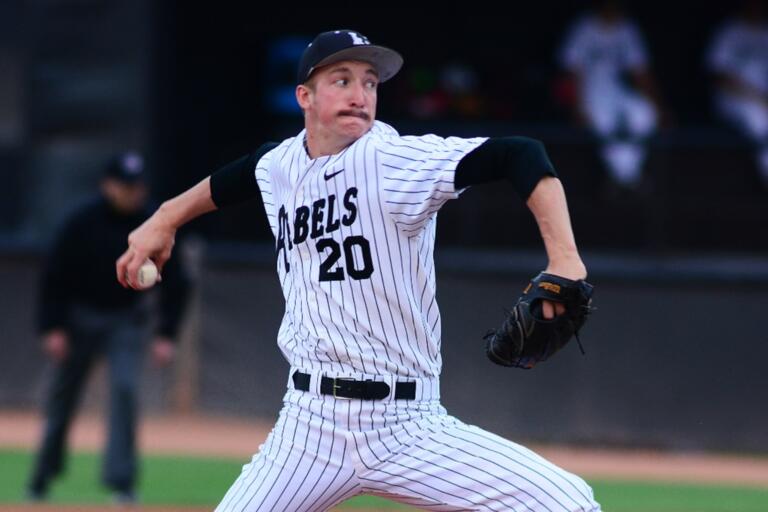
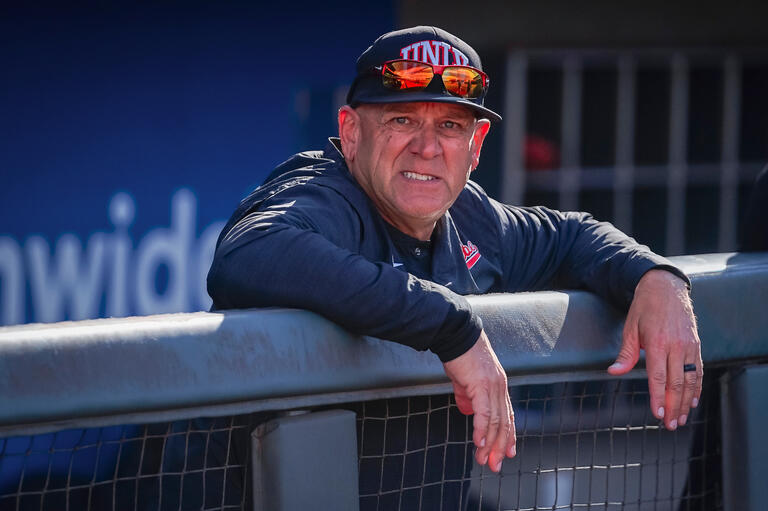
It’s late February in Milan, and Kaysha Love and Azaria Hill are high atop the Cortina Sliding Centre preparing for their fourth and final run in the two-woman bobsled event at the 2026 Winter Olympics.
Half a world away, the man who pushed over the first domino that led to this moment sits on the edge of his couch shouting some words of encouragement — as if his former pupils are within earshot.
“Believe me, I was trying to speak through the TV like every coach does,” says Larry Wade, UNLV’s assistant track and field coach for sprinters and hurdlers from 2014-21.
The message Wade telepathically conveys to Love and Hill: “You go out there and you be you — be your vulnerable, strong selves and do the very best you can. And your very best will be good enough.”
Moments later, Love climbs into her pilot seat, Hill pushes off, jumps into her brakewoman position, and the duo zips down the 1,445-meter, 16-turn track one last time.
Just two Rebels making their Olympic dreams happen.
Falling in 'Love' with UNLV
This story is as much about destiny as it is world-class athleticism. It’s a story that never would have unfolded without UNLV — or without that timeworn Vegas cliché: a roll of the dice.
It was 2016, and young gymnast-turned-elite sprinter Kaysha Love had just completed her record-setting senior year at Herriman High School in Utah. Scholarship offers flooded in from every major track and field program in the country. Love had narrowed her choice to five schools and scheduled official visits to each, including Georgia, Houston, and UCLA.
Then Larry Wade picked up the phone and rolled those dice.
A two-time NCAA national champion as a hurdler at Texas A&M in the late 1990s, Wade had transitioned to coaching and training, mentoring numerous athletes in multiple sports at both the collegiate and professional levels.
In other words, Wade knew talent when he saw it. And what he saw in Love — Utah’s 2016 Gatorade Athlete of the Year in girls track and field — was a budding star.
“Kaysha was the most decorated female track athlete in Utah high school history, winning championships in multiple running and jumping events,” Wade says. “She was tall, strong, and had a lot of muscle — totally different from the majority of sprinters.”
Wade invited Love to meet with him and his wife — then-UNLV track & field head coach Yvonne Wade — for an unofficial visit.
In the first of several twists of fate, Love had family living in Las Vegas. So she figured why not make the short trek from Utah, see her family, check out UNLV, and get a sense of how college recruiting visits go.
“When I got there, I fell in love with Las Vegas, the [campus] culture, and Coach Larry and Coach Yvonne — both their marriage in general and also their coaching dynamic,” Love says. “It was amazing. And when I met the women’s team, I was really inspired.”
More inspiration came when Love learned about the strength and reputation of UNLV’s hospitality, psychology, and business programs — areas she was interested in exploring.
“That,” Love says, “is when I really became intrigued.”
She would go on to make her five official visits, all the while knowing she would turn them all down. “I knew UNLV was where I wanted to be.”
Sprinting into the Record Books
Love made her Rebels debut in fall 2017, competing in four indoor and seven outdoor meets as a freshman. Indoors, she ran the 60 meters, 200 meters, and did the high jump. Outside, she ran the 100 and 200 meters, and was part of UNLV’s 4x100-meter relay team.
In addition to setting numerous personal-best records in her first season, Love competed in the Mountain West Conference championships (indoor and outdoor), as well as the NCAA West Preliminary and NCAA Outdoor Championships.
“As she started to compete for us, she immediately made an impact on UNLV history,” Wade says. “She’s one of the fastest 60-meter and 100-meter runners in school history.
“To be able to take her 5-foot-9, 180-something-pound frame down the track as fast as she was going, I was like, ‘This is definitely a different type of athlete.’ And she could also jump. She was very explosive.”
With Wade as her tutor, Love continued to make strides each season. Off the track, she relished academic life, having settled on hospitality as a major.
“As a student, I absolutely loved that I was able to flourish in an environment that cared so much about the hospitality industry,” says Love, who earned her bachelor’s in 2023. “I genuinely loved the idea of being more than just an athlete.”
As excited as she was about a potential hospitality career, Love’s primary goal remained the same since childhood: to be an Olympian.
At first, she thought it would happen in gymnastics. When injuries forced her out of that sport, she found track and field and began to envision sprinting for her country at the Summer Olympics.
Then, a bystander at an NCAA nationals meet during Love’s junior season approached her and Larry Wade. Soon after, her path to the Olympics shifted from one track to another.
Pursuing the Family Business
Usually, it’s hyperbolic to suggest that something is “literally in someone’s blood.” When it comes to Azaria Hill and the Olympics, it’s not an exaggeration.
Her parents — Virgil Hill and Denean Howard — met while competing for Team USA at the 1984 Summer Olympics in Los Angeles. Virgil won a boxing silver medal, and Denean and her sister, Sherri, won gold on the 4x400-meter relay team. The sisters also captured silver in 1988 in Seoul, and Denean added another silver at the 1992 Olympics in Barcelona. Meanwhile, Virgil Hill went on to become a two-division world champion over a 20-year Hall of Fame boxing career.
So it’s no surprise that Azaria Hill grew up in Southern California determined to add her own chapter to the family’s Olympic legacy: “For as long as I can remember, I’ve had that internal fire and inspiration of wanting to be like my mom and dad — I wanted to become an Olympian.”
Hill began running track in eighth grade, and immediately took to the sprinting events. After a successful high school career, she accepted a track scholarship to Long Beach State, where she competed for three seasons while working toward her kinesiology and sports psychology degree. Then came the COVID-19 pandemic, which wiped out the 2020 outdoor track season.
That’s when Hill decided to conduct a thorough self-evaluation. “I sat down and reviewed my track career and was kind of disappointed with where I was in the sport. I felt like I should’ve been further along.”
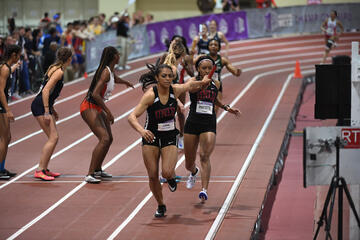
Hill concluded that if she was going to achieve her Olympic goal, she needed to move on. She researched schools and the times that female sprinters were logging. When she came across the numbers that Love and her Rebel teammates put up, Hill’s eyes widened.
She found Larry and Yvonne Wade’s emails and sent a blind inquiry. When neither responded, Hill turned to social media.
“I DM’d Coach Larry on Instagram,” she says. “We ended up meeting, but he told me he had given away his last scholarship.”
Wade offered Hill the opportunity to walk-on, and she took it. “I was willing to take the risk because I knew it would offer the best environment for me to progress.”
Enrolling as a graduate student, Hill competed in the fall 2020 indoor and spring 2021 outdoor track seasons.
“I always knew that Azaria had talent, but I never believed that she felt she had talent from a confidence standpoint,” Larry Wade says. “To be able to be around a group of young ladies like Kaysha Love, who was confident but also encouraging, and a coach like myself, who is also very confident and encouraging — it makes it easier to have hope that you can be more. Once she got here, she took advantage of that.”
Unfortunately, Hill’s improvement on the track didn’t reach an Olympic-caliber level. So when her lone season at UNLV ended, so too did her lifelong dream.
Or so it seemed.
'Coach, You're Crazy'
The bystander who approached Larry Wade and Kaysha Love at that national meet in 2019? It was a USA Bobsled coach who was there to scout talent, as track sprinter skills often translate to bobsled.
After watching Love run, the bobsled coach said that with proper training, she could make the Olympic team — perhaps as early as 2022.
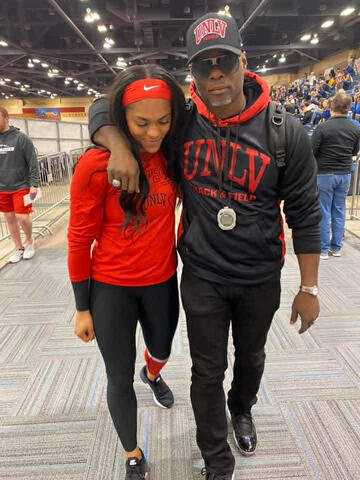
Ironically, Wade had already mentioned the bobsled option to Love before her junior season. He remembered that his good friend Willie Gault — who twice qualified for the Summer Olympics as a sprinter and hurdler, and who had an 11-year career as an NFL wide receiver — transitioned to bobsled and made the 1988 U.S. team as an alternate.
“That’s what gave me the idea,” Wade says. “I told her, ‘You know, you’re kind of built more for this.’”
Love’s response: “Coach, you’re crazy!”
That sentiment didn’t change months later when she met the USA Bobsled coach.
“He kind of told me that I was doing the wrong sport, and I wasn’t having it,” she says. “Even though I brushed it off, he continued to have conversations with Coach Wade.”
And Wade continued to lay out the reasons why Love should at least go to the USA Bobsled facility in Lake Placid, N.Y., for a tryout. Love relented, and in October 2020, she left UNLV to attend a 12-day push camp.
Says Love of Wade: “He’s one of the most persuasive coaches and people I’ve ever met.”
Love says she immediately fell for the sport during her time in Lake Placid, but admits that her first trip down the bobsled run weeks later in Park City, Utah, had her stomach in knots.
“It was quite intimidating and one of the scariest things I’ve ever done,” she says. “But by my second run, the bobsled coach told me I had pushed national team-like times, and that if this was an Olympic year, I would’ve made the national team. That was all that I needed to hear. All that fear turned into motivation to chase my lifelong dream.
“I honestly didn’t care how it happened — gymnastics, track, or bobsled. The goal was to make the Olympics.”
She did just that, competing as a brakewoman for Team USA’s two-woman bobsled team at the 2022 Winter Games in Beijing.
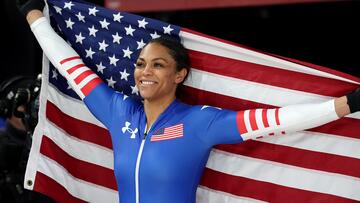
“I genuinely couldn’t believe it, because [athletes] just don’t make Olympic teams within the first couple of years of trying a sport,” Love says. “It was really cool that the previous eight years of training relentlessly on the track paid off through bobsled.”
She's quick to credit Larry and Yvonne Wade and others at UNLV for helping to make it happen.
First, the athletics department made accommodations that allowed Love to begin pursuing bobsled while juggling her scholastic and track responsibilities (often virtually). Even the UNLV athletics training staff pitched in, equipping Love with winter gear like gloves, thermal outerwear, and a winter coat — items not typically found in a track athlete’s closet.
“That was just another moment that confirmed I made the right decision to come to UNLV,” Love says. “Because I just don’t see how another university would’ve let a scholarship athlete miss a whole season to pursue something else.”
To Wade, the decision was a no-brainer.
“My wife and I felt like the sacrifice was worth it for us and as a team to give her that shot,” he says. “She turned down a lot of top-level Division I schools to come to UNLV and train with me. So I knew I wanted to get more out of her beyond being a UNLV star.”
Rebels Reunite on Bobsled Track
When Azaria Hill transferred to UNLV, she was a stranger in a strange land. One of the first Rebels to extend a welcoming hand? Kaysha Love, who invited Hill to her birthday party just weeks before departing for Lake Placid to begin her bobsled journey.
“I was new and a little bit shy,” Hill says. “But Kaysha was super nice from the get-go.”
When Love returned to UNLV for the spring 2021 outdoor season, she once again competed on the Rebels’ 4x100 relay. This time, one of her teammates was Hill, who was impressed that her friend was pulling double duty on two completely different surfaces.
“I thought it was a super cool opportunity for her to be doing bobsled and track at the same time,” Hill says. “But [bobsled] was nowhere on my radar — not even a thought.”
That would change a couple of years later, all thanks to a stream-of-consciousness social media post.
After her competitive athletic career came to a halt, Hill struggled to find a fulfilling replacement. One day, she took to Instagram to share her feelings. The post found its way into Love’s feed, who reached out to her former teammate directly:
“Hey, would you consider bobsled? You’re so powerful and so fast that I think you would be an amazing bobsled athlete. You could make a super quick transition.”
By this point, Hill had seen her friend compete in the 2022 Olympics. Still, she wasn’t convinced that she could follow the same path. “My initial reaction was ‘I haven’t been training. I’m two years removed from competing at an elite level. I don’t think I can do it.’”
A USA Bobsled rookie camp in fall 2023 was looming, so Love nudged Hill in the same way Larry Wade had nudged her four years earlier. The encouragement worked: Hill accepted a camp invitation at the 11th hour, excelled in much the same fashion as Love, and quickly established herself in a brand-new sport.
“Kaysha had so much belief in me,” Hill says. “She was speaking my name in rooms that I wasn’t even in. At one point, she told me, ‘I can’t wait for you to become an Olympian!’ She said that in 2023. So she definitely saw potential even when I didn’t necessarily see it myself.”
In Pursuit of Olympic Gold
While Hill was developing her skills as a brakewoman, Love was making her move from the back of the two-woman sled to the front (while also taking off as a “solo artist” in what’s known as the monobob).
It seemed only a matter of time before the erstwhile sprinters who once tore up the track on the Rebels’ 4x100 relay team raced down a bobsled run together. Sure enough, in December 2023, the pair joined forces at a two-woman World Cup race in La Plagne, France. It was Love’s first competitive experience as a pilot and Hill’s first race ever.
Six weeks later came another first: a podium appearance after placing third at another World Cup event in Lillehammer, Norway.
Jump ahead two years, and the duo were racing down track at the Cortina Sliding Centre — this time as U.S. Olympic teammates.
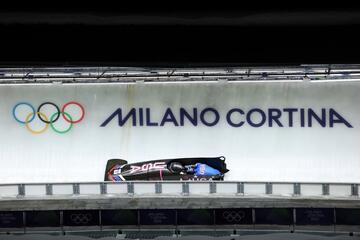
With their former UNLV track coaches watching from afar, Hill and Love posted a combined four-heat time of 3 minutes, 49.71 seconds. That placed them in fifth — just a half-second shy of bronze medalists (and U.S. teammates) Kaillie Armbruster Humphries and Jasmine Jones.
Love also competed in Milan in the monobob, finishing seventh overall and third among Team USA competitors.
“The 2022 Olympics will always hold a special place in my heart because it was my first Games,” Love says. “But 2026 is definitely something that I will cherish forever. To watch Azaria not only achieve her lifelong dream but also continue her family legacy — because I know how much that meant to her — was incredible.”
Says Hill: “It was such an amazing experience. Being able to do it with my best friend made it extra special.”
The only thing that would’ve made it more special, of course, was if they had returned home with an Olympic medal. And make no mistake: That’s next on the agenda.
Both women expect to compete at the 2030 Winter Games, although it may not be in the same sled, as Hill will soon participate in a two-week driving school for a possible move to the pilot’s seat. Should that transition happen, the two might compete against each other in the monobob and two-woman events.
Then again, it would be quite fitting — one might even say fateful — for the friends to pair up once again at the 2030 Winter Games. After all, they would be doing so in La Plagne, France, on the very same track where they raced together for the first time.
“I’ve realized my dream of joining my parents as an Olympian,” Hill says. “Now I’ve got to get me a medal! And I hope to do it with Kaysha. Because we’ve got some unfinished business.”