Focus on the things you can control; forget about the rest. College coaches have been imparting this message to players for generations.
Recently, though, modern-day coaches have had to flip the script, applying that mantra to themselves.
And it’s all because the rigid black-and-white rulebook that governed college athletics for more than a century has been cast aside for an updated version that’s often vague, constantly evolving, and written in various shades of erasable gray ink.
For instance, the rule that required scholarship athletes to sit out a full year of competition if they transferred to another university — a rule designed, in part, to prevent college athletics’ version of free agency? Obliterated.
Thanks to the advent of the transfer portal, student-athletes can theoretically play for four different schools in four successive years (if not more).
And the rule that flatly prohibited schools or boosters from compensating players in any way — the one that had severely punitive sanctions attached to it? Also gone. Now it’s not only legal to pay student-athletes above (rather than under) the table, but those athletes can sell themselves to the highest bidder.
These are the most significant among many changes — in just 5 years — that have completely altered the aesthetic of collegiate athletics. Considering the college coaching community is, by nature, averse to change, this sudden jolt has felt more like an 8.0 earthquake.
So much so that several iconic coaches have chosen to hang up their whistles rather than adapt. (Two of the biggest names to walk away: Alabama football coach Nick Saban and Duke men’s basketball coach Mike Krzyzewski.)
The rest — including the 14 coaches who lead UNLV’s 17 Division I athletics programs? Well, they’ve been repeating their own words on a seemingly never-ending loop:
Focus on what you can control; forget about the rest.
“My thing is you can’t look at the glass as half-empty; you have to look at it as overflowing,” says new Runnin’ Rebels head coach Josh Pastner, who took over the program in March after previous head coaching stints at Memphis and Georgia Tech. “What I mean by that is: This is the deal now. These are the rules we’re all playing by.
“So from my viewpoint as coach, if you have any negative feelings, if you’re overly frustrated, if you’re going to complain about it, you’re just going to get left behind.”
Sharing a similar perspective? Pastner’s UNLV counterpart, women’s basketball head coach Lindy La Rocque.
“I’ve told a lot of people that my personal opinion of how the new model is working and where things are going doesn’t really matter,” says La Rocque, who is embarking on her fifth season leading the Lady Rebels. “This is what’s happening, and you either have to figure it out, adapt, and make it part of your strategy or you probably need to find another line of work. Because one thing we’ve learned throughout history is that we never go backward.”
To shed light on how they’re navigating these new and still somewhat murky waters, we chatted with Pastner, La Rocque and new UNLV football coach Dan Mullen to learn how they’re adapting to a new normal.
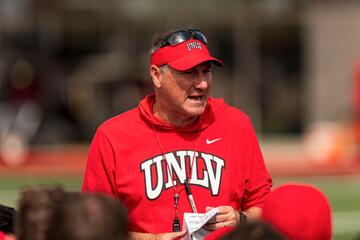
Dan Mullen
UNLV football coach (first season)
- Career record: 103-61 in 13 seasons at Mississippi State (2009-17) and Florida (2018-21)
- Highlights: Maxwell Club National Coach of the Year (2014); SEC Coach of the Year (2014); 7-3 record in bowl games; coached 76 players who were selected in the NFL Draft
Coach Mullen, prior to taking the UNLV job in December, you spent three years as an ESPN college football studio commentator. During your coaching sabbatical, the college athletics’ landscape underwent a major face-lift. Was there any hesitation to get back into coaching?
Mullen: There was a little bit, which is one reason why I spent the last few years doing TV — I wanted to let some things sort out and see how [the new system] was working. Doing the ESPN stuff gave me a chance to assess it from a 30,000-foot viewpoint rather than having to deal with it on a daily basis.
That helped me develop an understanding of the different game that I would be getting back into. And by “different game” I don’t mean the one that you play on Saturdays or when you’re on the practice field; that’s still the same. I mean you have to run your program differently than you did in the past.
Doesn’t this new model add another layer to the challenges of managing student-athletes while developing a program’s culture? In other words, has the job of a collegiate head coach gotten a lot more difficult?
Pastner: Are there challenges we didn’t have to deal with before? You’re darn right there are. Are there some frustrations? Of course. But I’m one who believes there are certain things about the new model that make college athletics better.
Just because student athletes are getting paid does not change the standards that we’re going to hold them to or how we’re going to coach them. Maybe our players — our roster — will change yearly. But our standards and our culture won’t change. And if you don’t want to be coached hard and held accountable, then this isn’t the place for you.
La Rocque: I view myself as an educator, which is part of being a coach. So to me, the isn’t any different than a teacher having to learn new technologies to reach their students. My mindset is you can continue to complain about it and get left behind, or you can figure it out and make [the new system] work for you.
The simple fact is the horse is out of the barn. So you better get on it before it runs away — or start chasing a different animal.
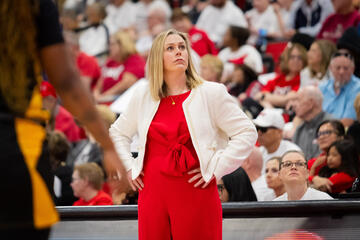
Lindy La Rocque
UNLV women’s basketball coach since 2020-21 season
-
Career record: 128-30 (all at UNLV)
-
Highlights: Four-time regular-season Mountain West Conference champions (2021-24); three-time Mountain West Conference Tournament champions (2022-24); three NCAA Tournament appearances (2022-24); two-time Mountain West Coach of the Year (2022, 2024)
Coach Pastner mentioned that there are certain changes that he likes. So what are some of the positives from a coach’s perspective?
La Rocque: I believe there are positives in pretty much everything. For example, the transfer portal. I think the intent is to allow our young athletes the chance to find where they feel is the right place for them. That’s a positive.
There’s also a much shorter recruitment period now, which is positive from a time standpoint — but it also can be risky. You have to do a lot of information gathering and research in a three-week window when you used to have three months, if not three years.
Pastner: I love that you’re not wasting time anymore. And the great thing about the transfer portal is the players are older; they’re 20, 21, 22 and have experience being part of a college program. Not only do you have tape on them playing at the college level, but they understand how a college system works and what you have to do to be successful.
When you’re dealing with younger players — especially freshmen — they can get overwhelmed because everything is coming at them from different directions. When you recruit a player from the portal, they’ve been through all that. They understand about taking care of their bodies, about managing their time and how to juggle academics and basketball responsibilities.
Mullen: I also think the transfer portal can be very positive. For one thing, you can fix your program quicker if you make a mistake in recruiting.
The troubling part is how certain things have been set up.
The fact that football’s three-week transfer window [in winter] starts in December instead of January — which would align more with a university’s calendar — makes no sense. Also, because the lifespan of a team now is one year, January to January, that should be the only window; there shouldn’t be a spring transfer portal.
Now, that second one actually helped us this year; we lost very little and added some great pieces. But I believe what’s good for the game is to have one window. That way our student-athletes understand when they sign with a school that it’s a [minimum] commitment of exactly one year.
How players are being paid also needs to be looked at. As originally designed, players could only profit from their name, image and likeness (NIL). The reality is — and everyone knew it would end up this way — that it’s a pay-for-play model. That leads to a lot of discrepancy and imbalance, and I don’t love that.
Pastner: At some point there has to be some uniformity and [governance]. From where I sit, there are only two ways to go about it: Either the student-athletes become university employees, or there have to be federal regulations established.
Regarding the topic of paying players: How do you manage this new dynamic in your program and keep jealousy, resentments, and/or pettiness from infiltrating your locker room?
Pastner: I like to be very up front with players: “Hey guys, let’s talk about the elephant in the room. You all know that everyone is getting paid at different levels, but when the ball is tipped, my loyalty is to UNLV. I’m putting the best players on the floor to win the game. And before that, we’re going to coach you as hard as possible to get you to be the best you can be.”
La Rocque: Our young people are not naive to which of their teammates might be making more money — especially once things go public. But we try hard to teach them how to be adults in this financial space. Because out in the real world, not all salaries are equal.
Mullen: Listen, if our guys want to go play in the NFL, they better get used to that. I can go right down the street to the Las Vegas Raiders’ complex, and they’re all making different amounts of money.
La Rocque: Part of my approach also has been, “To whom much is given, much is expected.” That’s one way I can try to protect the culture: If you have been given a major blessing, then the expectation is going to be different for you — as it is in life, as it is in professional sports.
Pastner: You also can’t be afraid of confrontation and telling your guys the truth and pushing them to get the most out of their abilities.
All of that is part of the old landscape, too. Just because there’s now a financial component involved, you still have to find the guys who deep down inside are driven to improve, who are about winning, and who want to be pushed and coached hard to achieve both goals.
In the end, when the guys get on the floor, we’re not concerned about the money thing. We’re coaching them every day in practice like it’s Game 7 of the NBA Finals.
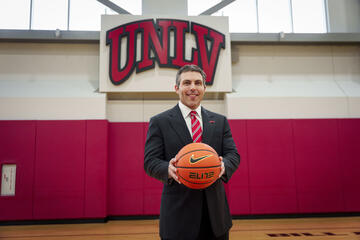
Josh Pastner
UNLV men’s basketball coach (first season)
- Career record: 276-187 in 14 seasons at Memphis (2009-15) and Georgia Tech (2016-23)
- Highlights: Two-time Conference USA regular-season champions (2012-13); three-time Conference USA Tournament champions (2011-13); ACC Tournament champions (2021); five NCAA Tournament appearances; two-time conference Coach of the Year (Conference USA in 2013, ACC in 2017)
Not so long ago, college players recruited out of high school stuck around for three or four years. That gave fans the chance to develop strong connections to their favorite players — an element that’s been completely lost in the one-and-done era. So how difficult is it for coaches to build and sustain a rabid fan base in today’s game?
Pastner: That is one of the downsides of the transfer portal — fans having to relearn their team every single year in college athletics. The flip side is, because of social media, people can pick up their phones and instantly find information about new players and learn about their personalities.
Mullen: That’s where you encourage your fan base to become more attached to the program.
Now, one part that is going to be difficult — and we’re going to see this become more of a thing the further down the road we get — is how players are viewed by fans and the university in a historical context. For instance, here at UNLV, Randall Cunningham is a Rebel through and through. Tim Tebow is a Florida Gator through and through. Now you’re going to start seeing fans say things like, “Man, he was awesome for us! But he was only here for two years. And now he also has an attachment to another fan base.”
So when it comes to fan connections with players, it’s going to be less of a year-to-year issue and more about how fans will have fewer historical ties to all-time greats.
La Rocque: This is where I believe women’s sports finds its niche, with fans having an investment in the stories of individual players. That is a huge piece of how we get fans in the stands — and get them to come back and bring their friends.
But it’s also important to turn the focus back to the whole program. Because we are a program that has won [conference] championships, we have this platform for our individual players to stand out.
In the end, winning kind of solves everything, doesn’t it?
La Rocque: You would think so! And, for us, that’s the part we’ve tried to control. Whether it’s player retention or building the fan base, we want people around our program who value winning — on the court and in society.
The reality is not everyone shares that same mindset. So there will be players who [prioritize] something else, and that’s OK. It just gives us an opportunity to find other young women who do value what we value.