
For the 20-plus members of UNLV’s Birding and Conservation Club, the popular saying “birds of a feather” is more than an idiom. The club is a way for students, faculty, staff, or even community members to “unplug,” connect with nature, and practice conservation alongside those who share a similar enthusiasm for observing birds.

Franklin Ung, a fourth-year biology student, became the club’s president in January and has already led a series of conservation initiatives both on and off campus. “Being in this club allowed me to notice all the nature that’s happening, all the things that we are doing to affect it, and made me conscious of how much we’re actually doing to the environment,” says Ung.
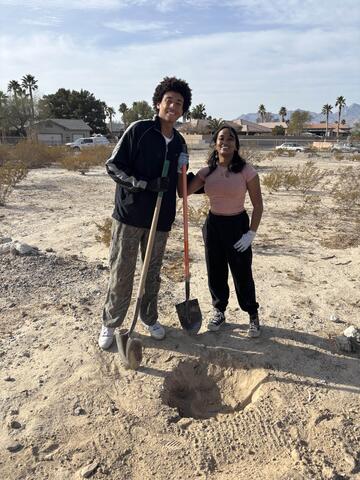
For Ung, who is interested in ecology and evolution, joining the club was a no-brainer. Especially since he has plans of applying to a master's program in wildlife biology. Besides the club complementing their academic pursuits, the club offers life sciences students like Ung and club vice president Paeja Salgado a way to participate in conservation projects across the Las Vegas Valley.
“The club provided me opportunities to gain experience in work related to ecology such as participating in burrowing owl den cleanups and stewardships at local parks and wildlife refuges,” says Salgado, a second-year biology major with a concentration in ecology.
It also offers members a safe space to de-stress and recenter themselves in between part-time jobs, homework assignments, and other stressors.
“What I enjoy most about birding is how relaxing and freeing it can feel,” says Salgado, who likens the experience to a meditation session.
“I find that fellow members are open individuals who take care in fostering a welcome and supportive environment. At the end of the day, we are a collection of people who have a strong interest in birds, and it’s nice being able to explore that hobby with others.”
Making Less of an Impact?
Conservation is one of the top priorities of the Bird and Conservation Club. Projects have included revegetating areas at Corn Creek in the Desert National Wildlife Preserve with native plants and creating the a pollinator garden located north of Beam Music Center.
But, the club's most recent and biggest initiative was about creating less of an impact on campus — not more. The club, which hosts monthly birding walks on campus, performed a bird window collision survey in the spring on nine UNLV buildings.
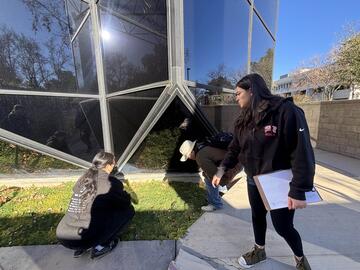
In the U.S., an estimated 1 billion to 3.5 billion birds die annually from window collisions. Members took advantage of the walks to collect evidence of dead birds or imprints on windows and identified three significant architectural offenders: the William D. Carlson Education Building (77 collisions), Beverly Rogers Literature and Law Building (28 collisions), and Student Recreation and Wellness Center (23 collisions).
After submitting their findings from the survey to administrators, and with the help of a grant from Red Rock Audubon, UNLV’s Facilities Management began installing the anti-bird collision decals on Sept. 18. The decals were featured stops at the club's first bird walk of the fall semester on Sept. 24.
“With the grant from National Audubon, Red Rock Audubon Society and UNLV, BCC purchased the decals from a company called Feather Friendly, who had already done the science behind the decals and have warranties to allow this installation to last,” says Ung. He also credits Michael Bailey, the associate director of work management, for his help with the decal project.

An Oasis for Migratory Birds
Although many members are studying fields within the School of Life Sciences, the club is open to all majors. Aaron Smith, a third-year cybersecurity major from Menifee, California, discovered the Bird and Conservation Club through the UNLV Involvement Center.
“People I’ve met through birding and this club come from all walks of life, all sorts of careers and backgrounds, and are all necessary and important to further the cause of conservation,” says Smith, who is now the club's social media coordinator. “Protecting wildlife for the next generations is something we can all be involved in.”
The Maryland Parkway campus provides a waystop for migrating birds during the spring and fall seasons because of its proximity to the many habitats located within the Las Vegas Valley. The approximately 350-acre campus is also home to the Xeric Garden, 10 champion trees, and is recognized as a Tree Campus USA, all of which supports native and migrating birds by providing shelter, food, and water.
It’s also why UNLV is considered a “hot spot” for local birders.

“Birding around UNLV is always a great experience and showcases more species diversity than one might think,” says Smith. “A constant star on just about every bird walk that always gets a big reaction is the Cooper’s hawk. We had several sightings of a nesting pair in the spring semester, and I’m hoping to see them again soon.”
Most birders can name their “spark” bird, an initial sighting that introduced them to birding.
“For me, it was the Green-tailed Towhee,” says Ung. The songbird can be identified by its reddish-brown cap, a gray head and breast, and bright greenish-yellow wings, back, and tail. “I saw that bird as my first kind of, like, favorite forever.”'
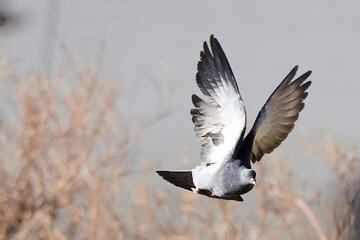
Salgado maintains a soft spot for the rock pigeon. “While it is a rather ‘boring’ and common bird, my casual observations of pigeons are what kickstarted my birding journey,” says Salgado.
Smith, meanwhile, has a fondness for the mourning dove and its gentle coos. For him, birding isn’t about being an expert.
“I’m not knowledgeable about the particulars of every species I see, but I still enjoy getting out in nature and spotting either familiar birds or some that are new to me,” he says. “As long as you’re willing to listen, others you meet through birding will always be excited to share interesting facts and stories about birds and other wildlife.”
A ‘Tweet’-worthy Accomplishment
Many bird varieties can be observed on UNLV's campus — from yellow-rumped warblers, finches, and sparrows to mockingbirds, hummingbirds, and brown-headed cowbirds.
David Zechman, a music scheduler for the School of Music, sits at the top of the pecking order when it comes to bird identification on campus.
“In the three years I’ve been on campus, I have been fortunate to identify 90 different bird species on my lunch hour,” says Zechman, who is acknowledged as the “top birder” at UNLV on Ebird.org. “Anyone in the world can check the website to see what birds are being reported in any region, country, city, or specific hotspot. Just use the website’s Explore Hotspot feature and enter UNLV. It will show all of the birds observed and reported through the Ebird app.”

It was in 2000 that Zechman’s casual interest in birding peaked. While taking his dachshunds for a walk in North Las Vegas’ Craig Ranch Park, he became curious about two birds he saw but couldn’t identify without doing research: black-crowned night herons and common mergansers.
“Everyone has different joys, experiences, and motivations for birding. I enjoy watching the behavior, relationships, and interconnectedness of wildlife — birds, insects, plants, and others. The physical and mental health benefits are the icing on the cake,” says Zechman, who volunteers as a trip leader for the Red Rock Audubon.
In addition to providing the grant for the anti-collision decals, the Red Rock Audubon offers free guided birdwalks and other educational programming.
“You’ll meet lots of great people, and you’ll learn how to find, identify, and appreciate many of our feathered friends, from hummingbirds to hawks and everything in between,” says Zechman.
For Zechman and the students in UNLV’s Bird and Conservation Club, there are considerable benefits to being a birder: a hobby that supports wellness, a community that encourages their interests, and an opportunity to connect more deeply with nature and contribute to its protection.
Ready to Start Birding?
A starter birding pack might include binoculars, sunscreen, guidebook, water bottle, and apps useful for tracking and identifying birds such as Merlin Bird ID and eBird.
Remember: The best seasons for birding are spring and fall, particularly the early morning or evening hours when it’s cooler.
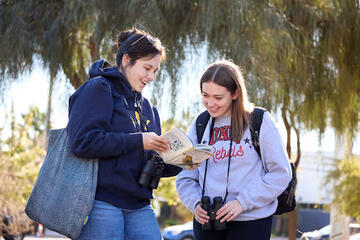
Top birding locations near Las Vegas
-
Henderson Bird Viewing Preserve: At this 140-acre site, catch the greater roadrunner, black-necked stilts, waterfowl, and crissal thrashers.

- Clark County Wetlands Park: Walk trails and wetlands home to over 200 bird species — American coot, Gambel’s quail, or even a white-faced ibis.
- Red Rock Canyon: Discover resident desert species like Albert’s towhees, red-tailed hawks, golden eagles, and the cactus wren.
- Corn Creek (Desert National Wildlife Refuge): Spot a rose-breasted grosbeak, northern parula, American redstart, or the outgoing orchard oriole.
- Floyd Lamb Park at Tule Springs: The park’s ponds and trees are known for attracting herons, egrets, and ducks.


