You might remember a time on social media where sommeliers were asking: Does a dry rosé pair well with Flamin' Hot Cheetos? Perhaps, a pinot grigio and Ruffles? At UNLV, one course pairs another experimental combination: wine and music. For students curious whether chardonnay goes better with Laufey or Led Zeppelin, this class offers an answer.
The Course: Aesthetics of Music and Wine
The class explores 10 countries from nearly every region of the world and how their music, wine, and culture evolved in parallel over time.
“We’re looking at a very rich background in viticulture and viniculture. So those things tend to be together,” says Tim Jones, vice dean for the College of Fine Arts. “There’s a common saying of ‘What grows together goes together,’ and that is true for the culture, as well.”
Why is it being taught?
The course started as a collaboration between former associate professor Murray McKenzie in the Harrah College of Hospitality and Jones in the School of Music.
“We wanted to pair music and wine in a way that made it interesting to students who wanted to take an elective class,” Jones says. The students end the semester with a proficiency in both subjects and a better understanding of their personal preferences.
The class aligns with Las Vegas's role as the Sports and Entertainment Capital of the World. Hospitality professionals continually develop innovative ways to offer elevated experiences to guests. The course reflects the kind of “only at UNLV” learning experience that prepares students for the future of hospitality and beyond.
Who’s taking it?
Open only to students 21 and older, the course is typically taken by juniors and seniors. “It’s a fun course to take,” Jones says. “You relax, listen, and enjoy the information that’s being shared.”
Who’s teaching it?
Jones is no stranger to teaching interesting courses on campus; he was formerly the coordinator of percussion studies and taught the History of Rock ‘n’ Roll class. His long list of credits includes performances with the Las Vegas Philharmonic, Andrea Bocelli, Michael Bublé, Josh Groban, Blake Shelton, and Las Vegas bands the Wild Celts and Mojo Risin’. He also brings wine expertise, having grown up in Australia’s famous Adelaide Hills and McLaren Vale regions and recently completing the WSET Level 4 Diploma in Wines.
The course is co-taught by Joseph Phillips, one of fewer than 350 people in the world with the Master Sommelier designation. Phillips was previously a sommelier at the Bellagio and later a director of wine at the MGM Grand, overseeing wine programs for restaurants including Tom Colicchio’s Craftsteak and Joël Robuchon at the Mansion. He joined UNLV's College of Hospitality in 2014 as a part-time instructor.
Like Jones, Phillips also blends his expertise in both wine and music, having earned his degree from the Berklee College of Music in jazz, saxophone, and film scoring.
Despite their impressive resumes and cross-disciplinary knowledge, the instructors keep the course approachable and engaging. Says Jones,
“Joseph and I can play off one another with both the music and wine elements. It's really fun to teach in an interdisciplinary and collaborative way, and we happen to like working with each other and get along well! ”
He adds that, by the end of the semester, students often contribute to the in-class discussion more than the two instructors.
How does it work?
The course is partly based on work by professor Charles Spence’s Taste Perception Lab at Oxford University. Jones was inspired by Spence’s work in exploring how music and sound can change perception.
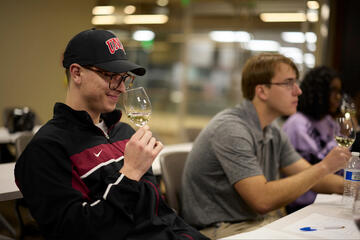
Students taste and evaluate a wine as a control. Then, they taste it again while listening to different genres and determine if certain songs enhance the experience.
“We believe that there are changes in perception — not in what's actually in the glass, but the way that you perceive that taste — if the music is right or if the music is completely off or absent,” Jones says.
Deep, low, or loud sounds can bring out bitterness in wine, he says, while high, gentle sounds can bring out acidity and sweetness.
What excites you the most about teaching this course?
For Jones, the course is a perfect blend of his original passion, music, and his interest in wine. And, even better is when he sees the “a-ha” moments from his students during class.
“I like to see the enlightenment that happens when that penny drops,” he says. “I like the fact that I get to be in the classroom and get to teach. It’s a great way to end the day — with good music, an understanding of wine, and great discussion that ends up opening all kinds of conversations.”
What can even casual wine or music lovers take away from this course?
Jones explains that the course gives students an introductory knowledge of a variety of cultures alongside the significance of the wines and music that shape some very significant regions. By developing an understanding, and therefore an appreciation, of the global influence of music and wine, students can recognize how these elements enrich daily life.
How does this course connect to students’ future careers?
For students in hospitality, the course is vital to developing a venue concept or guest experience. “When you can understand how music can influence the feel of a space, you can choose playlists that are appropriate for the type of venue,” Jones says.
The course also gives any students a foundation of wine knowledge that will help them talk to their colleagues in the future. For music students, learning to perform the appropriate songs that energize guests, create reflective moments, or serve as background enhances their professional versatility.
“Understanding that’s going on in the total picture can really benefit both areas, music and wine,” Jones says.
The listening list:
For readers interested in learning how to pair music and wine themselves, Jones recommends starting at the extremes.
Pair a light riesling or moscato with classical harp or airy piano music. Then, try again with the Rolling Stones or AC/DC. Consider which one elevates or distracts your experience.
Pair a cabernet sauvignon or a merlot with classical piano. Then, try listening to acoustic guitar or flamenco music. Jones recommends, “I found that the acoustic guitar flamenco music can give a warmth to medium- to full-bodied red wine that is complementary.”