The news video is vivid, dramatic. A leaping fire consumes the two-story center of the University Gardens, the plaza across from UNLV’s Greenspun Hall, on the morning of Friday, July 25. Firefighters scramble to quell the flames even as nearby hydrants run low. The column of smoke is visible across the valley as much of this longtime Maryland Parkway fixture burns beyond recognition.

No one was injured, but there was plenty of pain. “It’s devastating to the core,” Marsean and Latricsha Nelson, owners of Tastebudz Creole Kitchen, posted on social media. Other tenants destroyed outright include a U.S. Post Office and a tattoo shop. Businesses in the two single-story wings — a hair salon, boba shop, photo shack, tamale joint, vape store, and others — were largely untouched by the flames but inundated by smoke and water. Clark County officials quickly condemned the building.
Now, in addition to the losses they sustained, these businesses face the costly possibility of relocating. And for some, that cost won’t be just a financial one, says Donna Jordan, manager of the Supercuts outlet, which has operated in that strip mall for four decades. It’s social, too. “It’s going to be very difficult if we have to move or relocate,” she told KLAS Channel 8, “because we love our little neighborhood here.”
A Place for Locals
The strip malls around UNLV’s little neighborhood haven’t been especially interesting from a design perspective. As a Las Vegas Weekly writer noted in 2005: “It looks as though a tide of bland architecture has rolled out, leaving behind a jumble of clunky, graceless strip malls.”
Time’s judgment has been harsh, as some structures have been torn down and many businesses have come and gone. Longtime faculty still lament the loss of Paymon’s Mediterranean Cafe.
Nevertheless, this stretch of Maryland Parkway has always enjoyed some level of street life, as generations of UNLV students, instructors, and staffers braved six lanes of traffic to gather in the bars, restaurants, and coffee shops, check their mail, get a haircut.
In the 1990s, the eastern side of Maryland Parkway came alive with cultural activity — poetry readings, rock shows, art happenings. Places like Café Espresso Roma, Café Copioh, the Freakin’ Frog bar, and the record stores Benway Bop, and Balcony Lights live on in the neighborhood’s cultural memory.
Later, in 2004, then-UNLV President Carol Harter and developer Mike Saltman conceived of an ambitious, big-footprint makeover of this little neighborhood — fewer traffic lanes, wider sidewalks, more creative businesses — to jumpstart what was called Midtown UNLV at the time. But in the post dot-com recession economy, progress came in incremental, rather than dramatic, steps.
At the moment, there is another boomlet of construction. A Regional Transportation Commission project is making extensive improvements along Maryland Parkway to include bus-bike lanes, wider sidewalks, better lighting, more trees, and upgraded crosswalks — to make the area both safer and more enjoyable. This follows a Clark County project nearing completion to move unsightly overhead power lines underground, improving the streetscape.
Through both partnerships with private developers and property acquisitions, UNLV has been able to introduce mixed-use buildings to the neighborhood, and expand its footprint across Maryland Parkway.
"The vision is to support the growth of a vibrant and authentic University District in Las Vegas — a place for the UNLV community and the public to enjoy more 'homegrown' local enterprises alongside popular brands," says David Frommer, UNLV's associate vice president of planning, construction, and real estate.
The seven-story University Gateway Complex, for example, houses retail shops and restaurants on the ground floor and two floors of UNLV offices with apartments on the upper floors. It’s also holds University Police headquarters and a UNLV parking garage.
Another acquisition moved UNLV Lifelong Learning programs from the old Paradise Elementary School. And, most recently, the Board of Regents approved the purchase of the United Methodist Church property.
This is where we come back to University Gardens.

Function Before Form
Pj Perez, '07 BA Communication Studies, is documentary filmmaker whose Parkway of Broken Dreams is a definitive chronicle of that 1990s scene. He noted that University Gardens rarely comes up in these narratives. It wasn’t by and large a cultural hotspot. The joints that old-timers celebrate in nostalgic Facebook groups were arrayed on either side of the now-torched plaza.
“It was in between all the ‘cool’ stuff,” Perez says. “It was a big, physical piece of connective tissue.”
But there’s a reason for this, he adds.
Whereas those other sites drew artsy strivers from elsewhere in the valley, University Gardens had evolved into “an essential-services sort of place” for locals, he says. It’s where nearby residents and members of the campus community came for fabric-of-daily-life errands rather than cultural events: to get a haircut, have a meal, drop off a package, fulfill their smoke-shop needs. “It’s necessary if you live there,” Perez says. “Innocuous, but necessary.”
That comports with memories shared by artist Holly Rae Vaughn '15 BFA, who recalls “neighborhood children sitting around on the covered deck,” hanging out. She frequented PhotoShack, which started in 1982 as a 1-hour film store and evolved to serve a devoted base of professional photographers, artists, and hobbyists.
“I used that post office a lot,” says UNLV history department chair Michael Green, “and it was so convenient. For that reason, it seemed to me that the people in line tended to be a little more pleasant than I found at other post offices. I’ll miss it.”
If the (Wooden) Walls Could Talk
Still, it’s not fair to say University Gardens was entirely innocuous. As with any location where varied types of people cross paths over many decades — the plaza was so old it predated sprinkler laws, which played a role on July 25 — this place has its share of stories to tell.
For example, its design was enlivened by singular octagonal windows and charming custom wood-crafted ceilings and walls, as seen in an Instagram Reels video Vaughn posted after the fire. The owner of Battle Born Pins and an old-Vegas enthusiast had turned her artist eye toward the buildings, recording the architectural details she loved during a past errand to the building.

To her it speaks to a time before computers were ubiquitous in commercial design. “It was a beautiful old building that offered a more human experience,” she says. “It’s important as we lose these buildings to appreciate them while they’re there” – in particular for their noncorporate character.
And while most cultural action happened elsewhere, University Gardens had its moments. During the early 2000s, Perez recalls, the It’s Yoga studio took up much of the second floor and hosted intimate performances by musicians from the Blue Man Group. Meanwhile, setlist.com lists 22 music shows at Yayo Taco from 2010-13, including local bands and noteworthy touring outfits like Deafhaven, Touché Amoré, and Thou.
And, since this is Las Vegas, the plaza saw a few activities of a uniquely Sin City variety.
In a 1984 column for the Las Vegas Review-Journal, the late journalist Ned Day described early morning private gambling sessions at a University Gardens restaurant called Rube’s: “(B)eginning at 4 a.m. on Saturday or Sunday, a strange transformation takes place and this lounge becomes a special blend of time and place that deserves a historical record.”
Alleged mobsters mixed with showgirls, entertainers, casino people, society figures, and everyday others in the kind of wildly mixed social swirl that Las Vegas specialized in then. At some point, a car owned by one of the alleged wiseguys burned in the parking lot.
A favorite hangout of mob figure Anthony Spilotro, Rube’s was also where the staff of the now-long-defunct Valley Times newspaper gathered for a wake in honor of publisher Bob Brown, who died in 1984. That night, Spilotro was also in the joint.
“As I remember the story,” says Green, who was on the paper’s staff but not at the wake, “one of our staff sent a drink to Spilotro's table first, with a note saying who it was from. Then Spilotro sent his round over, with a note saying it was in Bob Brown's memory. They drank and then tore up the notes!”
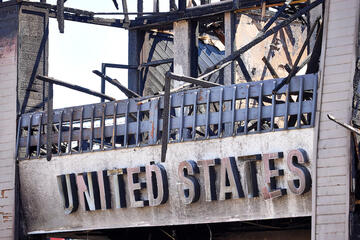
That’s just one more Vegas tale among many from University Gardens that are now destined to outlive the place itself. The sad heap of condemned rubble represents another gap in this little neighborhood. More than one person has suggested that the scorched words “United States” from the post office sign could be a glum metaphor for the state of things.
But some are adopting a more philosophical perspective. Computer science major Percy Kinser, frequented the plaza and told KTNV, “It makes me thankful for life, really. Everything can just be gone in a second, so I’m thankful for where I am right now.”