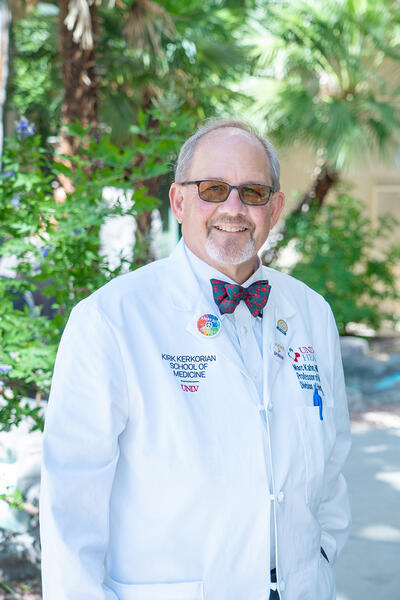
Since stepping down as dean, Marc J. Kahn, MD, MBA, has returned to faculty, flourishing in the role of educator, researcher, and division chief of hematology.
By Paul Joncich
EDITOR'S NOTE: This story was featured in the Summer 2026 issue of the Kirk Kerkorian School of Medicine at UNLV Magazine.
Up at the crack of dawn again, Marc J. Kahn, MD, MBA, the former dean of the Kirk Kerkorian School of Medicine at UNLV, laces up his running shoes and heads out the door of his Summerlin home. Going for a run is an important part of his morning routine. The rhythm of shoes touching pavement puts an active mind at ease. It’s a good time to think about the road ahead.
In April 2020, during the height of the COVID-19 pandemic, Dr. Kahn became dean of the school of medicine, taking over for interim dean John Fildes, MD, FACS, a noted trauma surgeon who was the inaugural chair of the department of surgery.
Dr. Kahn arrived with impressive credentials. Ivy League-educated and carrying a reputation as a prolific researcher in benign hematology, medical education, and healthcare finance, he went right to work teaming up with UNLV Health – the associated clinical practice of the school – to oversee the first large-scale COVID curbside testing operation in Nevada, and later, help run one of Southern Nevada’s largest COVID vaccination clinics. Shortly after his arrival, he pushed for the development of convalescent plasma to speed recovery from COVID: using antibodies from patients who’d recovered, and giving it to those who were seriously ill. Within days, Dr. Kahn got things moving by calling an old medical school classmate, then a vice president of Vitalant. Very quickly, Nevada became one of the first states to use convalescent plasma – one of very few therapeutics available at the time.
“During COVID, I think we really became known as the experts in the community,” Dr. Kahn says. “Organizing large-scale testing and vaccination locations, frequently appearing on TV and other media outlets was absolutely critical and really showed why the medical school needs to be here.”
He’s most proud of helping the school receive full accreditation from the accrediting body, growing the class size by 10%, overseeing the move into the new medical education building, and as vice president of health affairs for UNLV, building out the concept of an academic health center, bringing together the five health science deans to formulate the initial strategic plan.
“When I was dean, we got our first two endowed chairs for the school, we increased research expenditures, and we brought brain health into the school of medicine ... We also started an MD/MPH program and an MD/MBA program and received approval for a hematology/oncology fellowship. Financially, I think we made the practice plan more financially stable, received a record number of student applications, and our students have been very successful in not only standardized testing, but in their match results. Also, I’m proud that a third of our students are first-generation college students; it’s evidence that we’re providing social mobility for our community, and that’s just critical.”
Arthur Brooks, in his book, “From Strength to Strength,” talks about career transitions and opines that as we get older, we become better teachers and mentors. Dr. Kahn has taken this sentiment to heart in his new roles. This includes his participation nationally in an American Society of Hematology-sponsored mentorship program for hematology trainees preparing for their first academic jobs.
After stepping down from the dean’s role in April of 2025 and while pondering his future, Dr. Kahn searched for literature that might help with his decision. But he found there was no playbook for his next career move.
“I reached out to at least two dozen deans who had been in similar situations and found many similarities,” Dr. Kahn says. “It’s a huge blow to one’s ego. Most deans have been successful in virtually all aspects of their careers, so when deans step down, it doesn’t feel very good – and it’s often the first time something like that has happened.”
Motivated by his own career crossroads, Dr. Kahn began gathering data on medical school decanal resignations. His research, “When Medical School Deans Resign,” was published by Academic Medicine, a journal of the Association of American Medical Colleges (AAMC). Deans and former deans from all over the United States reached out, thanking him for his thoughtful treatise and sharing stories of their own.
Among the takeaways from his paper: “Interestingly it’s at about four years that marriages start to see stress, and that’s about the average tenure for medical school deans.” Dr. Kahn spent five years in the role.
“What’s so unfortunate,” according to Dr. Kahn, “is that four years (or 10,000 hours) is about the same time it takes to become an expert in anything – if you subscribe to author Malcolm Gladwell’s popular theory – that’s about the same time most deans either step down or are removed.”
The AAMC was intrigued by his paper and has started its own study on former deans. “I think it is now recognized that there needs to be a little more attention paid to this,” Dr. Kahn says.
“Maybe the biggest take-home message is that when people become deans of medical schools, they see it as a destination, rather than part of a career journey, like, 'I’ve wanted to do this, I’m now the dean of a medical school.' They are told that the tenure is short, but they say, ‘You know, in my career, I’ve been very successful, I’m going to be better than that,’ but most often they aren’t. I think it’s really an important point that needs to be instilled in people who either are brand new deans or want to become dean.”
“As I talked to colleagues around the country,” Dr. Kahn says, “I learned it’s difficult to return to faculty, it’s uncomfortable for a number of reasons. Not very many do that. But for me, it made sense, I’ve always liked to teach and see patients.”
Now, one year after stepping down as dean, Dr. Kahn has found his stride again. “I think for me, probably the most difficult thing is I’m somebody who, for many years now, has been very, very busy with full days, and it’s difficult to transition into a situation where you’re a lot less busy. I don’t particularly do well with that,” Dr. Kahn says. “But I’m finding new things to do.”
In addition to seeing patients in clinic two days a week, he’s teaching a hematology block and mentoring students and residents, as well as building the hematology/oncology section and fellowship. “I’m also staying busy from a scholarly perspective. I just wrote a new edition of my book on the business of healthcare, and published a couple papers that I’ve been meaning to publish for awhile.” (He’s authored over 110 peer-reviewed manuscripts in addition to 180 book chapters and seven textbooks during his career).
“I’m also a member of the Liaison Committee on Medical Education (LCME), the group that accredits medical schools across the United States, so I’m getting back to being involved in national academic leadership after having to back away when I was dean.”
Sandwiched between all that, Dr. Kahn remains a favorite among Southern Nevada media, typically appearing multiple times a week on television and digital platforms, discussing various medical topics. He’s even earned a weekly spot on KVCW-TV’s morning show. “You know, my whole life I’ve been a teacher ... and doing interviews, I see it as teaching the community. I’ve given interviews on everything from COVID vaccine to healthy living, to menopausal symptoms, it really spans the gamut of health and wellness, and I see that as a role of the physician to educate. So, that’s why I enjoy doing it. It’s like being a teacher on live TV for five minutes every week.”
Dr. Kahn remains passionate about improving healthcare in Southern Nevada and committed to building a comprehensive cancer program and starting the hematology fellowship. He’s also developing Nevada’s very first state medical journal, working with the University of Nevada, Reno’s medical school dean, Paul Hauptman, MD. “I’ve developed a very good relationship with Paul. We hope to have our first edition published in January of 2027. It will be a way to disseminate information and ideas to our medical community and give the state some legitimacy as a hub for academic medicine.”
Admittedly, the transition back to faculty has not been easy, but these days he’s feeling confident with his decision. His wife, Chris, is happy living in Las Vegas. His daughter and son-in-law are nearby, and there are frequent family gatherings. Life is good.
Suffice it to say, that with all he’s doing, and all he plans to do, Dr. Kahn has simply shifted gears in the midst of a long, very successful career. Sometimes as the sun comes up during those morning runs, words from his paper on decanal resignations come back to him ... to the rhythm of shoes on pavement ... “Former medical school deans should cherish the relationships formed, relish the lessons learned, and look forward to a future where they can continue to be productive in the next facet of their lives."
To make an appointment with Dr. Kahn, please contact the UNLV Health Internal Medicine Clinic at 702-671-5060 or visit the UNLV Health website.