School of Life Sciences News
Life sciences involves studies of living organisms and their life processes, including their evolution and relationships with other living organisms and our planet. The courses and programs offered by the School of Life Sciences are designed for those students pursuing professional careers in medicine, science, and science education.
Current Life Sciences News

The Tseng Lab at UNLV discovers frog larvae can regrow their eyes, and seeks ways to replicate the process to benefit humans.

Some of the hottest headlines featuring UNLV faculty, staff, and students.

Students share their hopes for the semester ahead.

New Ph.D. graduate Taylor Gerson credits faculty for putting her on the path toward graduate research.
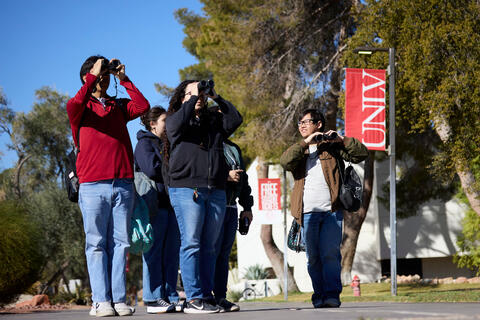
Chill vibes and a focus on observing and preserving nature have students flocking to UNLV's Birding and Conservation Club.
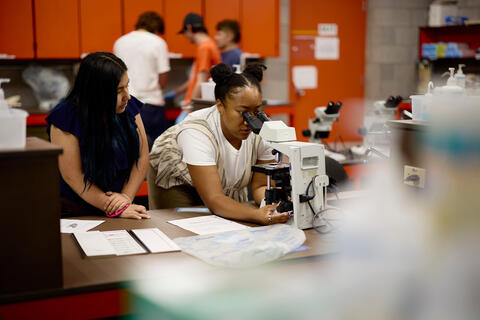
While studying hibernation physiology in ground squirrels, Raizel Yankaway discovered a community that welcomes and empowers.
Life Sciences In The News

A 2018 study from UNLV and the local nonprofit Tortoise Group estimated that more than 150,000 desert tortoises are being kept as pets throughout the Valley. Backyard breeding is a major driver of this overpopulation problem, and there simply aren’t enough people to house all of them. Ill-suited for the wild, roughly 1,000 of these captive creatures are displaced or put up for adoption annually.
Gardening and bird watching often go hand-in-hand with the feathered visitors bringing joy to many a British home, but experts say there are six things to avoid if you want to attract more avians.
Foxes are vital to ecosystems, helping reduce rodent and rabbit populations. However, they can also dig holes in yards, get into trash, tear up fencing, and steal fruits and vegetables from gardens. While they certainly are important, you may not want them in your yard all the time. Fortunately, there are ways to naturally and humanely deter them—here, we spoke with experts about a few go-to methods.

Since mid-November, bird enthusiast Skye Marsh of Las Vegas had been hoping to get the call she received Wednesday afternoon. The lost toucan, appropriately named Sam, had been found.
Birding experts say your outdoor space could be missing several key elements.

Las Vegas is not a good environment for a toucan to be in the wild with its too-hot summers and cold winters, said Donald Price, a professor and biologist at the University of Nevada in Las Vegas who studies how winged animal species adapt to different environments.