Sara Aprigliano was six years into her career at Merrill Lynch when she decided to leave her job and go back to school to study finance.
Not to study the financial advising she'd spent years doing, though. She wanted to get into the mathematics behind it — the kind of analytical work that had always interested her.
Ali Farid came from a very different background. He had studied biology and worked in his family's Las Vegas business, but investing had long been on his mind.
And Ajay Nune already had experience in accounting, finance, and business management. He wanted to build on what he knew and see where it might take him.
All three enrolled in UNLV's Master of Science in Quantitative Finance (MSQF) program at Lee Business School. With varied backgrounds and motivations, they were able to leverage their finance degree to meet their unique goals.
Ali Farid, Senior Analyst at Sahara Investment Group
'23 MS Quantitative Finance
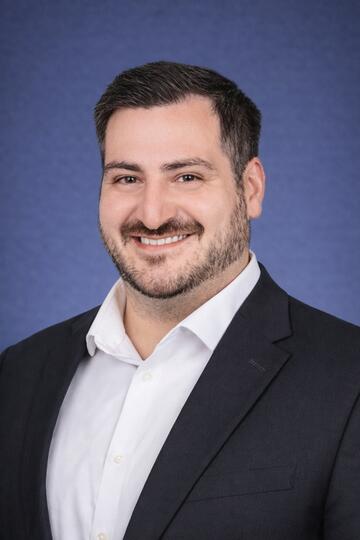
An in-depth analysis of Amazon might sound like an ambitious graduate school assignment. For Ali Farid, it became one of the projects he remembers most.
As part of his MSQF coursework, Farid examined the company's financial performance and valuation, working through questions similar to those investment analysts face when evaluating a business.
He still uses what he learned from that project in his work today.
A friend's encouragement initially led Farid to explore UNLV's MSQF program, and a conversation with finance professor Daniel Chi helped him decide to enroll. The program gave him an opportunity to build the technical foundation he needed to move into the investment industry.
After graduating, he secured an analyst position and eventually advanced into private credit. Today, he's a senior analyst at Sahara Investment Group, where he evaluates investment opportunities and assesses financial risk.
"The return on investment has paid immediately and with long-term dividends," Farid said.
But his experience wasn't limited to learning financial models or finding a job. Farid also developed relationships with faculty members who have continued to offer guidance and mentorship since he graduated.
It's something he continues to encourage other students to prioritize: Get to know your professors, ask questions and find opportunities to put what you're learning into practice.
Sara Aprigliano, Quantitative Operations Analyst at Bank of America
'25 MS Quantitative Finance

During a job interview with Bank of America, Sara Aprigliano was asked about time-series analysis and forecasting. Fortunately, she'd spent plenty of time studying both at UNLV.
The questions drew directly on the coursework she'd completed while developing her skills in statistical analysis, programming, and financial modeling.
About a week before graduation, she received a job offer.
Today, Aprigliano works in Plano, Texas, as a quantitative operations analyst at Bank of America. Her work involves using data and statistical methods to support forecasting and operational decisions.
"Without the MSQF program, I would not be where I am today," Aprigliano said.
For Aprigliano, the change has also brought greater professional fulfillment. She's doing the more technical work that first motivated her to return to school.
She encourages students considering the program to take the challenging coursework seriously and look for opportunities to apply what they're learning.
Ajay Nune, Logistics Account Executive at Total Quality Logistics
'26 MBA/MS Quantitative Finance

What does negotiating a freight deal have to do with quantitative finance? Ask Ajay Nune.
After graduating from UNLV's dual MBA/MSQF program in summer 2026, Nune joined Total Quality Logistics in Las Vegas as a logistics account executive.
It's probably not the first job that comes to mind when someone mentions a graduate degree in quantitative finance. But pricing, negotiations, and performance analysis are all part of his work. His background in finance has proven useful in each area.
In graduate school, Nune studied investment modeling, credit risk, and portfolio analysis. He also gained experience through research, internships, student organizations, and graduate teaching.
The combination of business and quantitative coursework gave him a chance to strengthen his technical abilities while developing his leadership skills.
Now, he uses that training in a setting quite different from a bank or investment firm.
"The MSQF gave me a quantitative toolkit and a professional confidence that pay off in every role, whether I'm underwriting a loan, evaluating a portfolio, or negotiating a freight deal," Nune said.
His experience is a good reminder that the financial side of a business doesn't disappear just because the business isn't in finance. His experience reflects the breadth of finance — every business, regardless of industry, needs a financial expert.