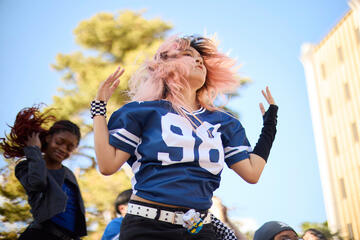
In a room on the second floor of the College of Hospitality building, chairs are pushed into a circle, framing an open space where students gather for a Random Dance Play. Through the wide-panel windows, the sun sets behind Lied Library as participants, legs bouncing in anticipation, wait for the event to start. Some students come dressed in plain clothes; others in stage-ready, K-pop-inspired streetwear.
That kind of supportive, energetic atmosphere is exactly what the UNLV K-pop Club aims to create. Launched this semester, the club is the passion project of Vivian Montalvo Sanchez. “I wanted people to have a space where fans could meet, share their love for K-pop, and try dancing without pressure,” says the first-year dance production major, noting they were surprised UNLV didn't already have a student K-pop organization.
The Debut of K-pop
In the early 1990s, K-pop emerged in South Korea with groups like Seo Taiji and Boys, one of the first acts to blend rap and dance, and H.O.T., the first idol group to use the trainee system. The music fuses multiple genres, including pop, hip-hop, and EDM, while the choreography is precise, intricate, and eye-catching. The visuals — from outfits, hair, makeup, and staging — are often bold and trendsetting.
Groups such as BIGBANG, EXO, Girls’ Generation, SHINee, Super Junior, and Wonder Girls found major success in the years following, helping bring K-pop to a wider international audience and setting the stage for its continued growth. Now, that growth has been solidified with the return of one of K-pop's biggest acts: BTS.
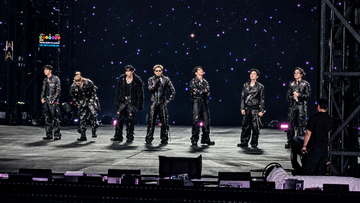
After a four-year hiatus that included solo projects and mandatory military service for all seven members, K-pop global sensation BTS returns to Las Vegas for their ARIRANG world tour. Fans, known as ARMY, are set to fill Allegiant Stadium for four nights — May 23, 24, 27, and 28 — underscoring the group’s lasting influence on the genre’s worldwide popularity.

The rise of K-pop in recent years parallels growing interest in Korean entertainment, from Parasite (the first non-English film to win an Academy Award for Best Picture) to Netflix smash hits Squid Game and K-pop Demon Hunters.
Even the “DNA” of what defines a K-pop group is evolving. KATSEYE, whose GAP campaign featured a viral dance to Kelis’ “Milkshake,” debuted with five non-Korean members, showing just how much the genre has broadened.
Devon Alvizo, a second-year hospitality major and the club’s event manager, says K-pop's universal appeal has to do with more than a Billboard-topping album. “What’s amazing about K-pop is how it combines music, visuals, and choreography into one performance,” he says. “There’s something about the energy — it’s infectious, and you can’t help but get into it.”
The Moves That Make K-pop Pop
Besides offering an inclusive platform for fandom discourse, the K-pop Club invites members to bring their best moves to the dance floor. Three of the club’s founding members met while taking dance classes through the College of Fine Arts.
“I’ve been doing K-pop dance covers since high school, and I wanted to bring that back to campus,” Montalvo Sanchez says.
Members meet weekly to discuss K-pop topics, give themed presentations, and to play games. The club also holds mini performances and Random Dance Play events, giving members a chance to practice the routines that make K-pop so intricate and engaging.
“The choreography is what pulls people in. It’s high-energy, and the patterns are really creative,” says Alvizo, who initially learned of the club via a Reddit post created by Montalvo Sanchez. “Organizing Random Dance Play and performances is fun, but getting everyone in sync is a real puzzle.”
He adds that seeing dances posted online by other fans is what inspired him to begin learning routines. “I started watching dance covers on YouTube and TikTok, and it just clicked for me — I had to try it myself.”
Blood, Sweat & Choreography
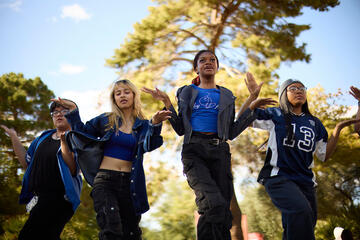
With the inclusion of a dance team, members can follow in their bias’s [fandom speak for favorite idol] footsteps by performing at on- and off-campus events. “We have 12 dancers this semester preparing for upcoming performances,” Devereaux-Gonzalez says.
Dance team member Genesis Payne, a first-year kinesiology and dance double major, says K-pop has been a creative influence for as long as she can remember.
“I first got into K-pop in middle school through BTS — they’re still my favorite group,” she says, confiding that she double biases powerhouse dancers Jungkook and J-Hope. “With my love for K-pop and wanting a sense of community here at UNLV beyond just my majors, joining the club felt like a no-brainer.”
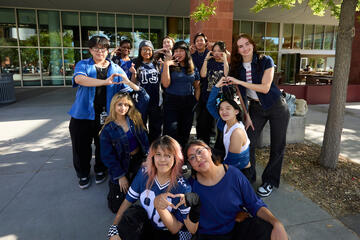
Payne adds her love of K-pop pushed her to improve as a performer. “BTS choreography is complicated but iconic. Learning it really challenged me and helped me grow into the dancer I am now,” she says. “A lot of the routines let dancers show their star quality, which makes performing even more exciting.”
Joining Payne on the team is first-year dance production and management double major Minjun Alejandrino. With 15 years of dance experience — including cheer, gymnastics, and colorguard — he was drawn to K-pop for its synchronized group choreography and high-energy performances.
“I love working with teams to create a performance for people to enjoy. Learning choreography and adapting it to match our formations just brings me so much joy,” he says.
Besides highly technical routines, K-pop is known for its fusion of dance styles. Many memorable performances are shaped by choreographers from diverse backgrounds, including Sienna Lalau, a Samoan American, who contributed to “ON” and “Dionysus”; Brian Puspos, a Filipino American, who worked on “Serendipity” and “Butterfly”; and the Norwegian-based dance crew Quick Style, who collaborated on choreography for songs like “Save Me.”
Alejandrino counts BTS’s “Blood Sweat & Tears” as his ult-fav routine to perform and shares that his bias is ENHYPEN main dancer Nishimura Riki. Being part of the K-pop Club's dance team has also helped him settle into campus life. "I didn’t know many people outside my classes," he says, "but performing with the team has made me more comfortable and helped me meet others."
He encourages anyone curious about K-pop to join. “Even if you’re just starting out, or just looking for friends, it’s a really welcoming space."
Ready to join?
If the K-pop Club sounds right for you, be sure to check out their Instagram for the latest events, meetups, and performances.