
What's in a name? That which we call a book by any other name would be as collectible.
From the parchment of medieval manuscripts to the paperbacks on our shelves, books have long been a reflection of culture.
Why did authors like Charles Dickens publish in serial form? How does a book become “rare” and worth collecting? And what can the feel of paper tell us about the time in which it was made? Students at UNLV can find answers through an English course that pulls book history off the page and places it literally into their hands.
The Course: What is a Book? Collecting, Libraries, and the Materiality of Texts
Offered through a collaboration between the Department of English, UNLV Special Collections & Archives, and alumna and philanthropist Beverly Rogers, the course explores books as cultural artifacts.
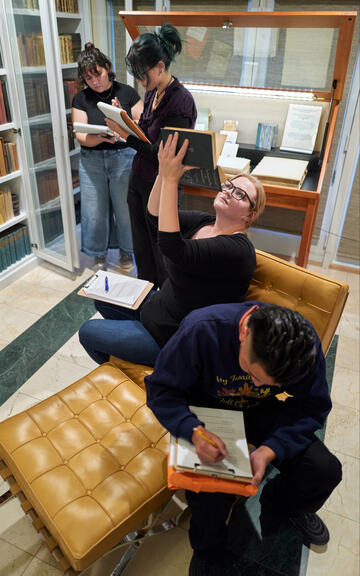
The workshop-style class explores the history and materiality of books, examining how they’ve been made, collected, preserved, and changed over time. “The nice thing about being in Special Collections is that the material is out every week,” associate professor Jessica Teague says.
Students study everything from the history of papermaking and binding to the development of libraries and modern collecting. Through guest speakers, bookstore trips, and even a visit to Beverly Rogers’ private collection, they see firsthand how materials, design, and context shape the reading experience.
Rogers says, “You learn something so different handling a copy of the real book, than you do by reading the text on a Kindle. ”
How did this course come to exist?
After meeting at a Black Mountain Institute event, Teague discovered that Rogers owned a collection of first-edition and association copies of John Steinbeck novels. At the time, Teague was teaching The Grapes of Wrath and invited Rogers to share her collection with the class.
The invitation sparked a deeper collaboration between the two.
“I was so blown away by what an incredible presentation she did,” Teague recalls. “I said, ‘You should really teach a class on this stuff’ — and she said, ‘What if we team-taught?’”
The course was delayed due to the pandemic — after all, you can’t touch a book remotely — but the additional time allowed Rogers and Teague to further develop the course content, leading to a collaboration with UNLV Libraries.
“To teach a class is just a delightful experience,” Rogers says, “not just to be making a presentation where you stand up there and talk to people and hope they absorb three or four sentences, but to actually have the students really engaged with the books.”
How does it work?
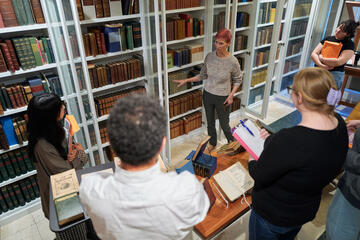
The course culminates in a curation project, where students put their book history knowledge into practice by designing small exhibitions of rare books and manuscripts, displayed in glass cases in UNLV Special Collections & Archives. The materials come from UNLV’s archives and from Rogers’ personal collection.
“It's a different type of skill building than they would normally see in an English class,” Rogers says.
The exhibits reflect the interests of the students. Past exhibits have explored topics such as serialized literature or the evolution of the Gothic genre. No matter the theme, the curation tells a story and considers books as material objects — their paper, binding, or cover giving insight into the culture at the time.
“Curation is a really wonderful skill that students get by being in a workshop-style class, which is not typical in an English department,” adds Teague.
More about the teachers
Arts, education, and culture have always been a huge part of Rogers’ life. Rogers’ lifelong passion for books began in childhood, but her journey as a rare book collector started in 1999, when she picked up a copy of Used and Rare in an airport bookstore. It's a memoir from a couple who collected rare books for each other. “By the time the plane landed, I was hooked,” Rogers says.
Since then, Rogers has gifted a $5 million endowment to UNLV Libraries and donated the Mavis Eggle “Books as They Were Bought” collection. Her personal library, valued at more than $1 million, will also become part of the university’s holdings. The Rogers collection contains four sub-genres: Victorian first editions; Joseph Conrad firsts and association copies; John Steinbeck firsts and association copies; and “books about books.”
Similarly, Teague has loved reading for as long as she can remember. “I didn’t always know that I was going to be an English professor, but at the core, I was always interested in storytelling. I loved what books could do,” she says.
She would go on to earn her bachelor’s in English at UCLA, followed by a doctorate at Columbia University. As a graduate student, she took a book history class that intertwined books with her media studies specialization. “It was really eye-opening for me,” she recalls. “I’m fascinated by how the development of different media technologies over time has shaped the way we tell stories, the way we read.”
What excites the instructors the most about teaching this course?
Rogers and Teague agree that the most rewarding part of the class is watching students develop a genuine curiosity about books and then pursue their own research paths.
They also credit the collaboration with the curators and archivists from Special Collections & Archives for engaging the students by bringing their expertise and presenting materials for the workshops. “I'm learning so much because of it — I learn as much as the students,” Teague says.
What’s something students might be surprised to learn?
For undergraduate English student Meghan Murphy, the biggest surprise was discovering what UNLV Libraries has to offer. “Being able to get closer with the librarians and learning about the resources available has been great,” she says.
Laura Anderson, also an English major, says that she was most surprised by the materials themselves. “Seeing an original copy of a book I read in an old class, or seeing some of the actual manifestations of the arts and crafts from art movements through the books,” she says. She’s enjoyed the primary research aspect of the class so much that she is now considering a graduate degree in library sciences.
What can even lay people learn from this course?
“Anyone can get curious about a book, even if it was printed last year,” Teague says. “You can learn something — who published it? What other kinds of books does this publisher publish? Where’d you buy it?”
“Where do they get the blurbs on the back?” adds Rogers.
All of these questions, they say, offer insight into the author, the work itself, and the culture around it. “Books tell stories that might be lost if not for the existence of the material artifact,” Rogers says.
The reading list:
When asked to name book recommendations, Teague laughs. “Don’t ask the English professors that question; it’s impossible!”
Nevertheless, they recommend:
- The U.S.A. Trilogy by John Dos Passos — “Dos Passos was one of Hemingway's best friends, but a lot fewer people read him. His books are just absolutely masterful depictions of America during that time. They have wonderful characters, they're incredibly rich, and I wish more people would read Dos Pasos,” Teague says.
- The Written World: The Power of Stories to Shape People, History, Civilization by Martin Puchner — Teague says, “I took a class with him back in graduate school at Columbia… It gives you a really good primer on book history, but he tells it through these wonderful stories about particular books.”
- Possession by A.S. Byatt — “Poets should love it. Non-poets should love it. It's a great love story, as well as a book that covers a couple of centuries of literature,” Rogers says.
And, of course, Rogers recommends the book that sparked her interest in rare book collecting: Used and Rare by Lawrence and Nancy Goldstone


