Department of Mechanical Engineering News
The Department of Mechanical Engineering prepares students for the lifelong practice of mechanical engineering and related engineering disciplines. Our students to become problem solvers through applying science to deal with the relations among forces, work, or energy, and power in designing systems, which ultimately contributes to the betterment of the human environment.
Current Mechanical Engineering News
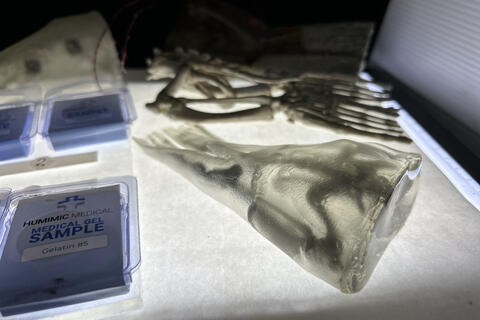
UNLV mechanical engineering lab creates 3D-printed synthetic sea lion pelvis, enhancing veterinary capabilities and countering ongoing beaching crisis.

Do you know how to use a makerspace? This class will teach you.

A selection of top news headlines featuring UNLV faculty and students.
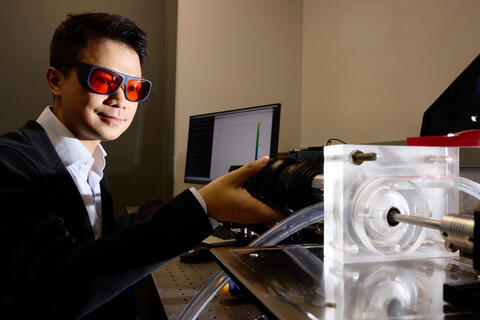
UNLV aerospace engineer Huang Chen turns turbo engine research into life-saving pumps for failing hearts.
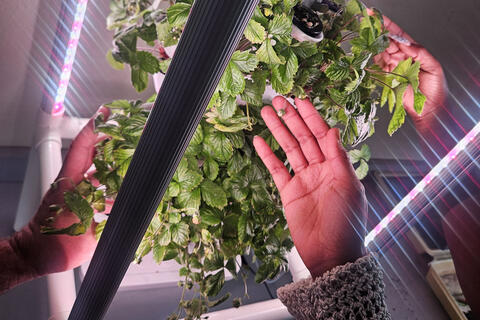
UNLV, UNR Extension collaboration cultivates an early interest in science and engineering.

A collection of colorful headlines featuring UNLV staff and students.
Mechanical Engineering In The News
In recent years, sea life along California’s southern coast has been in a state of crisis, with growing numbers of deceased or sick sea lions washing up on shore. The cause can be traced to toxic algal blooms and domoic acid in particular, which acts as a neurotoxin and can lead to seizures, brain damage, and death. In order to diagnose and treat sick sea lions that are beaching themselves, veterinary professionals are on site to collect blood from the animals. In an effort to improve this procedure and enable vets to work more efficiently, a team of researchers from the University of Nevada, Las Vegas (UNLV) as developed a synthetic sea lion pelvis using a combination of medical imaging and 3D printing technologies.

The arid desert landscape of Death Valley is not the obvious place to find water. Yet it’s here, in one of the planet’s hottest and driest places, that Massachusetts Institute of Technology engineers decided to test new technology to pull drinking water from an unconventional source: the air.

The global water system is showing its fragility, and water resilience is fast becoming a defining challenge for economies and investors. UN-Water estimates two-thirds of the world’s population faces shortages for at least a month each year. Analysis by CDP warns that companies could face $225 billion in costs from water-related risks in the short term, while as much as $2.5 trillion in corporate revenue is at risk if water scarcity disrupts supply chains and markets.

Rep. Susie Lee hosted her summit at Springs Preserve on Thursday morning to discuss the most pressing issues regarding Las Vegas’ tiny share of the Colorado River. She was joined by U.S. Sen. Catherine Cortez Masto, D-Nev.; Colby Pellegrino, Southern Nevada Water Authority deputy general manager; the Colorado River Commission of Nevada and UNLV startup WAVR Technologies.

It might sound like science fiction, but for one startup in the valley, atmospheric water harvesting is reality. In the desert valley of Las Vegas, where water is as precious as gold, a team of researchers at WAVR is working to turn the air we breathe into the water we drink.
Those who have taken a road trip through the Southwest know that it is a very unique desert region, scattered with extraordinary canyons and lofty plateaus. As with any arid region, rainfall is scarce and temperatures are sky-high, making droughts inevitable. Thankfully, a bio-inspired film has been engineered by innovative minds, which pulls gallons of water per day by ‘drinking’ air like plants.