Bradford Solomon is less than a decade removed from his time at UNLV, but the two-time graduate from the School of Integrated Health Sciences is already making a name for himself in the world of football nutrition.
It is why, in just seven years, he has gone from an undergraduate student in the department of kinesiology and nutrition sciences to director of football nutrition at Big 10 Conference powerhouse Penn State.
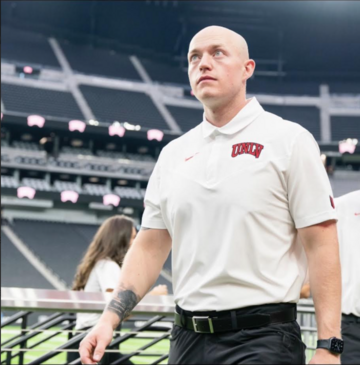
And he credits his alma mater for helping him get there.
“The people at UNLV matched the energy that I was ready to put out,” he said. “They took the time to make sure I wasn’t going to UNLV just to get a degree, but that I was there to have an experience and to get to the other side with an opportunity.”
As a football player for Palo Verde High School, Solomon’s identity was wrapped up in football. After high school, he played center at Division-II Colorado Mesa University but returned to Las Vegas in the hopes of walking on to UNLV’s football team.
He lost 60 pounds and got in the best shape of his life. But after health concerns prevented him from pursuing a football career, Solomon struggled to find out what the future held for him.
“I lost my identity when I was told I couldn’t play football anymore,” he admitted.
Solomon leaned into the nutritional and lifestyle changes that helped him regain his health. And, inspired by his then-girlfriend (and now wife) Lana Loudermilch, a fellow student in UNLV’s School of Integrated Health Sciences, he found a new career path that would keep him connected to football: as a dietitian.
In UNLV’s department of kinesiology and nutrition sciences he thrived, thanks in part to professors like Laura Kruskall, he said.
“Dr. Kruskall was in my corner throughout my entire academic career at UNLV,” Solomon said. “She helped me through many dark days and felt like she was always watching out for my best interests. In a lot of ways, she's the reason I made it through.”
After graduating with his bachelor's degree in 2020, Solomon took a job as a nutrition assistant with the Las Vegas Raiders and gained invaluable experience working with professional athletes, learning about their dietary needs, and finding ways to help maximize their performance.
“We monitored the athletes’ weight and compositions. We provided meals, hydration, supplementation, snacks, smoothies, and recovery — just the whole picture of what it meant to be an athlete,” he said.
Expanding His Nutrition Skillset
Solomon took the knowledge he acquired from the Raiders and brought it back to UNLV as a master’s student in the nutrition sciences program. He excelled in the program while working as a graduate assistant with UNLV’s football team for the 2021 season.
“Brad was so passionate about becoming a sports dietitian since he started his studies with me as an undergraduate student,” Kruskall said. “He was able to dive deeper into the field and better understand how to bridge the gap between science and practice.”
Solomon also married Loudermilch, who received her bachelor’s in kinesiology in 2017 and her doctorate in physical therapy from UNLV in 2020.
After a successful first season at his alma mater, Solomon was offered a position as a registered football dietitian with the University of Wyoming. In 2023, now as a new father with more experience under his belt, he accepted the role of assistant director of football nutrition at the University of Texas, one of the biggest football programs in the country.
Three years later, he was recruited to become Penn State University’s director of football nutrition, where he joined a new coaching staff for the 2026 season.
Working in Happy Valley
Solomon hopes to build relationships with student athletes and the coaching staff through nutrition education, which played a critical role in his own development at UNLV.
“We need to teach them that nutrition is an enveloping aspect of their life,” he said. “How are they sleeping? How do they feel when they eat specific things? We want to build a program around teaching young men how to be leaders in their community. That means they’re leading others to make healthy choices for themselves, and people are going to feel that.”
Solomon arrives at the team facility by 4:30 a.m. to ensure everything is prepared by the time the players arrive at 6 a.m. From there, he and his staff check in with every player to determine how they are feeling ahead of that day’s practice.
“As a performance staff, we’ll communicate about a player if something doesn’t look right. Who’s coming in heavy? Who’s coming in at-risk for a soft tissue injury?” Solomon said. “Then we go to our meetings, the players go to their meetings, and then we get into training, whether it’s lifting weights, conditioning, or football practice itself.”
On the field, Solomon and his staff monitor and record weight data, sweat data, heart rate, speed, acceleration, and movements to make sure players are performing at their highest level. They also provide snacks and beverages when needed.
After training, Solomon and his staff hold one-on-one consultations with the players if an issue needs to be addressed, followed by additional staff meetings before the day is finished.
It is a daunting job, but one that is important to ensuring student athletes can bring their optimum performance to the more than 100,000 screaming fans during each home game in the fall; but it is also an opportunity that Solomon has relished from the beginning.
Kruskall, a Penn State alumna, still remembers when Solomon called to let her know that he was set to become the director of football nutrition at her alma mater.
“When Brad called me, I was shedding tears of joy,” she recalled. “He remembers my many stories about being at Penn State, and now he gets to create his own experiences and memories. I am so proud of him and wish him a lifetime of success.”


