
It doesn’t always start with theory. Sometimes it starts with a story. About a marathon or a bond trade. Or that time an old dog curled up by a desk.
Lee Business School professors bring more than expertise into the classroom. They bring anecdotes and details of their personal life to spark the kinds of conversations that make lessons last.
What these small moments add up to is something research has long confirmed: When students feel connected, they stick with school and succeed. Recent studies specifically link professor – student rapport to deeper learning and improved academic outcomes.
This fall, finance, MBA, and technology programs saw a notable increase in applications. Part of what will keep them here is the connection they feel with professors like these.
Faculty as People, Not Just Professors
Building rapport isn’t only about office hours and timely feedback. It often begins with vulnerability — when professors let students see the person behind the syllabus. Those moments, small but genuine, turn authority figures into relatable human beings.
Take Erin Hamilton, who has the resume you would expect from a professor: Big Four accounting firm experience, research, and a steady hand guiding students. What students don’t expect is her other calling — caring for senior and special-needs dogs. On the first day of class, Hamilton introduces her professional background as well as photos of her three dogs. Students often respond by sharing pictures of their own pets.

Hamilton carries that same personal touch into exams, where she sometimes includes pictures of her dogs holding calculators. It's a lighthearted way to show students that even in accounting, connection matters, she says. “Animals bring everyone together,” she says. Years later, alumni still check in to ask how her dogs are doing.
That blend of rigor and humanity also shows up with finance professor Michael Sullivan. He played competitive tennis before moving to Wall Street as a bond trader. Now he asks his students to manage a real investment fund worth more than half a million dollars. “Once they’re dealing with actual money, the theory suddenly clicks,” Sullivan says. For students, that click is more than an academic insight; it’s the moment abstract ideas turn into lived knowledge.
Making the Abstract Tangible
When professors turn abstract concepts into something students can grasp, even the most technical material feels approachable.
Cybersecurity can intimidate newcomers, says Greg Moody, director of UNLV’s program. He begins with people rather than hardware or software. “When students realize cybersecurity is about human behavior, it feels less intimidating,” he explains. That starting point makes a difficult subject more accessible.
And when coding feels abstract, information systems professor Han-fen Hu turns to a kitchen metaphor. As someone who enjoys baking, she compares coding to recipes and helps them see that precision and creativity can exist side by side. “Follow the steps at first, then start to play with it,” she tells her students.
Economics in Everyday Life
For economics professor Eric Chiang, relevance is key. In his Macroeconomic Principles course, class begins with an analysis of economic headlines from outlets like CNBC, tying real-world issues to lecture content. He connects theory to decisions students or business owners make daily, like how to allocate a budget or price products to maximize revenue.
“My goal is to ensure students learn something relevant to the real world with every class,” Chiang explains. His students see how economics is more than managing money; it’s about making choices with limited resources to improve lives.
Outside of the classroom, Chiang brings the same spirit of applied learning to a different arena: mini-golf. A longtime competitor in national tournaments, he even appeared on ABC’s Holey Moley, showing students that economics, like mini-golf, is about strategy, creativity, and having a little fun along the way.
Learning That Lasts
”Students want to know not just what professors teach but how they have lived. Before becoming a professor, assistant professor Kirk Silvernail worked in the music industry, where he saw how perceptions of fairness could make or break a workplace. That insight shaped both his research in organizational justice and workplace fairness as well as the way he teaches about leadership.
He often tells students about a corporate turnaround when bankruptcy loomed and stakeholder pressure was high. Rather than focus only on numbers, he chose to meet with employees directly, listening to their concerns and figuring out a successful way forward for everyone. “I learned that success doesn’t come from withholding information and making unilateral decisions in secret,” he says. "It's about involving experienced stakeholders in the conversation while adhering to principles of empathy and fairness.”
Joseph Lozano, an MBA student, says that comes through in case discussions. “In professor Silvernail’s class, we study how CEOs reacted when their companies were in crisis. He doesn’t just have us analyze the business decisions, he asks us to think about the human side too — what it meant for the people in the room. That changes how I look at leadership,” Lozano says.
Leadership with Personality
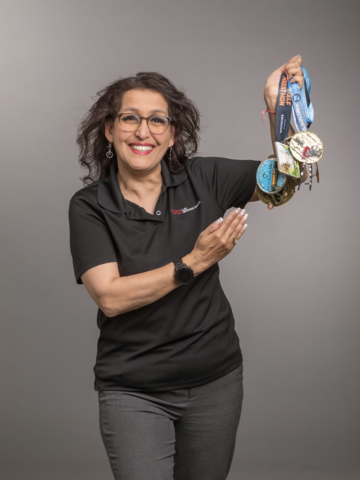
Connection also shapes leadership at the top of the school. Lee Business School Interim Dean Anjala Krishen has run more than 90 marathons, earned a black belt in Tae Kwon Do, and makes candles and soaps by hand. She tells her students that creativity and discipline are not opposites but two sides of the same approach to problem-solving.
Krishen has her marathon medals hung in her office and often uses them to spark discussions about consumer behavior and motivation. She asks students to think about why runners collect medals and display them as part of their personal storytelling. And how brands tap into that same desire, meaning and identity.
Ramhae Awit, an undergraduate marketing student, says her takeaway from Krishen’s classes is the importance of taking creative risks. “We’ve built marketing proposals from scratch, and she pushes us to try unconventional ideas,” Awit says.
Faculty who bring their whole selves into the classroom — from Wall Street to marathons, baking to dog rescue — do more than spark curiosity. They create conditions where students can belong, persist, and thrive.


