
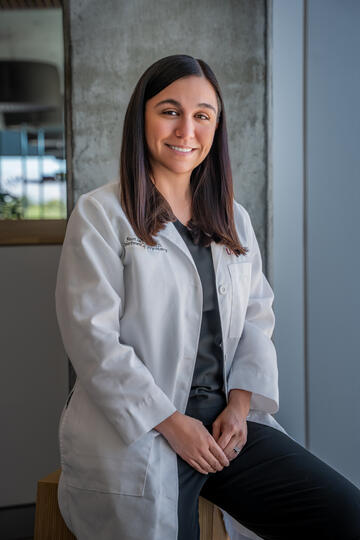
Dr. Faun Lee Powers
’21 MD Kirk Kerkorian School of Medicine
Faun Lee Powers developed an interest in medicine as a young teenager. Unfortunately, it was for a less-than-ideal reason: Her mother was in and out of hospitals for addiction-related struggles.
“Even though the circumstances were sad, I enjoyed spending time soaking up the atmosphere of the hospital and watching the medical providers at work,” Powers says.
A few years later while still at Clark High School in Las Vegas, she attended a camp in which attendees learned about the virtues of a career in medicine.
“That,” she says, “solidified my desire to become a doctor.”
So after earning her high school diploma, Powers headed north to Reno with a locked-in goal of earning her undergraduate degree before moving on to medical school.
That plan went awry, though, after Powers began to question if she was cut out for a career as a physician, which led her to change her major multiple times before settling on comprehensive medical imaging.
The new plan: become an ultrasound technician.
Powers traveled a long and windy road that included a two-year break from school, a return to Las Vegas, and a transfer to her hometown university. Finally, in 2011, Powers completed her UNLV undergraduate degree in comprehensive medical imaging. She then embarked on her chosen profession, performing ultrasounds for high-risk obstetric patients and fetal echocardiograms.
“I got to be an investigator as part of the diagnostic team working with a great group of healthcare providers,” Powers says. “It was a job that exposed me to numerous facets of medicine.”
Although the dream of becoming a doctor had vanished, Powers was very much at peace with her career choice. That is, until another family health issue popped up — this one involving her own child.
“My oldest son had to have surgery when he was about 18 months old,” Powers recalls. “I remember being so nervous while waiting for them to take him to the operating room. Then his surgeon came and spoke to me. The way she explained everything put me at such ease.
“It was then that I decided that I wanted to do that for others — not necessarily as a surgeon, but a doctor. I wanted to help people through some of the most difficult or scary times in their lives and help them reach a point where they felt empowered and confident — like I did after my son’s doctor spoke to me.”
Before long, Powers was enrolled at Nevada State College taking courses that were required to get into medical school while also researching institutions to attend. That included an institution that was about to debut in her backyard: the Kirk Kerkorian School of Medicine at UNLV.
“After meeting with some of the administration, I knew it was the place for me,” she says. “The inviting and collaborative culture was — and remains — much more attuned to who I am than the traditional competitiveness seen in other medical schools.”
Powers applied and was accepted into the School of Medicine’s 2017 charter class. Four years later, she was part of the inaugural graduating class.
Upon reciting the hippocratic oath, Powers promptly began her graduate medical education with the School of Medicine’s psychiatry residency. As a resident, Powers began paying it forward by guiding UNLV medical students through their various rotations.
Powers proved to be such an effective instructor that in 2023 — just two years after completing her primary medical education — she was honored by the school as its Outstanding Resident Teacher. Then in her final year of residency, she served as a chief resident, which entailed additional administrative duties.
Powers’ commitment to — and passion for — her alma mater reached yet another level in July when she started a new dual position at the School of Medicine: assistant professor in the Department of Psychiatry and Behavioral Health, and associate residency program director for the General Psychiatry Residency.
These new roles provide Powers with a best-of-all-worlds experience: When not teaching medical school students in the Phase I psychiatry block, she tends to the needs of mental health patients in clinical settings both on and off campus.
“Half of my clinical time is spent at the Grant a Gift Autism Foundation Ackerman Center seeing children and adolescents with neurodevelopmental and related disorders,” Powers says. “The other half is split between our community partner, University Medical Center of Southern Nevada, and the UNLV Health Mojave Counseling Clinic.”
This is hardly the first time Powers has come to the aid of her community. While working toward her medical degree, she was involved in several charitable endeavors, including manning the School of Medicine’s call center during the COVID-19 pandemic and caring for (and interacting with) infants, toddlers, and young children temporarily housed by Child Haven.
On top of that, Powers founded MedSpeak Community Service, a School of Medicine organization that facilitates student involvement in community outreach, including educational and medical activities and presentations. Additionally, she served for more than three years as treasurer for the medical school’s Alumni Association.
Add it all up, and one can easily understand why Powers was chosen as the second-ever recipient of the Kirk Kerkorian School of Medicine’s Alumni of the Year honor.
Do you recall your emotions when you first learned that you had been accepted into the program?
I remember trying to hold back tears because I was at work. I was so excited and relieved that all my hard work was going to pay off.
You ended up gravitating toward psychiatry and behavioral health as a specialty. What was appealing about this field?
I wanted a specialty where I could really take the time to talk to and get to know my patients. Also, psychiatry offers a good work-life balance, which was important to me.
Of all the extracurricular activities you were involved with as a UNLV student, which one conjures up the fondest memories?
When I first started medical school, a team of us were assigned to learn about the Corridor of Hope (also known as the Homeless Corridor). During that time, we learned of a severe water shortage for the Las Vegas homeless population during the dead of summer. I helped organize a drive for the Salvation Army that resulted in multiple pallets of water bottles being distributed to homeless individuals.
It was an amazing way to start medical school and start my service to the community.
What is the one medical school class that was the most challenging?
Renal physiology and neuroanatomy.
I went into medical school knowing I was not going to be the smartest in the class and there would be some struggles, but I was prepared and determined to put in the extra work when it came to subjects that were more difficult than others.
What’s your advice to the current UNLV medical student who is having a difficult time and beginning to doubt they can make it to the finish line?
Getting into medical school is one of the biggest hurdles you’ll ever have to jump over in your quest to become a doctor. So when times get tough — and they do, for every medical student — remember to lean on that accomplishment.
If you have the internal drive, you’ll be able to get through the classes, tests, and board exams. And for those who doubt they are smart enough, trust me, I can relate. Because that thought went through my head many times when I was a student. But I can guarantee you that you are smart enough to be a doctor.
If you keep your expectations realistic, you won’t be disappointed with — or surprised by — what you achieve.
Every career is filled with challenges and rewards. What is one of the greatest challenges you have encountered, and how did you navigate it?
As a psychiatrist, I have had to learn to balance my patient goals with realistic expectations. During my intern years (first of four years of residency), I worked with patients with serious mental illness, some of whom most likely will never improve to the functioning level needed for an independent life. It was very difficult to accept these less-than-ideal outcomes my patients had time after time.


