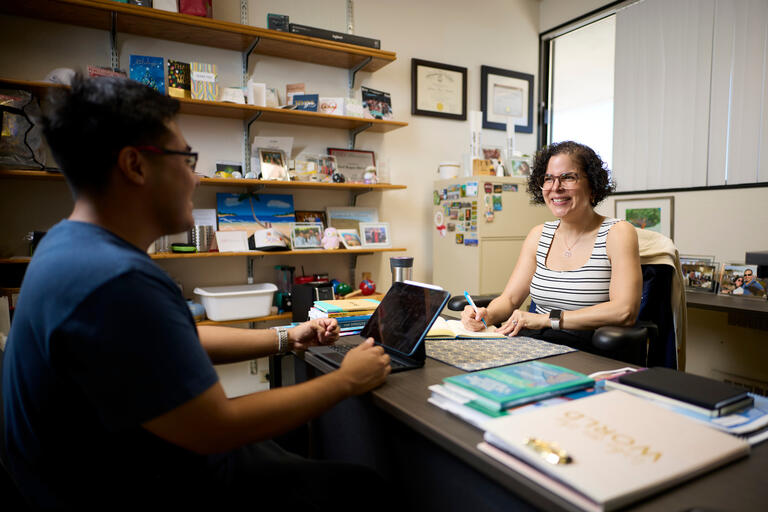
In January, Kyle Ethelbah took on a new role for him and for UNLV: as the inaugural associate vice president for institutional engagement and experience.
Reporting directly to the president, Ethelbah will guide UNLV’s faculty and staff engagement efforts and build a positive and mission-aligned campus culture.
We sat down with him to learn more about what he brings to the new role and hopes to accomplish.
He’s a product of the same college opportunity programs he’s led.
Ethelbah is White Mountain Apache and grew up on the Fort Apache Indian Reservation in Arizona. There, he connected with the federally funded TRIO program, which provides tutoring, college-prep support, and career-planning services to low-income and first-generation students. Eventually that led him to the University of Arizona for his bachelor’s in cultural anthropology.
“I’m the only one left in my nuclear family,” he says. “My mother died when I was 3, followed by my father and brother — and all died of pretty heavy causes, the kind that are evident in the poverty found on the reservation. So, this work has been close to my heart.”
He knew he wanted to help other first-generation college students, so he built a 25-year career in higher education. His most recent position was with UNLV’s Center for Academic Enrichment and Outreach, where he oversaw a number of major federal grants and programming over the past five years to improve student retention and graduation. It was his second time at CAEO, having worked in various student-serving positions 1999-2011. In between his UNLV stints, he led the TRIO programs at the University of Utah.
He’s a UNLV graduate (’09 Master of Public Health), and he just completed his EdD in Organizational Leadership at the University of Southern California.
His dissertation focused on American Indian faculty at non-tribal colleges and universities and the experiences they had in pursuing leadership positions, including the importance of community and cultural identity.
He says he’ll bring that background into his work in culture building at UNLV. “There isn’t any single theoretical framework I follow,” he says, “but the Kotter [methodology for change management] steps are solid. The first steps are defining the need and getting buy-in, which is exactly what led to this office coming into being. Ultimately, our goal is to achieve a shared understanding of what it means to be at UNLV.”
He sees his new position, which focuses on faculty and staff, as a natural extension of his work helping students.
Fostering engagement in students, he says, is done through intentional processes and programs. It’s about making them feel seen and connecting them to people who will be there for them and resources that they may not know of. It takes coordination across many areas to achieve.
“We’ve known that students, particularly first-generation ones, are more successful when they feel they have a home at UNLV,” Ethelbah says.
Now, he hopes to make the engagement process for faculty and staff more intentional, too.
“This role should help connect the different parts of campus into one vision,” Ethelbah says. “It’s taking [interim President Chris Heavey’s] idea of ‘One UNLV’ and formalizing it, with this office as the central hub. We know our campus is filled with caring and committed employees who accomplish great things. We want them to feel like we’re all moving the institution forward together.”
One of his first priorities is launching the Institutional Engagement and Experience Council this spring.
The council will include representatives from academic and administrative units and focus on initiatives that influence the experience of faculty and staff.
“I see the council as a working group and a place where we can be open about where we have had shortcomings,” he says. “UNLV is so large and has grown so fast that faculty and staff in some areas may have felt siloed from administrative decision-making or that their perspective could add to. I don’t think this has happened in intentional ways, but the feeling is there for some.”
The council will be a vital conduit for bringing those issues and concerns forward, evaluating them to see if there are institutional issues, and working to ensure we continually strive to have the campus culture we want.”
Another early priority is to bring structure and consistency to campus affinity groups. “These really have formed organically and evolved through informal processes,” Ethelbah says, “so, one group may be highly active with experienced members while another tries to start from scratch and is frustrated by the process, or more likely, the lack of process. I think this is one area where we can quickly make progress.”
He’s an avid trail runner.
He picked up the hobby when he was working at the University of Utah and typically runs about 20 miles a week, most often at Sloan Canyon.
“It’s not easy getting older,” he says. “My back went out recently, and it was hard to make myself rest. I’m learning to listen to my body more when it says to rest.”
He decompresses from the day with British baking and mystery shows.
“I think I like how formulaic the crime shows are. I take comfort in how it all gets resolved. Same for The Great British Bake Off,” he says. “My partner, Chuck, is the baker in our family. He really finds the kitchen to be his sanctuary. I do not find peace in actually cooking, but I do like to watch."
Another favorite show has been Reservation Dogs, a coming-of-age show that follows Indigenous teens in rural Oklahoma.
“It’s interesting because it shows some universal themes that may be felt by all Native Americans, but there were also very distinctive cultural references different from my own tribe’s.
“I think at the end of the day, that’s a good lesson for all of us: That we all want to be seen as individuals but that we are also a product of our heritage and cultural identity. And together, our various cultural identities are what make up this American fabric.”