
Clarisse Andrada grew up going to Exploration Peak Park near her childhood home. This semester, as a UNLV student, Andrada returned to the park for a different reason: to help educate future hikers about the trails.
Neon to Nature, a local app operated by the Southern Nevada Health District, helps residents discover walking and bike trails in their neighborhood.
With over 1,000 miles of trails in the valley, data on the trails can become outdated. That’s where students in the PBH 455 class — Active Transport, Physical Activity, and Health — come in.
Students like Andrada visited trails they found using the app to complete updates on current trail conditions and to collect new photos.
Throughout the semester, Andrada said she learned about walkability and how to make infrastructure in our communities conducive to active transportation, including walking, biking, and even taking the bus.
The Neon to Nature project put all that she learned into practice and reinforced what she had learned more than if she had simply read about the benefits in class.
“I really feel like I’m making an impact,” she said. “Everything I did is going to help out the Southern Nevada Health District.”
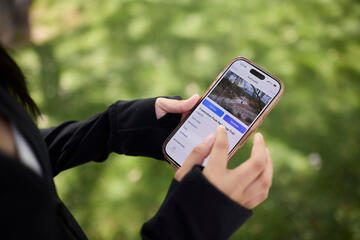
How Students Help Map Local Trails
As part of the class, students took photos of what they saw on the trails and made sure to check boxes on things like shade, exercise equipment, and other amenities.
Mindy Meacham, a chronic disease prevention health educator at the health district, said residents use the app to find trails in their neighborhood and as far out in the federal lands surrounding Las Vegas.
“The work that the students did is really going to go a long way in helping us keep that information accurate and find out if there’s anything we need to change or correct along the way,” she said.
Part of that work included taking updated photos of the trail and trail conditions.
Several of the older trails in the valley don’t have photos on the app, and trail conditions may have changed. The district seeks to give residents the most accurate information about what the trail is going to look like and how steep it is so they can adequately plan for their trip.
In the age of smartphones, Meacham said the students' ability to document current conditions was invaluable.
Sheila Janofsky is an associate professor-in-residence who teaches the Active Transportation class, which she called one of the most important parts of the undergraduate degree in public health.
“We know that physical activity rates are so low overall in the community,” she said. “This is a great way to help people add some exercise minutes to their day, especially in ways that don’t take time away from other things.”
She also sees dividends anytime students have the ability to get out into the community and apply what they learned in the classroom.
“We always get better quality work; we get students that are excited about what they’re doing,” she said.
For Andrada, who will graduate this week with her bachelor’s in public health, the class reinforced the healthy tips she’s gotten from her time in the School of Public Health.
After taking a stress management class last year, she started going to the gym, a habit that she’s kept up since the end of the class.
“With a lot of these public health classes it’s given me motivation to go out and do stuff I used to enjoy,” she said. “I’m a little more motivated to be outdoorsy after this assignment.”


