
The blue, glowing arcs generated by the Tesla coil flashed against the deep black sky. At 500,000 volts, the device, developed from microwave parts, created a lightning-like show in Matthew Chavarria’s backyard.
“My parents don’t really understand everything I do but they encourage me,” the rising Centennial High School senior said. “They're happy to see me proceed with these experiments.”
A YouTube video inspired Chavarria to recreate the Tesla coil, an invention by Nikola Tesla that helped in the development of radio technology.
“It was a lot of trial and error because I went through a lot of design iteration and things like that,” he said, adding that the extra-curricular project took about two years to build. “It was a huge, huge learning experience for me. All of the knowledge that I've gained from building this will help propel me in the future.”
He’s now hoping that a new UNLV College of Engineering program that encourages experiments, albeit on a tinier scale, will give another boost to his already impressive resume as he applies to electrical engineering programs in the coming year.
Supported by a $1.3 million National Science Foundation grant, the college's AI-driven, Career Inspiring Experiential Program for Semiconductor Education (ACIES) debuted this spring to immerse high school students in the world of microelectronics and semiconductors.
A Growth Field for the Next Generation of Workers
Semiconductor manufacturing is a booming field, with an estimated 115,000 jobs to be added by 2030. But the Semiconductor Industry Association estimates that nearly 60% of those jobs will remain unfilled due to a skills and training gap.
That’s where ACIES comes in. Over the next four years, ACIES will train 96 high-achieving high school students in electronic systems, circuit-level design, and semiconductor manufacturing to hopefully pique their interest before they enter college.
“The coursework is at such an advanced level that it’s not available in high school curriculums,” said Mei Yang, ACIES program director and chair of the electrical and computer engineering department at UNLV. “We want [future college students] to consider choosing a career in this field, and this program is one way to do that.”
Semiconductor technology is present in nearly all of the devices we use on a daily basis. The latest bingeworthy TV show you want to stream? You can thank your Internet router — and the tiny semiconductors inside — for that. Cell phones, cars, smart washing machines, medical equipment like blood pressure sensors, solar panels, and more, are all powered by powerful computers on microchips that are getting smaller by the day.
“We use it everywhere, every day,” Yang said. “Without this technology, we couldn’t survive.”
The program trains participants across a series of three distinct workshops starting in January and running through early June. The sessions take a top-down approach, with students learning about system-level design and building robots in the first session, circuit-level design) in session two, and then manufacturing the chips that power robots and other technology during a three-week workshop in the summer.
“They’re exploring all levels of the microelectronics and semiconductor industry, and jobs are available at each level,” Yang said, adding that ACIES builds on a longstanding partnership with the College of Education that has included summer camp programming for young students and their secondary school teachers.
One of the most hands-on experiences involved experiments in the Science and Engineering Building clean room — a laboratory that maintains an extremely low number of airborne particulates — during the third training session.
For three weeks this summer, Chavarria and his fellow cohort members donned head-to-toe personal protective equipment to enter the laboratory in order to handle fragile microchip materials.
“Each chip contains very complex logic and it must be actually manufactured in a very clean environment. You cannot allow any dust to invade the intricate inner workings of the chip,” said Yang.
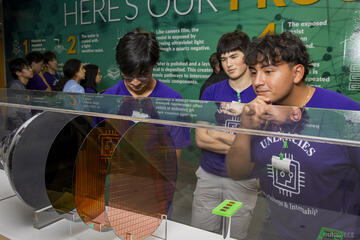
One afternoon, the students, under the direction of Emely Garcia, instructor and a direct-to-Ph.D. student in electrical engineering, used acetone and methanol to clean silicon wafers, a foundational material for building photodetectors, or light-sensing devices. Students also had a chance to visit the Texas Instruments’ advanced 300-mm wafer fabrication facility in Lehi, Utah.
Internships Build Interest and Confidence
Later this summer, one of the program’s most unique aspects will get underway. Participants will put their training to use with an internship at a local company — working up to 160 hours at $12.50 per hour — paid for by the grant.
“Students are highly engaged when AI, hands-on learning, and real-world semiconductor applications are combined,” said Shaoan Zhang, ACIES co-PI and a professor of teacher education. “We are seeing the importance of career exploration in helping students envision themselves in the semiconductor ecosystem.”
Chavarria landed a spot at Pololu Robotics, where he expects to do some soldering work.
“[The ACIES students] are very confident, and they’re very capable,” said Hongming Xu, a CCSD high school teacher and graduate researcher with the College of Education. “And even when they face challenges, they don’t back down. I can see their motivation and how they get inspired from more challenging topics.”


