
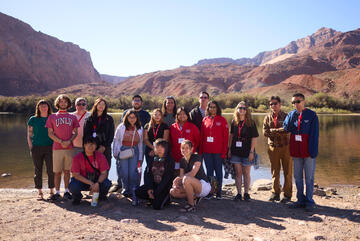
On a chilly March morning beneath red canyon walls, the UNLV Honors College students in the Western Water Policy course rolled up their pant legs and stepped into the subject they had studied all semester: the Colorado River.
The stop at Lees Ferry was meant to be brief, a chance to see a noteworthy bend of the river. Instead, the whole class was soon ankle-deep, splashing one another in the cold water that makes life possible in the American Southwest.
For co-instructors Andy Belanger, ’98 BA Political Science, and Annalise Porter, ’13 BA Journalism and Media Studies, the unplanned moment captured exactly what the class was built to do. Over three days, the group road tripped through Arizona and Utah into Colorado, tracing the river’s path upstream from Las Vegas.
"We really wanted the students to connect with the river as a river, to see it as more than just a water supply and an irrigation source for crops," said Belanger, who serves as deputy general manager of administration for the Las Vegas Valley Water District and was named the Honors College’s 2025 Alumnus of the Year.
The Defining Issue of Our Region
The course began with a question most Nevadans quietly carry: Is the West going to run out of water?
This summer, the question has rarely felt more pressing. Lake Mead and Lake Powell have sunk to their lowest combined level since 1957, federal officials are finalizing new operating rules for the Colorado River, and Nevada is expected to give up more than a quarter of its share. The river that supplies most of Southern Nevada's water is under more strain, and more scrutiny, than at almost any point in living memory.
Dean Lisa Menegatos had been turning that question over with Belanger, a member of the Honors College advisory board who has spent nearly three decades shaping conversations about water policy and conservation in Southern Nevada.
"Water is the defining issue of our region's future, and yet, it's something most of us take for granted," Menegatos said. "We wanted to start equipping our students — our future leaders — with knowledge of how our most vital resource is managed."
To co-teach the Honors seminar, Belanger brought in his colleague Annalise Porter, a public affairs analyst at the Southern Nevada Water Authority and fellow UNLV alumna. Both have spent their careers inside the very debates their students were about to study.
"We purposely brought in leaders from the Southern Nevada community to teach this class because learning water policy from the people who actually shape it is an incredible opportunity for our students," Menegatos said. "It's a truly elevated educational experience."
Laying the Foundation
Leading up to the trip, the class spent the semester learning the "law of the river," the tangle of compacts and agreements that governs how water is shared between the lower basin states of Nevada, Arizona, and California and the upper basin states of Colorado, Utah, Wyoming, and New Mexico. They studied drought, aridification, and the population growth that makes water management so complicated across the West.
"The Colorado River is the hardest working river in America," Belanger told the class. It serves nearly 40 million people across seven states, dozens of tribal nations, and two countries, yet carries only a fraction of the flow of other major American rivers. "Over the last 26 years," Belanger said, "we have seen that river under extreme stress."

To keep the coursework tethered to the real world, Belanger and Porter filled the classroom with the people who shape water policy for a living. Students heard from state legislators, the general manager of the Southern Nevada Water Authority, and a panel of scientists, engineers, and journalists.
They also agreed that students could not truly understand the Colorado River without standing beside it, a conviction that called for an ambitious field trip across three states over spring break.
Enter Randy Garcia, founder and CEO of the Investment Counsel Company (ICC) of Nevada and a UNLV graduate, whose donation allowed all 18 students to make the trip free of charge.
"Without the generosity of Randy and ICC, this trip would not have been possible," Menegatos said. "He believes students here deserve the same opportunities as those at the nation's most elite universities. When I told him about the idea for this water policy class, he enthusiastically stepped up to make it happen."
It was not Garcia's first investment in Honors College students. ICC also funded a class trip to Carson City last year, which took students inside Nevada's Legislature.
Bringing the River to Life
Porter describes the shape of the course in three words: care, connect, change.
"First you care about your resource. That helps you connect to it," she said. "And that connection then leads you to be motivated to do something to change it."
This trip was the connection point.
"It's always hard to understand something when you just read or hear about it," said geology major Asha Rohani. "But getting to experience the river brought the class to another level."
The stops were chosen to bring their class discussions to life. Students toured Lake Powell by boat, ate lunch on the rim above the San Juan River at Goosenecks State Park, and closed one long day at Dead Horse Point, watching the Colorado thread through the landscape far below.
"Dead Horse Point was definitely a highlight," Rohani said. "It was crazy to see how the Colorado River had carved these vast canyons."

Learning From Each Other
Something shifted on the road. In class, Porter said, the material could feel "academic and sterile," and students hesitated to risk a wrong answer. Long days packed into the vans loosened that. "Being out together, sharing space in pretty close proximity, really helped them let their guards down," she said.
The diverse mix of majors among the students also served as an asset. A geology student read the canyon walls; biology students highlighted the wildlife, including a California condor that became a trip favorite. Students took turns teaching short lessons at the stops, an "each one, teach one" approach.
For some, the trip was a string of firsts.
"Some of the students had never been outside Nevada before," Porter said. "Some had never been on a boat before. Some had never touched snow before. And they got to do all of those things on this trip."
Seeing the Big Picture
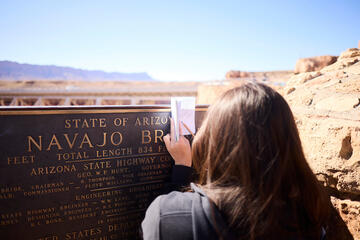
Back home, the learning continued. The class toured Hoover Dam, which holds back the Lake Mead reservoir that fills their taps, and went behind the scenes at the Bellagio to see how one of the Strip's largest resorts manages its water.
"You hear so much about what it's like in Las Vegas with Lake Mead, but you don't see how it is impacting everywhere else," said hospitality management major Michaela Bornales.
Belanger is careful to pair the reality of the challenge with reason for optimism. Southern Nevada uses less Colorado River water today than it did in 2002, he notes, even after adding some 750,000 residents. "That's a testament to everybody doing their part," he said. "The future will be won by those who choose to adapt."
What Belanger and Porter most hoped to leave behind was a habit of attention, a sense that the water in the tap has a source worth protecting. "To be a good steward of your water resources, you have to connect to your water resources," Porter said.
For Michaela, the connection took.
"This class opened my eyes about how dire our water situation is, and it made me more driven to want to find ways to fix it," she said.


