
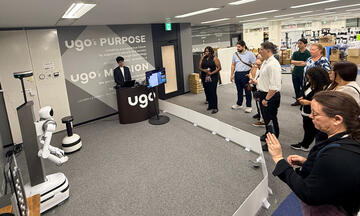
Inside a Tokyo office building, UNLV graduate students watched robots move through tasks once handled by human workers. The machines patrolled spaces, conducted inspections, and offered a glimpse into how Japanese companies are adapting to a changing workforce.
The visit to Ugo, a robotics company in Tokyo, was one stop during Lee Business School’s annual international seminar in Japan. The trip brought graduate students from Lee Business School's graduate programs — including the Master of Business Administration — to Tokyo, Osaka, and Kyoto, where they examined how Japanese companies respond to challenges while maintaining the values and practices that shape their workplaces.
“We intentionally rotate our international seminar to different parts of the world so our students experience a variety of cultures and business environments,” said Lisa Davis, executive director of graduate student services at Lee Business School and one of the faculty advisers on the trip. “Japan gave students a chance to see how culture shapes leadership, teamwork, and the way organizations operate.”
Before traveling, students studied Japan’s economy and business culture while researching the organizations they would visit. They carried those lessons into the field, documenting their experiences through journals and field notes before completing a consulting-style analysis of a Japanese company’s strategy and operations after returning.
Robotics Built Around a Labor Shortage
Japan’s shrinking workforce has pushed companies to find new ways to maintain essential services with fewer people. At UGO, students saw how robots are being used to support employees and take on tasks that are increasingly difficult to fill.
The visit challenged assumptions about automation and gave students a closer look at how technology can be integrated into the workplace as a tool for employees rather than simply a replacement for them.
“Americans often view robotics and artificial intelligence with fear,” MBA student Roy Cardenas said, “while Japanese culture appears more willing to view technology as helpful, engaging, and part of everyday life.”
A Collective Model of Leadership
At Quintbridge in Osaka, students saw entrepreneurs, corporations, universities, and community organizations sharing space and working across institutional boundaries. The open innovation facility, operated by NTT West, demonstrated how groups with different expertise can work together to develop solutions.
MBA student Daniel Zappitello said the visit changed how he thinks about the value of teamwork. “Businesses don’t always have the resources to solve every challenge on their own,” he said. “Collaboration is an effective way to develop meaningful solutions while still operating within your own expertise.”
Students also noticed a leadership style that emphasized group success over individual recognition. That same collective mindset extended beyond the workplace and shaped how companies approached their long-term goals.
MBA student Nancy Mayorga noticed the same mindset in the way companies talked about their futures. “Japanese businesses emphasize longevity, long-term planning, and being part of something bigger rather than short-term gains,” she said.
What Service Looks Like Without Tipping
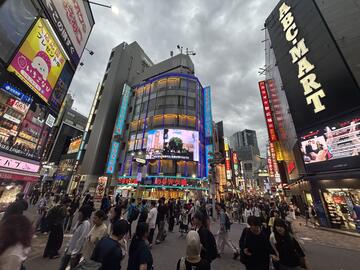
At Uniqlo, Mayorga expected a routine shopping trip. Instead, employees offered to alter a pair of jeans at no additional cost and had them ready within an hour.
Tipping is not customary in Japan, and Mayorga said high-quality service seemed to be viewed as a basic expectation rather than something tied to a financial incentive.
Students noticed that attention to detail extended beyond formal business settings and into everyday life. They saw how companies communicated their standards through ordinary moments of service.
A Centuries-Old Tea Business in a High-Tech Economy
In Uji, students visited Mitsuboshien Kanbayashi-Sannyu, a tea shop operated by the same family for more than 400 years. The Kanbayashi family has deep roots in Uji’s tea tradition, including serving as tea masters to the shogunate and Imperial Court.
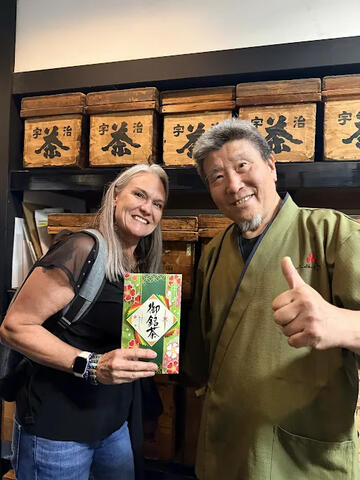
Today, the shop preserves that history while continuing to sell tea, host traditional tea experiences, and serve matcha to visitors.
The visit offered a different perspective on innovation. While robotics companies were developing new tools to respond to labor shortages, the tea business showed how adaptation can also mean preserving what has defined a company for generations.
Students also learned about the Japanese concepts of kaizen, or continuous improvement, and omotenashi, an approach to hospitality centered on anticipating the needs of others. At Mitsuboshien Kanbayashi-Sannyu, those ideas were visible in a business that continued to evolve while remaining closely connected to its history.
Learning to Observe Before Leading
Students expected Japan’s technology and business environment to stand out. They did. But many of the moments they remembered most were quieter: the care that went into routine interactions and how quickly they had to adjust when their own assumptions did not fit.
Mayorga reflected on how the experience changed the way she approaches working with people from different backgrounds. “Navigating unfamiliar environments requires patience, self-awareness, and a willingness to ask for help,” she said.
Faculty adviser John Baur, an associate professor of management and director of Lee’s MBA and Executive MBA programs, said the visits helped students connect classroom concepts to real-world experiences. “By engaging with executives, our students observe concepts like global supply chains and international business in real time," he said.
For Cardenas, the experience reinforced for students the importance of cultural awareness when working across borders. “Leaders cannot assume that the same communication or management style will work in every country,” he said. “They need to observe, listen, understand how another culture operates, and adjust their leadership approach.”


