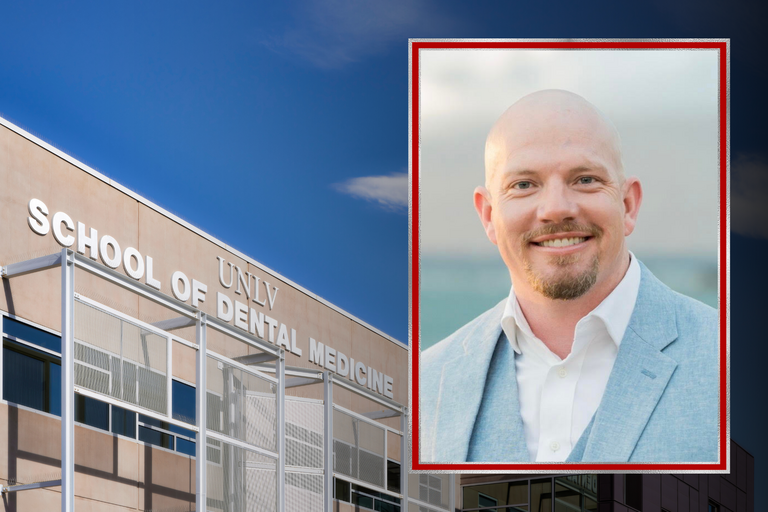
Dave Valenta
Dave Valenta isn’t ashamed to admit it all these years later: As a teenager in the late 1980s, he was a big fan of the TV police drama 21 Jump Street.
But that doesn’t mean Valenta grew up dreaming of becoming a cop. He knew there was a big difference between fighting crime on Hollywood sets and doing so for real on the streets of Las Vegas.
That’s why when he enrolled at UNLV in 1990, Valenta had visions of spending his professional years not with a firearm on his hip but a pencil in his hand.
“I started at UNLV thinking I would be an accounting major,” Valenta says. “I grew up with a well-off uncle in Nebraska who was a CPA. He had the nice house, a riding lawn mower, took nice vacations — I thought that was what I wanted and how I would get it.”
Then while scanning the course catalog for an elective during his freshman year, Valenta spotted a class that piqued his interest: Criminal Justice 101.
He signed up, got the class and — by the time the semester ended — had found his true calling.
In other words: goodbye pocket protector, hello bulletproof vest.
“My passion for law enforcement and criminal justice quickly took over,” he says. “I decided I didn’t want a job sitting behind a desk.”
At that moment, Valenta could’ve chosen to depart UNLV, enroll in the Las Vegas Metropolitan Police Department’s academy, and never look back. After all, in addition to taking a full load of classes, he was working a full-time job to cover tuition and living expenses.
Joining the academy would’ve allowed Valenta to quit both full-time pursuits while also jump-starting his career.
Instead, with his parents’ voices echoing in his head, he simply switched his major to criminal justice and carried on as a full-time student (and full-time employee).
“It was instilled in my brother and me from a very young age that college was the logical next step after high school,” Valenta says. “It didn’t matter what college or what field — just that we went to college.”
Eventually, though, the burdens of school and work began to take their toll, forcing Valenta to reduce his course load and begin taking nighttime and summer classes. Finally, during his senior year in 1995, Valenta decided to push pause on his education when he was accepted into the police academy after testing for a second time.
Valenta made it through the academy and embarked on what would become a nearly 27-year career with the Las Vegas Metropolitan Police Department, where he would rise from patrol officer to sergeant to lieutenant.
Early on in that career, though — very early, in fact — Valenta returned to campus and finished what he started. While simultaneously working graveyard shifts as a rookie cop, he completed his criminal justice degree during the fall 1997 semester.
And because the police department at the time offered to reimburse officers for college tuition, he did it on the company’s dime.
“I honestly never considered not finishing my degree, as I was only seven credits away at that point. I was simply taking a timeout,” he says. “Also, I quickly saw the benefit of having a [college] education in the academy. I was one of just a handful who had been to college, and that academic experience showed in our studying, test taking, and decision making.”
He could not have known it at the time, but earning that degree opened the door to a second fulfilling career — a door that led Valenta right back to his alma mater.
Shortly after retiring from the force in 2022, Valenta began donating to a criminal justice-specific scholarship. It was the latest in a long line of alumni contributions ranging from the University Libraries to campus radio station KUNV.
The scholarship gift caught the attention of Sarah Truby, the director of development for the College of Urban Affairs. The two met for lunch and were joined by assistant professor-in-residence Josh Donnelly, who specializes in teaching and studying policing, crime prevention and analysis, and community safety.
“I advised them that I was recently retired and would love to give back to the school beyond just financially,” Valenta says. “I asked Dr. Donnelly to please pass my name around to other criminal justice professors and see if anyone would like me to be a guest speaker on various law enforcement topics.”
That offer led to a pair of guest-speaking appearances during the fall 2024 semester. Then came a chance encounter with Donnelly at a UNLV football game.
Several months later, Valenta was again standing in front of a class of Rebel students. Only this time not as a guest speaker but an instructor for a class titled “Police in America.”
“I had taught police-related classes for the LVMPD for the last 15 years of my career, and I had always dreamed of being a criminal justice instructor,” says Valenta, who taught at UNLV in the spring 2025 and fall 2025 semesters. “I still can’t believe how the opportunity fell in my lap and became a reality.
“I remember the impact of some of my criminal justice professors, including an LVMPD lieutenant who taught my criminal investigations class. Each and every one of my professors had a positive influence on me, and I hope I can do the same for my students.”
The icing on the cake for the 2025 College of Urban Affairs Alumnus of the Year? He isn’t the only member of his family strolling the UNLV campus these days. Both of his daughters are Rebels: Taylor Gauthier is projected to graduate in May 2026 with a dual degree in Math and Computer Science, while her younger sister, Peyton, is a freshman in the Entertainment Engineering & Design program.
“It goes without saying that they’re both much smarter than me,” he says. “I can’t wait to see what they accomplish.”
What went into your decision to attend UNLV, and when did you know you made the right call to become a Rebel?
While my parents always instilled the importance of college, the topic of paying for it never seemed to follow. And while I was smart, I wasn’t “scholarship smart”. So to put it bluntly, UNLV was all I could afford, and I had to work full time as a student to pay for it.
As a result, I never allowed myself the true “college” experience. So the realization that I made the right decision came much later. Like when I was finally taking the upper-division criminal justice classes that fueled my passion. And when I finished with only $13,000 in credit-card debt.
Attending UNLV allowed me an almost immediate financial freedom that I would not have had otherwise.
How difficult was it to juggle being a full-time student while also working full time to pay for your tuition?
It was very difficult. At one point during my sophomore year, I landed a job as a parking valet at a local casino. Unfortunately, it was the graveyard shift. So I’d often leave work early in the morning and have to go straight to class.
I will never forget one day sitting in my Psychology 101 class. I was hiding in the dark upper levels of the auditorium classroom when I fell asleep. At some point, I jolted myself awake and in some weird reflex reaction, I chucked my notebook several rows in front of me.
After that, I only came back to that class for two days — the midterm and the final.
That’s when I realized I would not be a successful student trying to work full time while taking a full class load. I went from being an honor roll student in high school to being a very average college student. So I dropped down to about nine credits a semester and took summer school.
Beyond academics, how did your experience at UNLV help mold you into the person you are today?
I have always said that regardless of your major, completing a college degree requires discipline and dedication. The drive it took to work and go to school helped teach me early in life that hard work pays off. That then translated into my career with the LVMPD.
Every assignment I received and every promotion I earned required extremely hard work to surpass the competition.
Looking back on your Metro career, what was the most fulfilling part of the job? What kept you putting on that uniform day after day, knowing the challenges and trauma you inevitably would encounter?
In a single word, justice.
I have seen a side of crime and humanity that most will never know. I spent my last six years as the investigative lieutenant in the homicide division and sex crimes bureau. While it was the most rewarding time of my entire career, it was also the most difficult. I saw a lot of death, heinous abuse, and sexual assault.
I took crime personally. And I found great purpose in being part of a select few that had the power to do something about it.
A current UNLV criminal justice major who is considering a career in law enforcement asks you for some “must dos.” What’s your response?
I have actually had the opportunity to give this exact advice as a UNLV instructor!
First, do a ride-along or sit-along with whatever department or agency you are interested in. That will give you a real-world look at the job versus whatever perception you may have developed from TV and movies.
Second, finish college. I had a student ask if she needed to finish school since it was not “required” for a career in law enforcement. I wholeheartedly believe that my education made me a better officer, detective, and leader. Plus, many police departments do require a college degree if you want to be promoted.
Finally, travel the world. I don’t care what your major is — get out of your bubble. There is no greater education than seeing how people live all over the world.
What about a “must don’t”?
Never forsake your integrity — for any reason. And rest assured, it will be tested.
In addition to teaching and guest-speaking appearances, you’re a longtime UNLV donor. What sparked your desire to give back to your alma mater?
While I was never in a fraternity nor a student-athlete, I have always looked back on my time at UNLV with fondness. I can still recall professors, small fragments of my 30-year old education, overnight KUNV radio, and Runnin’ Rebels basketball. My time at UNLV bolstered my confidence and decision-making throughout my career moving forward.
As I became more financially independent — thanks to not being burdened with student loans — I was able to show my appreciation.
I have always wanted to be a positive example of what a UNLV graduate can be, and giving back is one more step in helping the future to be even better.
You spent nearly three decades protecting and serving your community as a police officer. Recently, though, you decided it was time to support your own by participating in the Police Unity Tour. What did that entail, and why was it important?
When I was working, it was too easy — and too true — to simply say “I’m too busy” when asked to get involved with something. But being retired, that’s no longer the case.
So last year, I committed to joining Team Vegas on the Police Unity Tour, a massive police memorial bicycle ride over multiple days and almost 300 miles through New Jersey to the National Police Memorial in Washington, D.C.
The organization’s motto is “We Ride For Those Who Died”. And having been a career police officer, I have lost more than a couple friends in the line of duty. So the cause was very personal.
Part of my commitment included doing a lot of fundraising (not to mention extensive bike training). It all culminated in May when we joined approximately 1,400 other officers from across the country as we biked into D.C. to celebrate National Police Week.
Most everyday citizens won’t understand the significance, but when you personally see or meet the child or partner of a fallen officer and hear their stories, you will carry it forever.