
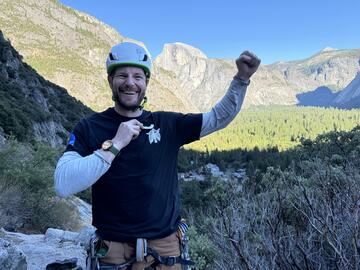
As Tony Ferrar approached the dusty, rose-hued cliff face in front of him for this story's photoshoot, he was struck by a memory.
“You’re gonna shoot me like the magazine cover that I was dreaming about,” Ferrar mused.
Ferrar — now chair of UNLV’s Department of Applied and Interdisciplinary Engineering — began rock climbing when he was teaching in Philadelphia. He got an issue of a climbing magazine in the mail featuring an image of a climber ascending Cannibal Crag at Red Springs and immediately set his sights on achieving the same feat.

Now, he’s the one posing for the camera. “I used to subscribe to Climbing Magazine to just drool over the places I’d take a trip to some day,” Ferrar said, adding that the closest boulders and cliff faces were at least seven hours away. “I was like, some day I’m going to go there and do that.”
And he has — more than once.
He calls it the “after-work special” because of how easy the Calico Basin location is to access after a long day of work, and to arrive in time to catch the last rays of sun.
“It’s a really cool life moment — this is the thing I dreamed about having in my backyard,” Ferrar said. “How much more fortunate can a person get?”
The intrinsic motivation, grateful mindset, and “Rebel” spirit he carries is the throughline for Ferrar's personal life and career as a professor, researcher, mentor, and now leader of a brand new department.
He describes the AIE department as “nimble” and “agile” — similar to a rock climber’s attributes — that is able to create new programs that meet employer demand more rapidly, positioning graduates to find high-tech, hands-on careers right out of college.
His new duties may have expanded and shifted in the past couple of months as he shepherds the department, faculty, and students forward, but this engineer-turned-rock climber will always return to the red rocks to grade some papers, puzzle through a difficult work situation, or, as time allows, climb.
What does being a Rebel mean to you?
Eliminating the words “that's how we've always done it” from the vocabulary. We cannot make progress until we question the way we do things.
Whether it's the way a program's organized or the way a course is taught or the way a one-on-one meeting with the student goes, we should all be asking the questions: Why do we do it this way and how could it be better? Being a Rebel means asking why so many times that you get down to the heart of it.
This shows up most in my personal life when I go rock climbing. Climbing is an activity where the only question that you can ask if you fail to accomplish a goal is, “How could I have done it better?” The whole thing is an experiment, right? Everything in my life is a draft.
Tell us more about this hobby. Where do you go rock climbing?
Oh, all over in Red Rock. I travel for it, too. I've climbed all over the country, from New York to California; I think I’ve climbed in 15 states.
Red Rock is my home, but Yosemite is my favorite trip. I travel there every year. I’ve climbed Half Dome twice — the Snake Dike route is very exciting. In Red Rock, I've done everything from 10 foot boulders to 2,000-foot cliffs.

It's a passion that I found a little bit late compared to most people that get into it. I didn't start climbing until I was 30. It just took over my personal — and family — life. My wife and I discovered this together and got hooked. All three of my kids were roped up in harnesses and climbing up 80-foot cliffs before they could walk. My oldest son recently led his first route. My youngest son has been going to Red Rock since the month he was born. We’d sit him in a car carrier at the base of a cliff like Cannibal Boulder. We go out and have fun as a family every chance we get.
You had to channel a bit of Rebel spirit recently when you had a surgery. How did this impact your rock climbing?
I had a big surgery where I actually had a rib removed. It was a strange combination of genetics and lifestyle — where too much pulling and not enough pushing in my exercise led to it. One of the weird side effects was that I had hit a plateau in climbing. Ultimately, I had to have surgery or lose my arm.
I had to take a year off climbing. That’s how I measured my recovery time: How long until I can climb again? But ever since my surgery, the thing that really has me going now is How hard can I climb? I’m making progress on the difficulty side.
When my doctor came to discharge me, he handed me an envelope. I thought it was a bill. He’s like, “I think you'll be interested in what's in here.” And it turned out it was my rib with instructions on how to preserve it. So when I climbed Half Dome, I carried it to the top and took a picture.
The College of Engineering just debuted Applied and Interdisciplinary Engineering this semester — a department you helped build from the ground up. As chair, why this new department?
Because the traditional model of higher education has worked for a lot of people, but there's also a lot of people that it hasn't worked for, both at the faculty and student level, whether it's a lack of flexibility or an emphasis on certain aspects of the academic journey. Some of our students, especially underrepresented and first-gen, are not really finding themselves in the traditional model, and the programs don’t always align with what they’re looking for.
In creating this new department, the No. 1 theme that keeps getting thrown around in answer to the question of “who do we want to be” is: nimble, agile, responsive, and driven by an interdisciplinary philosophy.
For example, there are plenty of students dropping out of college because they got a job as a coder and they don't need a degree to do it. What's happening there? Well, something is misaligned in terms of what the programs can offer and also how quickly they can update based on the pace of innovation.
So, when we see a need — such as having more students trained to work in the biomedical technology sector — we will figure out how to meet it. I bring that up to say that that’s one of the new concentrations we’re creating for our new B.A. in engineering technology degree, which launched in fall 2025.
Why launch the department now?
I came to UNLV in 2019 and was among the first of a new group of faculty members hired to focus on increasing student retention and success. We didn’t fit neatly into the college’s established programs, and so we were housed under the dean’s office.
I was focused on teaching, primarily, and innovating new ways of teaching students math and physics — the early, “gateway” courses that sometimes prevent students, who possess the engineering mindset, from progressing forward into a traditional engineering major.
Over time, that’s grown. There are eight of us now. We saw some great success in improving retention, especially among students who were on the cusp of leaving the program. We wondered, can we fix this issue in a more holistic way? That became the driving factor to create both the new Department of Applied and Interdisciplinary Engineering and one of its signature new programs, the B.A. in Engineering Technology. It’s a hands-on, dynamic program that emphasizes the real-world application of engineering principles and currently features three tracks. It’s also our first college degree to require internships for graduation.
Because of our department’s interdisciplinary nature, we also now co-house along with the College of Fine Arts the entertainment engineering and design (EED) program — the only ABET-accredited B.S. in EED program in the world. We also have UNLV's new B.S. in cybersecurity, which we share with the Lee Business School, and also launched in fall 2025.
What is the “Engineering Launchpad” initiative?
Several years ago, we began partnering with the mathematics and physics departments on an initiative that sent engineering faculty to teach math and physics to engineering students. This is a large part of why our students are doing well and choosing to stick around.
It's exciting because it's something that everyone in the department has expertise in and the ability to contribute to. It’s a big service to the rest of the college in terms of retaining and graduating students.
The faculty in our department tend to have sign-up lists and wait lists for their classes that are as big as the enrollment in the class — not just two or three students who didn't get in, but 100 students who wanted to take the class and couldn't get in. The reason we’re seeing such demand is that, by taking these courses from an engineering professor, surrounded by fellow engineering students, people feel a stronger sense of connection to the college.
What's one collaboration you're hoping to build with other departments or colleagues?
I’d love to see more collaborative research opportunities with the College of Education to measure our effectiveness. Hopefully, that research could be used to help change the landscape of the way engineering is taught.
The truth is, there's education researchers out there who are doing incredible work but [it needs to get] implemented by the rest of us. I like to think of us as the early adopters of that critical work.
Another question we’re pondering is: Where's the balance between rigor and access at a university like ours? I think that any collaboration here at UNLV that encourages other faculty to question their practice is something we want to explore.
If you could have a chat over coffee with anyone alive in the world right now, who would it be and why?
You. Our conversation right now. We're only ever doing one thing, which means there are an infinity of things we could have been doing that we chose not to do.
I get one precious life. And I remind my students of this all the time — attending college is an option. You don't have to go to college. You don't have to get a degree. There's no law requiring that. Which means you chose it, and if you chose it, then no matter how hard it is, you're not a victim. You're in power. And for me, that's really empowering.
I have a timer running on my phone that tells me how many hours I've been alive. And every time I open my phone up, I see that number and I think for a minute, Am I happy with how I spent this last hour? Because I'm never getting it back. We get something like 24,000 days. I'm gonna do something with them.


