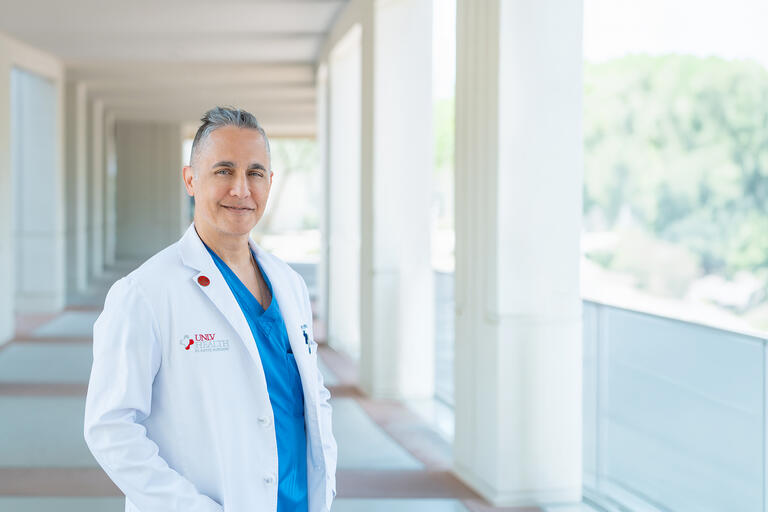
If there’s one thing Anirudh “Ani” Singh, DO, and Joel Jimenez Vargas, MD, have in common, it’s their shared passion to connect with people that made them pursue psychiatry. As third-year residents in the Kirk Kerkorian School of Medicine at UNLV Psychiatry Residency program, those connections are at the heart of their work. Inside and outside of their clinical duties, they serve Las Vegas on an individual and community level.
“I went into medicine because I had a lot of experiences where I was able to seamlessly connect with people, and I really valued meaningful conversation,” Dr. Singh explains, “and the specialty in medicine that really lets you do that more than anything is psychiatry.”
For Jimenez Vargas, being a psychiatrist was a way to pursue his love for science while connecting with people on a deeper level. “Very similar to Dr. Singh, I also enjoyed talking to people and building those more meaningful connections with patients and having a chance to use science and that human aspect was really compelling for me to pursue medicine,” says Jimenez Vargas. “I didn't think I was going into psychiatry, and then during my third year at medical school, I realized that psychiatry was the only field where you could really do both – have that more human connection and all the science foundations – so that's why I ended up pursuing psychiatry.”
Building connections extends beyond just patients for the program’s psychiatry residents. Through the Nevada Division of Public and Behavioral Health (DPBH), medical residents are able to participate in Crisis Intervention Trainings, known as CITs, throughout the year. The purpose of these trainings is to educate members of law enforcement like police officers, social workers, and case managers on the most common presentations of psychiatric disorders during a crisis. These individuals, who all interact with the community in some form, can then recognize someone in a crisis and how best to help them.
“I think it really helps the community be safer, because if everyone is involved in crisis intervention it could reduce poorer outcomes. If you can catch it early and send them somewhere for help, whether it's at one of the ERs, a crisis stabilization center, or get them plugged into what's called wraparound services — it stops things from escalating or spiraling,” Singh states.
What psychiatry residents help trainees realize is how everyone has likely experienced at least one symptom out of the cluster of symptoms that makes up a diagnosis, which normalizes these issues. Singh adds, “I think most people raise their hand at one point or another saying they've experienced one component of that disorder, which humanizes it. We're all just trying to help each other out the best that we can, and if someone needs more help, we should be aware of what that looks like.”
Another community resource that psychiatry residents take part in is the DPBH’s Clinical Program for Assertive Community Treatment (PACT). This program aims to deliver comprehensive, intensive, and integrated care for individuals with serious and persistent mental health disorders through the assistance of a multidisciplinary team. Patients participating in this program get more wraparound services like case management, psychiatric services, and housing.
Jimenez Vargas says, “It's a really good program to help some of these patients get a good foundation and consistent psychiatric care.”
He has seen the impact of PACT resources at a grassroots level through a patient that he first helped as an inpatient at Rawson-Neal Psychiatric Hospital. When the patient was discharged, he assumed their care in the community on the PACT team, which made for an amazing opportunity to provide comprehensive continuation of their care.
“Now that we have her in the clinic, out of the hospital, she mentioned how she doesn't have a lot of clothes, so with the help of some of the nurses from PACT, we went to get some clothing items, like shoes, pants, shirts, just to make sure that they have what they need,” Jimenez Vargas says. “That's a huge resource that we use fairly often in the hospital and the clinic, as well. The state clinic, there's a lot of patients that don't have as many resources, so having that available can be really helpful.”
When it comes to engaging with the community as a whole, Singh believes that physicians have a duty to educate the community, whether it’s teachers, law enforcement, or patient’s families. “Everyone should be aware of what the signs are when someone needs or asks for help, and I think that's a community service,” he says.
Both residents encourage patients to use their providers as a resource and ask them questions about what is available in terms of assistance for the community. Singh adds, “Even if we don't know, we've been trained to find out. Don't be afraid to ask your doctor."
To schedule an appointment with one of the school of medicine faculty physicians — and the residents training under their supervision, like Drs. Ani Singh and Joel Jimenez Vargas — visit the UNLV Health website. To learn more about the school's psychiatry residency program, please visit the program webpage.