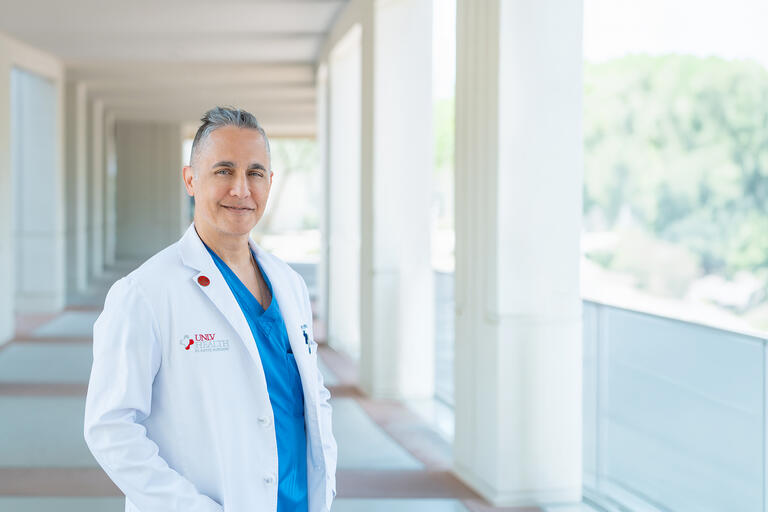
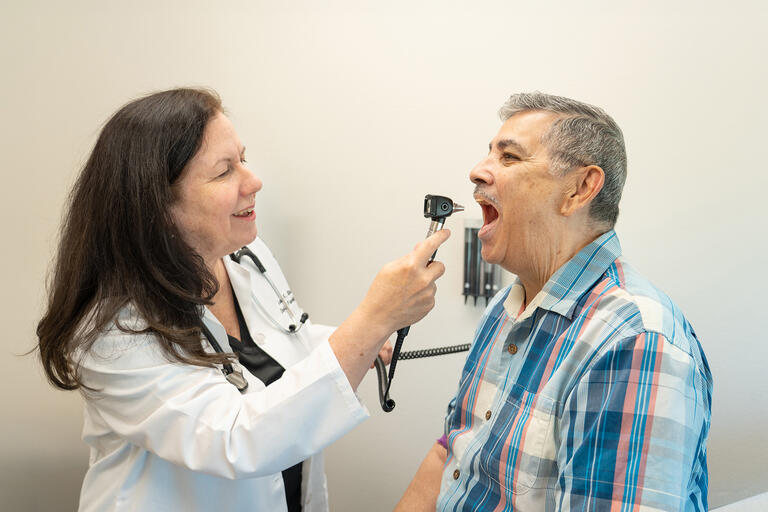
Doing good work for the community is inherent in the department of brain health at the Kirk Kerkorian School of Medicine at UNLV. Now in its second year under the school of medicine, brain health not only continues to lead the way in research to deepen the understanding of brain function and neurodegenerative diseases, but it provides many events to engage and educate the community about the importance of maintaining a healthy brain.
As Jefferson W. Kinney, founding chair of the brain health department and Reg Grundy and Joy Chambers-Grundy chair for brain health explains, the mission of the department is, first and foremost, research.
“While the mission statement for the department is about addressing brain health throughout the lifespan,” Kinney says, “our largest expertise has been in neurodegenerative disease. We've now added faculty that focus on other areas like stroke, but the mission remains the same, which is to understand and develop treatments or even diagnostics for disease and damage to the brain. Part of this effort is also research that includes promoting good brain health and efforts to develop new treatments and technology that help people.”
While the department stays true to its mission, it’s the focus on community engagement that makes it unique.
“Neuroscience programs or neuroscience departments typically have some areas that they specialize in,” Kinney notes, “but don't typically have some of the same community outreach and some of the same sort of emphasis on brain health. We were actually one of the first departments of brain health, that I know of, in the entire nation. There are a lot of neuroscience departments or interdisciplinary programs typically in a neuroscience department, but you wouldn't have the ensemble of clinical neuropsychology, MD neurology, cell molecular neurobiology [that brain health has]. That's not a common occurrence. We have a number of outreach programs and a number of community engagement programs that are about promoting brain health. There's a much stronger effort in advocating for successful aging and brain health [here] than is typical in any neuroscience department.”
The department's outreach includes community events, as well as efforts to support entrepreneurship and innovation by faculty and students that can improve lives.
In April, the department hosted its second annual UNLV Innovation Day, a free campus-wide community event that highlights innovation, entrepreneurship, and the commercialization of research along with cutting-edge discoveries, emerging technologies, and translational projects in brain health and related fields.
The program, which doubled in size this year, brings together internal and external speakers from academia, industry, and innovation-focused organizations, along with faculty, students, industry partners, exhibitors, and community stakeholders to demonstrate how ideas progress from early discovery to real-world application.
Innovation Day, Kinney says, is the brainchild of Dr. Jeffrey L. Cummings, research professor and director of the Chambers-Grundy Center for Transformative Neuroscience.
Says Kinney, “He has a particularly unique approach to science. While he is an incredible researcher, he also has worked with industry throughout his career. One of my favorite phrases that he's used over the last few years is that universities do a remarkable job of training students, especially graduate students for jobs in academia, but we don't do a great job of training students for industry careers and there are a lot more industry careers than there are academic.”
While Innovation Day may be the brainchild of Cummings, the actual day is led by Dr. Kate Zhong, research professor in the brain health department and director of innovation for the Chambers-Grundy Center for Transformative Neuroscience.
As a geriatric psychiatrist, pharmacologist, and trailblazer in Alzheimer’s and brain health research, Zhong’s background is perfect for relating complex topics to the community at large. Her expertise in health disparities in aging and Alzheimer’s disease are explained by Kinney, “[Dr. Zhong] has to be engaged with the surrounding community by using participants in her clinical research projects and with recruiting people to be part of the research, but it's actually more broad than that.
"We do a lot of presentations at community centers because we want to promote what it is that we're learning from the science, and we want to engage with the community. We're not just doing the science for the sake of papers. We're doing the science for the sake of progress in how people can maintain brain health and how they can fight off neurodegenerative disease. Our goal is to try and arrest or stop neurodegenerative disease,” says Kinney.
Brain Health & You (BH&Y) is another high-impact community engagement initiative under brain health and led by Zhong in conjunction with the Osher Lifelong Learning Institute (OLLI at UNLV).
The program, which started in 2021 as a quarterly online lunch meeting, has expanded to three to five large-scale events annually, consistently drawing hundreds of attendees from throughout the Las Vegas community.
Designed to translate advances in brain health, Alzheimer’s disease, and related research into accessible, actionable knowledge for the public, BH&Y is highly interactive and features experts from UNLV, clinical partners, and regional institutions, providing a platform for direct engagement between experts, researchers, clinicians, and the public. A broad and evolving range of brain health topics, including Alzheimer’s disease and brain health, women’s brain health, traumatic brain injury, social connection, mindfulness, music and the brain, gut-brain interactions, aging wellness, balance and fall prevention, memory and movement, and many more are covered at BH&Y events.
To provide maximum interaction with the public, these events are intentionally designed to go beyond lecture-style formats, often incorporating practical components such as movement sessions, wellness strategies, open discussions, and Q&As that allow participants to apply concepts in real time.
Kinney notes that he has witnessed the audience at these events really taking in the information and absorbing it regarding their own health. “There were presentations about diet and exercise and things like that around brain health. You could just see the light bulb go off for so many people when we were talking about diabetes or the Mediterranean diet or good cardiovascular health. It makes them better-informed patients, but it also makes them better informed about their own health.”
For the broader community, explains Kinney, good brain health is actually tied to good overall health. “Exercise and diet and all the things that we know promote brain health are also things that promote overall health. Good brain health, largely, is keeping the brain engaged, keeping it active.
"When we do community outreach to individuals, it's about staying engaged and staying physically active and eating right, all the things that promote general health are also the things that promote brain health. Your brain is subject to what the rest of your body is doing. When we talk to students about it, we talk about ideal brain health and what you can do in your twenties, in your thirties, and your forties that will result in strong brain health when you're older than that.”
Looking to the future, Kinney acknowledges that “community” is a critical component for the department of brain health. “None of what we are doing can be done if we just keep it within our labs at UNLV. We need participants involved in research and stakeholders to advise us on what is needed. We need the community engaged to learn about what we're doing to provide the capability to do this work.” He’s also excited about brain health now being a part of the school of medicine:
“I think there's tremendous opportunity now that we're in the school of medicine for collaboration with the physicians and faculty around some research projects … There's unbelievable power in what it is that the school of medicine is doing in the clinic, in training the next generation of physicians, and here in Las Vegas.”
The biggest and most impactful collaboration on the horizon for UNLV and brain health is one that will put Las Vegas on the map. The UNLV-Global Alzheimer Platform (GAP) Task Force was initiated to formulate the collaborative educational and research opportunities afforded by the inauguration of a GAP clinical trial site in Las Vegas.
GAP is a person-centered, clinical research organization dedicated to speeding the delivery of innovative therapies to those in need by reducing the time and cost of Alzheimer’s and other central nervous system (CNS) clinical trials. A memorandum of agreement between UNLV and GAP provided a preliminary foundation for these discussions. The goal of the task force is to examine the potential interactions between UNLV and GAP, to recognize opportunities for collaboration, and to provide a roadmap for developing this partnership.
"This is tremendously good for Las Vegas and for UNLV to be in partnership with them because then we're part of the clinical trials that are trying to treat Alzheimer's disease. That's a very big deal for us. GAP is an impressive organization that stemmed out of the realization that clinical trials could be faster and better. GAP is directly addressing the unmet needs of patients with Alzheimer’s disease. The fact that they're setting up here in Las Vegas is remarkable for many reasons.”