By its simplest definition, “community” means a group of people with a common characteristic or interest living together within a larger society. For the Kirk Kerkorian School of Medicine at UNLV, community ultimately defines its mission and purpose.
Nevada has consistently ranked in the bottom five states for total active physicians per capita. A commonly cited resource, the Physician Workforce in Nevada: A Chartbook – 2023 Edition, noted that Nevada ranked 45th among U.S. states for active physicians per 100,000 population, 48th for primary care physicians per 100,000 population, and 49th for general surgeons per 100,000 population. A 2025 Nevada Healthcare Report Card by the West Health-Gallup Center on Healthcare in America ranked the state 50th (out of 51 with the inclusion of the District of Columbia) overall on healthcare. In the categories of overall healthcare, quality, and access to healthcare, the state received C- grades. On the cost of healthcare, it received a D+.
It was out of this longstanding and bleak outlook for Nevada’s healthcare that the school of medicine was born. Officially established in 2014 when the Nevada System of Higher Education (NSHE) Board of Regents approved funding for the medical school’s start-up costs, the school was Nevada’s response to the need for additional quality healthcare. The school welcomed its charter class in 2017. The equation was a simple one: create a school to produce more physicians to stay in the state. At the heart of that equation evolved a much deeper mission: caring for the community.
Service Is Key Part Of Curriculum
Fast forward to today and the school of medicine is working hard each day to fulfill that mission. Irma Corral, associate dean for community affairs and associate professor in the department of psychiatry and behavioral health, oversees the school’s efforts in and for the community.
“Having grown up here in Las Vegas and attending our local schools, community isn't an abstract concept to me,” says Corral. “It's personal. This is my community. In medical education, I view community first as a social contract. A medical school doesn't just exist in a city. It exists for a city. That means that our success is not just measured by how well our students are doing and our board scores, but by the outcomes in the neighborhoods that surround the campus.”
For the school, that not only means Las Vegas, but Nevada as a whole. Corral continues, “We see community as our primary stakeholder and the ultimate evaluator of our relevance. When I think about the students and their journey to becoming physicians, community is, to some extent, our extended faculty. We know today that a person's zip code impacts their health more than their genetics. So with our students, engaging with local leaders, residents of the community, nonprofits, the community is the classroom without walls. It teaches our students really vital information about the social determinants of health that you just can't find in a textbook.”
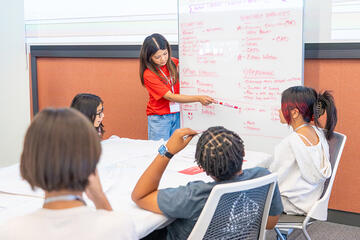
That is why community service is embedded in the curriculum for students at the school of medicine.
“Our students, collectively across the four years, average about 10,000 community service hours a year,” Corral notes. “That's substantial, and they do so many wonderful things. This includes outreach to our local schools and quite a bit of work that is done with the parks and rec [recreation] divisions of the cities and the municipal areas where students go in and build new programs and create infrastructure that’s missing. The students generate lots of great ideas every year. So, as we're teaching them to be listeners, to be responsive when they hear needs, they generate ideas that don't come from the school, it's coming from their interaction with [the] community. We've had students build out programs that have been sustained by the medical school long after that group of students graduated. We are creating generational programming that is like a signature, something that we value and that we want to make sure keeps on living as a commitment to the community.”
It’s also teaching students valuable lessons in how to communicate with their future patients. “It builds their skills,” Corral says, “First they learn to be bridge builders. For example, when our students go out and they're teaching STEM in local elementary schools, they're not just tutoring, they're practicing high-stakes communication tailored to a specific population. They're translating complex information to concepts that someone in fifth grade can understand. They build that bridge-building muscle to be able to communicate across socioeconomic and educational divides. That's one of the true hallmarks of being a great physician.”
It also teaches them that most important quality: empathy. “They don't just see a patient when they get to the clinics,” Corral says. “They see a neighbor, someone who lives in a context, maybe a food desert or an underserved area. They become more empathetic in their diagnostic style. They learn to listen for the stories behind the symptoms. This helps them to be able to create treatment plans that are consistent with the life reality of their patients. Their plans are rooted in what it means to live here in Southern Nevada.”
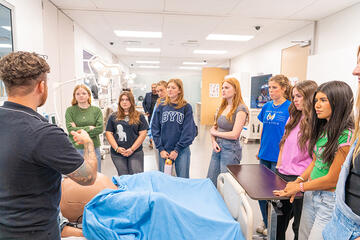
One of the best examples of the school’s commitment to the community has been its long-term partnership with the Clark County School District (CCSD). Since the founding of the medical school, it has fostered a visitation program where high school students come to the school and experience its educational technology, while meeting faculty, students, and staff.
“The medical school donated several Sectra tables [virtual anatomy tables] to several local high schools some years ago, including some of our rural schools. This has been an ongoing and growing relationship where we keep refining what it is that we offer to be responsive and reactive to the needs as they're changing. We appreciate that partnership so much. For me, the pipeline work that we do is the one that's closest to my heart," Corral says.
Beyond the students working in and for the community, the office of community affairs also advances the school’s commitment to community by fostering partnerships and developing programs that address health needs, promote educational and career pathways locally, and support personal and professional growth.
The school proudly partners with many outstanding organizations throughout the community including University Medical Center of Southern Nevada (UMC), CCSD, Southern Nevada Health District, Southern Nevada Regional Housing Authority, Special Olympics of Southern Nevada, Nevada Cancer Coalition, Las Vegas Science and Natural History Museum, UNLV’s other health sciences schools, and many others.
These partnerships didn’t happen in a vacuum. “We have to start by being listeners first,” Corral explains. “If you don't listen, then you end up building programs for a community that you don't actually understand.” When the office of community engagement (predecessor to the office of community affairs) was founded, “...They did not presume to know what Southern Nevada needed from the medical school. The leaders at the time engaged with residents, with local leaders, and they asked the community, ‘What keeps you up at night?’ So those initial conversations were really important, directing the office to what our community viewed as the most urgent issues. These were things like homelessness, nutrition, food insecurity, human trafficking, obesity, mental health, and addiction. Our early work was not about swooping in, it was really about creating authentic partnerships with organizations that were already on the front lines of those issues, so that we could be part of the solution that they were creating. As time has gone on, we've made it a mission to keep our ears to the ground so that we can remain attuned to how the needs of the valley are changing. We have to have an open door dialogue that is continuous. It's not a one-time exercise.”
Community Initiatives Are A Win-Win
In addition to fostering local partnerships, the school has also created two successful major community initiatives: Well Connect and the UNLV Community Clinic (UCC). Well Connect works to connect individuals and families to vital community resources such as food, utility assistance, clothing, job training, and employment services. Well Connect is part of the school’s first- and second-year students’ curriculum, so they lead this initiative by identifying available resources and providing personalized support to those in need.
The goal of the program is to strengthen students’ advocacy skills and cultural awareness while ensuring community members receive the assistance they deserve. They also participate in simulation workshops to develop the communication skills necessary to navigate what can sometimes be difficult subjects and conversations for many people.
The UCC, a collaboration with Volunteers in Medicine of Southern Nevada (VMSN), provides free (no cost to the patient) medical care to underserved populations in Las Vegas. The school’s faculty physicians work with its students, residents, and staff to deliver quality healthcare while also training the next generation of medical professionals. It’s a win-win for the community.
The school of medicine also works to create a lot of avenues for outreach within the community, demonstrating to children in area schools that medical school and a career as a physician is completely within their reach.
“When a fourth grader can see our medical students in their classrooms helping them out, teaching them, they can see that becoming a doctor is a local career,” says Corral. “It's not just a distant dream.”
“There's so much local talent here,” she continues. “There's so much grit in Southern Nevada that we owe it to our city to turn some of that into medical degrees. Part of the trust that we're building with the community is to recognize and reward academic success. Local students bring such a wealth of perspective, resilience, and genuine humility to our classrooms and to our clinics. These students are not just reading about barriers in Nevada. They've navigated them, right? They've lived it. Combined with rigorous training, this local experience produces clinicians of the highest caliber. Ultimately that's our goal,” she emphasizes, “we want the best trained physicians to serve our community.”
This isn’t just a one-way street either, according to Corral. “A great medical school is one that must move beyond outreach to integration. In some ways, it's a vision of reciprocity, where both sides are made stronger by the other. The school lifts up the community by providing top-tier clinical care, driving the local economy, and opening up clear pathways to a medical degree for local students. In return, the community strengthens the school. Local leaders and residents keep us grounded, teach our students the humility and perspective you can't get from a textbook, and hold us accountable to our mission. It’s a continuous loop of mutual investment and respect.”
One of the newest initiatives starting this year that Corral is most excited about is a pipeline program for rural students called HERO, which stands for Healthcare Exposure Rural Outreach. It’s a tailored program for rural high school students to talk about the specific challenges they face, participate in hands-on activities, and have an opportunity to meet the school’s rural faculty.
Community Always At The Core
Moving into the future, the school will continue to work in and build the relationships that keep the community at the heart of everything it does. It’s also important to remember the other positive impact the school has on the community: the economic impact. “People forget that a medical school is an economic engine,” says Corral. “We create local jobs. We support local vendors and most importantly, we retain Nevada-trained physicians to stay and practice right here. So it's about way more than what happens inside our campus. It's about the tangible legacy that we leave in the streets of this valley and how much better off Nevada is because we are here.”