High-quality, clinical training and strong mentorship is at the heart of the Kirk Kerkorian School of Medicine at UNLV Department of Gynecologic Surgery & Obstetrics and its obstetrics and gynecology (OB-GYN) residency program. The program’s participation in the Las Vegas Military-Civilian Partnership (MCP) – the largest and most complex MCP in the country – is one aspect that not only strengthens the residency program but also sets it apart from others in the country. By design, MCPs aim to help military physicians learn critical life-saving skills by practicing alongside civilian physicians in local, civilian healthcare systems.
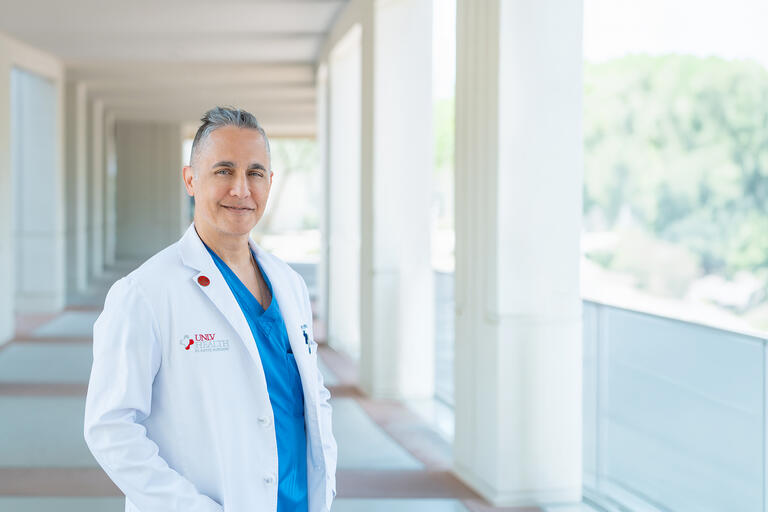
“At UNLV, this partnership allows military trainees to complete portions of their residency training in a high-volume civilian setting while still maintaining their military affiliation. It also provides our civilian residents with exposure to military medicine, systems-based practice, and a broader range of clinical perspectives,” says Dr. Leanne Free, assistant professor and residency program director of the OB-GYN residency program.
“As part of this collaboration," she continued, "all residents spend time at Nellis Air Force Base during their intern year, third year, and fourth year on the benign gynecology service. Military residents complete approximately half of their continuity clinics at the base and the other half at the UNLV Health Women’s Health Center. During the latter half of their chief year, they transition to completing all of their continuity clinics on base to further strengthen their clinical readiness prior to deployment.”
Military and civilian residents only differ when it comes to what they do after residency – military residents transition into active-duty service, while civilian residents either pursue fellowships or enter private or academic practice. The training they receive and the patient population they care for during residency are the same for both groups.
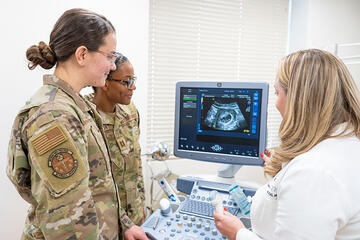
“For residents, participating in a military-civilian partnership adds an extra layer of richness to their training experience. Military and civilian residents work side by side, caring for the same patients and participating in the same educational curriculum, which creates a shared and cohesive clinical environment. At the same time, military residents often bring unique perspectives shaped by prior service and exposure to different healthcare systems,” Free says. “Despite these differences, the day-to-day training experience is intentionally similar, with all residents completing the same didactic and clinical curriculum, and being held to the same standards and expectations to ensure equity and cohesion within the program.”
Free also highlights the “strong educational and clinical collaboration” that comes with the partnership. “Military faculty contribute to resident didactics, Air Force family medicine residents rotate through our labor and delivery service, and high-risk obstetric patients from the base get referred to our academic maternal-fetal medicine team,” Free says. “Overall, this model fosters a highly collaborative environment that benefits both military and civilian trainees while enhancing patient care across systems.”
The OB-GYN residency program seeks to provide trainees with hands-on experience “caring for a high volume of diverse and high-risk patients;" ensure that trainees are ready and adaptable to any real-world clinical scenario; and foster collaboration by “bringing trainees from different systems, which strengthens teamwork, communication, and exposure to varied practice styles.”
Free says, “Ultimately, the goal is to produce well-rounded OB-GYN physicians who are well prepared not only to practice independently upon graduation, but also to serve as leaders and trusted points of access and support for the communities they care for, whether in civilian or military settings.”
Free points out the benefits of the residency program’s diverse patient population and clinical experience. “We care for patients across county, private, immigrant, and military systems, which provides residents with a uniquely comprehensive training environment,” she says. “Equally important is our focus on culture and mentorship, as we strive to create a supportive and collaborative environment where residents feel valued and prepared not only clinically, but also professionally and personally. The military-civilian partnership further strengthens this mission by broadening perspectives, enhancing teamwork, and ultimately improving the care we provide to our patients.”
For patient services, please contact the UNLV Health Gynecology & Obstetrics Clinic at 702-944-2888 or by visiting the UNLV Health website.