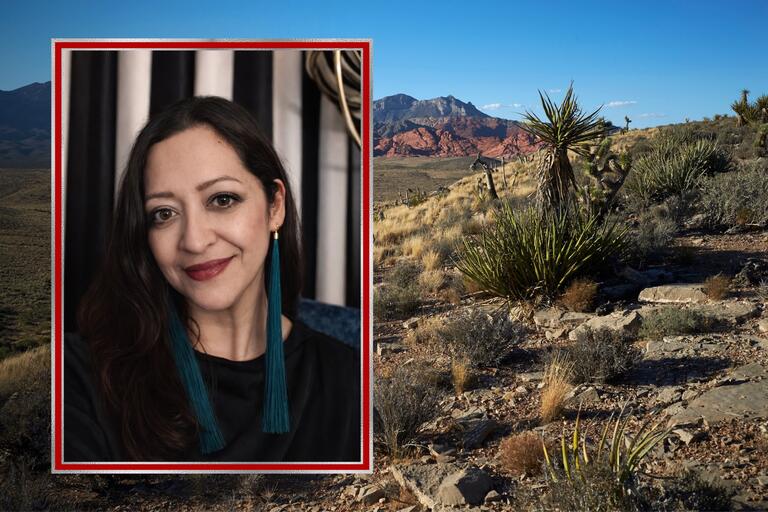
Silver State Award: Kevin Kraft
For nearly 15 years, Kevin Kraft’s generous support of UNLV has touched nearly every branch of the university.
From Rebel Ready Week and graduation celebrations to Rebel Homecoming and countless alumni mixers — you name a memorable UNLV moment, and Kraft and the team from his wildly successful events company By Dzign likely lent a helping hand.
And Kraft has done it without once extending his other hand for payment.
That’s right: The cost for every chair, table, table linen, centerpiece, flower arrangement, stage piece, lighting truss, AV component, and on-site staff member — for every UNLV event that By Dzign has helped produce since 2012 — has been covered by Kraft.
Estimated total value: several million dollars.
Kraft’s UNLV-related giving hasn’t stopped there. Over the years, he’s welcomed dozens of Hospitality College students and alumni into the By Dzign family as temporary and permanent employees. He and his staff also have opened up the By Dzign warehouse for student tours and dropped into classes as frequent guest lecturers.
Now you know why Kraft is receiving the 2026 Silver State Award, the UNLV Alumni Association’s highest honor given annually to a non-graduate in recognition of their support.
But here’s what you don’t know: Kraft never intended to support UNLV. Because he never intended to be in the events business. Because after enjoying tremendous success as a young entrepreneur operating nightclub, clothing, and music businesses in his native New York — the same place where his father ran several successful hospitality establishments — he never believed for a millisecond that he’d move to Las Vegas.
Let alone do so with little more than two not-so-crisp $1 bills in his pocket.
Put simply, Kevin Kraft’s riches-to-rags-to-riches backstory — which includes an important (albeit initially unintended) chapter on UNLV — almost reads like a work of fiction.
It’s a story best told by Kraft himself.
Before diving into how you got to this point in your life, let’s start with your long-running relationship with UNLV. How important has it been both professionally and personally?
Professionally, it has made our company better at what we do. Fundraising events are the hardest to produce well, because every dollar spent is a dollar that didn’t go to the cause. That discipline sharpened us.
Personally, it gave me something I didn’t have when I moved here. I arrived in Las Vegas in 2003 not knowing anyone. UNLV ended up becoming a large part of why I feel like I belong to this city rather than just live in it. I’ve made real friendships through the university, and I’ve watched students I met at events turn into professionals running rooms of their own.
In all honesty, when this started, I thought I was giving something to UNLV. Over the years I’ve come to understand that I’ve received considerably more than I’ve given.
But it all started in your younger years, when you often tagged along with your father when he visited his hospitality businesses in New York. How did that experience shape your future life path?
My father was Leonard Kraft — Lenny to everyone who knew him. He owned bars, nightclubs, and real estate, mostly in Queens and out on Long Island.
My mother, Maxine, died when I was 7. Not long after that, my dad started taking me with him — everywhere. To the bars, to the clubs, into his business deals. He didn’t set out to teach me anything. He was a widower with a young son to care for. But that’s how I learned (long before I realized I was).
He also put me in Eastern Military Academy for two years. I didn’t appreciate it then. I do now. It gave me a structure and a discipline I’ve drawn on ever since. But the real education happened in his rooms.
It’s important to mention that when I was 13 my father remarried to Rosina — the mother of my best friend, Ken Porcelli. Kenny was always handy. So when a bar or a club was getting remodeled, my dad would sometimes pull the two of us out of school to work on it. We learned electrical and carpentry. We also learned how to count money out of a jukebox and how to make sure a register came out even. At 13, I was being taught that a room has to be built and it has to be counted, and that those are the same job.
I also learned some important life lessons. For example: One night, while we were sweeping up after a full day of woodwork, I asked him why. Nobody was coming in tomorrow but us, and we were just going to make more sawdust. I won’t repeat his off-color answer, but the gist was, “You finish what you start and you leave it clean, whether or not anyone is watching.”
That stuck with me. It’s how I’ve run every warehouse and every job site I’ve ever been responsible for.
When did you begin learning about the importance of design in entertainment spaces?
It started at a place called STARZ — a Long Island gay club my father had purchased. I was about 9 years old, and STARZ is where my dad’s staff taught me about decorating. Every holiday had its decor — Christmas, Easter, Halloween. I learned how to work with flowers.
The people on that staff became father figures to me at an age when I’d just lost my mother and needed exactly that. Sadly, so many of them died from AIDS. I think about them constantly, and I mean that literally: What they taught me is in every design I work on today.
They also taught me the part many people miss: We weren’t decorating that room so it would look good in a photograph. We were doing it so the guests would feel something when they walked in and so the staff would want to come to work.
A room has two audiences: the people who visit it and the people who live in it every day. Get it right, and it lifts both. This is still how I judge everything By Dzign builds.
After learning the ropes from your dad, you struck out on your own and enjoyed early success in New York City’s nightclub, clothing, and music industries. You also founded your own marketing company. Then in 2003, you packed up and headed to Las Vegas. Why?
The short answer is family. But the critical thing to understand is that I didn’t land in Vegas on the back of my early success. I arrived about eight years after it all fell apart.
I’ll start with the move itself: It wasn’t my idea. My in-laws wanted to move West to be closer to their son and grandchildren, and they were deciding between Phoenix and Las Vegas. We scouted both. The Phoenix suburb of Scottsdale was beautiful, and I couldn’t believe how cheap the houses were. But for a club guy from New York, it felt way too sleepy.
For the next year, my mother-in-law and I went back and forth about it. She’d say there was nothing left for us in New York. I’d tell her, “If there’s nothing for us here, there’s nothing anywhere — everything is here.” But they’d made up their minds. So in late March 2003, we hopped on another plane to check out Las Vegas.
I’d been here before, but only to the Strip. I genuinely did not know where people lived. The Summerlin area got me immediately because of the Red Rock mountains sitting right behind it. I’ve loved cycling my whole life, and I stood there picturing myself riding out to those mountains. That’s not hyperbole; once I moved here, I did it constantly.
While we were on that trip, someone mentioned Lake Las Vegas on the east side of the valley, where a Ritz-Carlton had just opened. At the time, the hotel had two available jobs: baker and security guard. I’m not much of a baker, so I interviewed for the other position before flying home.
At this point, I was coming off years of things ending, and not in a good way — a company I built that I no longer owned, a business in Jamaica that 9/11 finished off. So I took a job walking a hotel property for $12.58 an hour. In a city where I had no home lined up.
My wife, Barrie, stayed behind to finish out the school year with our son Logan. So I drove out from New York. Alone. With two $1 bills for tips and a debit card for gas in my pocket.
I truthfully had no idea if it was a long-term move, but something happened on that drive. Three days across the country, a notebook on the passenger seat, and a stretch outside Omaha, Nebraska, where tornado sirens were going off and the sky went black and I followed a semi truck through it because he wasn’t stopping.
Somewhere in all that, I made a decision: “I’m going to make this work in Las Vegas. And if I ever go back to New York, I’ll go back on my terms.”
So I was committed to this city before I ever got here. And it turns out that Las Vegas is what let me rebuild.
I still have one of those two $1 bills. It sits by my sink, and I see it every morning.
So what led you to launch By Dzign?
Happenstance. Completely. If you had asked me at any point in my 20s what I’d be doing at age 60, “Running an events company in Las Vegas” would not have been on the list. I had never written a business plan for this. It found me.
And it goes back to that job at the Ritz-Carlton, where in time I became what I’d call the resort’s ultimate utility man. I worked banquets as a catering waiter. I worked shifts in the spa. I took guests on mountain bike tours. I drove the shuttle. I lifeguarded. When security needed a hand, I put that uniform back on, too.
If a department needed help, I was there.
I wasn’t strategizing; I just said yes to everything. Which turned out to be its own kind of strategy, because it made me visible to the right people.
One day I got stuck in an elevator with the hotel’s general manager — young guy, sharp, looked like he belonged on the cover of a leadership magazine. He made small talk, and I asked him what his goal was. He said, “This is it. I’m living my goal.”
I told him — honestly and without any attitude — “I don’t think I’d be satisfied being the GM of a Ritz-Carlton. I think I’d rather own one.”
I’ve thought about that exchange for years. It wasn’t arrogance. It was just clarity about how I’m wired. I’m built to build, not to manage what someone else built.
Soon after, the hotel launched a new Creative Event Services department, and I was asked if I wanted to help start it. I said yes on one condition: that I keep working in all my other departments, too. The people in charge agreed.
This was the first time in years that my creativity had a formal runway inside a real corporate structure. And it’s where I learned the events business from the inside out: vendors, logistics, pricing — what it actually costs to put a room together.
Eventually, I started my own small company called Design Events. I then connected with a man named Larry Ladd, who owned Uptowne Productions. We decided to merge our businesses and began operating as one company on January 1, 2008. That company is By Dzign.
When was the first time you connected with the university, and what were your initial impressions?
My first real interaction with UNLV was in 2012 and it was a little unusual — and I don’t come out of it looking especially good.
At the time, By Dzign was supporting March of Dimes events, providing our decor and event support at no charge. A broker I worked with brought me what he described as a good business opportunity: a UNLV fundraiser.
I knew the UNLV name and brand, and I knew it had one of the top hospitality programs in the world. That reputation reaches you whether you have a connection to the school or not. Still, I didn’t have that direct connection. Back then, UNLV was just a name to me.
When this broker gave me the budget, I asked a simple question: If we’re donating our work for March of Dimes, why aren’t we doing the same thing here? The answer I got was that UNLV had funding. That didn’t sit particularly well with me. My feeling then — and now — is that organizations that strengthen our community deserve support, not a markup.
I think I contributed a few elements to that first event, but I wasn’t especially invested in it. Because I didn’t yet understand what UNLV means to Las Vegas.
About a year later, one of my salespeople introduced me to Kathy Dyke. I still remember that salesperson telling me, “Kathy knows everyone.” Kathy had recently left Bali High Golf Club and eventually joined the By Dzign team. Not long after, we were approached again about the same UNLV fundraiser, and Kathy recognized immediately what was happening. She said, “What? The [broker is] marking up your price? This is a fundraiser.”
As a UNLV alumna, this was personal for Kathy. She called the alumni office, explained the situation, and said we would be happy to support UNLV directly. So Kathy opened that door. But I’ll say this: She didn’t have to push very hard. She took me to basketball games. She introduced me to people across the university. She helped me understand how important UNLV is to this city.
And what I came to realize is that UNLV and Las Vegas elevate one another. UNLV produces extraordinary hospitality talent in the greatest hospitality city in the world, and the city gives those students an environment to learn, grow, and lead that doesn’t exist anywhere else. It’s a genuine partnership between ideas and execution.
How did that partnership evolve from the first event that By Dzign donated to, which was homecoming in 2012?
The early years were event by event. UNLV would call, we’d say yes, and we’d go do the work. What changed is that we stopped waiting to be asked about a specific event and started thinking of ourselves as part of the university’s bench. At some point, it shifted from the university asking “Can you help with this one?” to us asking “What are we doing this year?”
What first started as a transaction quickly morphed into a relationship, and then from a relationship it shifted to something closer to family.
As for the number of events we do, it changes from year to year depending on the university’s needs. It works out to an average of 20 a year and roughly $200,000 in annual in-kind donation — that includes our decor, our staging, our production support, our people.
How did you come up with the By Dzign name and unique spelling?
Actually, I wanted “By Design” — it says intention, precision, purpose. But every clean website domain was gone. So in August 2007, I purchased By-Dzign.com. About the same week I bought the domain, the misspelling stopped being a compromise and started becoming the brand: bold, memorable, deliberately different.
It was also strategic, and this is the part I’m proudest of. The dominant events company in Las Vegas at the time was DBD — Destination By Design. Enormous, respected, essentially untouchable. But their name boxed them in. By calling themselves Destination By Design, they gave up the root of the phrase. They could have owned an entire system — Linen By Design, Home By Design, Life By Design. They never took it. So I did.
By Dzign was never meant to be just a name. It was meant to be a platform: entertainment by dzign, floral by dzign, print by dzign — a structure that could keep adding components. Even now, I think it can grow past events into something broader.
DBD filed for bankruptcy recently, after nearly 40 years. I take no pleasure in that — they shaped the Las Vegas event landscape and deserve credit for it. But there’s a lesson there: The brand that limited itself is gone. The brand designed to expand is still here, still growing.
Again, though, this was never some grand plan. Although now that I think about it a little deeper, I’m not sure it was happenstance, either. After all, I was raised in my father’s rooms. I spent my 20s building nightlife brands in New York. And I landed in a city that does nothing but build rooms for people.
In the end, I didn’t choose this business so much as I finally stopped doing anything else.
Rewinding to the impact your father had on you: How much do you attribute those tag-along experiences in your youth to your current success?
Nearly all of it. Because I never studied any of this. I was raised inside it. By the time I was old enough to have a career, I already knew how a room should feel, how it should be built, how the money moves through it, and that you sweep up at the end of every day. I’ve been doing the same job ever since. The rooms just got bigger.
Unfortunately, my dad didn’t live long enough to see a lot of it, as he passed when I was 26. Not a day goes by that I don’t thank him.
Pivoting back to your relationship with UNLV, over the years you and your colleagues have found your way into Hospitality College classrooms as guest lecturers and mentors. Is there one particular lecture that stands out?
Without a doubt: It was February 2020. That morning had already started with growing concerns about a serious illness spreading overseas. As my team and I were driving to UNLV, I got a call that a major event we had already begun building had just been canceled. Then another message came through that a second client had canceled. I was completely rattled.
When I speak to students, I speak from the heart. But that day my heart and my head were focused on something else entirely. My career had been built around bringing people together, and suddenly gatherings were becoming dangerous.
I was so distracted that I barely realized I had been introduced until one of my team members nudged me toward the stage. It was probably the shortest lecture I have ever given. Another member of our team, a UNLV alumna, stepped in and helped carry the session.
Looking back, I still wonder whether I should have been more honest with the students about what was on my mind. I didn’t want to alarm them. But in retrospect, it might have been the most important lesson I could have offered, because it was real.
A few weeks later, COVID hit full force and Las Vegas shut down. And I thought about those UNLV students often in the months that followed. They had chosen an industry that seemed to have disappeared overnight.
As events slowly returned, we resumed supporting capstone students and giving tours of our facility.
That’s been the most rewarding part of our relationship with UNLV: helping students see that this industry is more than events. It’s creativity, logistics, problem-solving, teamwork, and ultimately creating experiences that matter.
Your partnership with UNLV also extends to hiring students and alumni. When did that become a priority?
The moment I understood the relationship between UNLV, Las Vegas, and the events industry. Those are not three separate things. The university trains people for the industry this city runs on, and we are one of the companies that industry runs through.
Right now I believe we have around 10 people on staff who are either attending or have attended UNLV. I fully expect that number to grow.
I’ll put it plainly: We will always make hiring UNLV students and alumni a priority for as long as there is a hospitality and events industry in this city. Because we know those are the people who are most prepared to step onto an event or hospitality team.
Your philanthropic impact has stretched beyond the UNLV campus and out toward the broader Las Vegas community. Who or what inspired your desire to give back and be a supportive community partner?
My father is the honest answer, though he never once framed it as philanthropy.
He was a man who took care of people — his staff, his regulars, people who came in having a hard week. He fed people who couldn’t pay. He hired people who needed jobs more than they needed a résumé. He never called it giving back; that phrase would have embarrassed him. In his view, it’s how you conduct yourself when you own the room.
He also told me “Don't be a front-runner. Stick with your team when it’s losing, not just when it’s winning.” I've tried to live that with UNLV, and to pass it on to the next generation.
The other piece of it is the industry itself. Hospitality took a kid from Long Island with no formal training and gave him a career, a company, and a life in Las Vegas. When that happens, there’s a genuine desire to give back. I’ve never had trouble finding the motivation to give; I’ve had trouble saying no.
It’s important to mention that our contribution is rarely a check. It’s the thing we’re actually good at: building the room. We show up with the decor, the staging, the florals, the production and the crew, and we make a fundraiser look like a gala so it raises what it’s supposed to raise. This way, a nonprofit can spend its budget on its mission instead of on centerpieces.
And I’ll admit there is a selfish part: Seeing people smile makes me smile. That’s genuinely why I got into this business, and it’s why the charity work has never felt like an obligation.
I must also say that none of this happens without my wife, Barrie, and our four children — Cai, Brooklyn, Logan and Axel. Las Vegas became home for all of us, and UNLV became part of our family’s story.
You tend to shy away from recognition and deflect credit for good deeds. So what was your reaction upon learning that you were receiving this award?
When I first got the email, I honestly thought it was another request to help decorate something. But as I kept reading, I realized what was actually happening. And what nobody knew was how much I needed that message at that very moment.
Since COVID hit, By Dzign had been operating out of a much smaller building. The decision to move back into a larger facility in the heart of the city had been weighing on me. That email was the final push that helped me commit to a warehouse more than double the size of the one we just left.
Now when I walk out the front door of the new building and look to my left, I see the Las Vegas Strip. I see airplanes landing every few minutes, bringing people here to experience Las Vegas. It’s a sharp contrast to six years ago, when there were no airplanes in the sky at all.
Every plane that arrives now brings me a sense of joy, because those visitors are coming to experience the one and only Las Vegas — a city powered in large part by the one and only UNLV.