The invitation landed in Luis Burrola Bueno’s inbox, and it took but a nanosecond for the UNLV physics major to fire back a two-word reply: I’m in!
“When I got the email, I was so excited,” Burrola Buena said. “I knew I was going to have the time of my life here.”
“Here” would be the Nevada National Security Sites (NNSS), once known as the Nevada Test Site. The federal facility about 65 miles northwest of Las Vegas opened in 1951 and is famous for being a hotbed of nuclear weapons testing throughout the Cold War.
Today, the NNSS is a multifaceted U.S. Department of Energy facility that focuses on — among other things — nuclear stockpile certification, counterterrorism training and support, environmental stewardship and cleanup, emergency response training, and research and development. It also partners with other government agencies, including NASA, to help develop and enhance their own agency offerings.
Such a partnership with NASA is how Burrola Bueno — along with 13 fellow UNLV undergraduate students, two doctoral candidates, and three faculty members — found himself trekking in the dark across federally secure locations that are otherwise off limits to ordinary citizens.
In early 2025, NNSS scientists and engineers began to develop a four-day geoscience training course designed to teach space industry participants how to conduct operations on the surface of the moon.
This would evolve into the NNSS’ Lunar Surface Operations Course at the NNSS’ Nevada Space Proving Grounds, where the cratered terrain makes for a good simulation of conditions on the moon’s surface. It was designed in part for astronauts involved in NASA’s Artemis program. Artemis 2 expects to send a crew to orbit the moon this spring, making Artemis 3’s lunar landing — the first in more than a half-century — possible in 2027.
NNSS turned to a trusted partner for support: UNLV.
The offer from NNSS: Have a group of UNLV science and engineering students come out to the site, take the 13-module course, and provide feedback that would be used to fine-tune the finished product.
UNLV’s response: We’d be happy to be your guinea pigs.
Early in the fall 2025 semester, an email was distributed to science and engineering students asking for volunteers, and Burrola Bueno was among the first to reply.
In mid-October, the participants packed their bags and embarked on what geoscience Ph.D. student Dalton Pell described as a “one-of-a-kind opportunity in a one-of-a-kind area."
The jam-packed, pre-dawn to post-sunset schedule included daily briefings and both day and night treks to such NNSS landmarks as Icecap tower, Schooner crater, and Frenchman Flat.

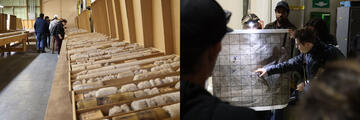
With clipboards in hand, students took copious notes as they observed large rock formations, gazed into expansive craters, collected samples, and traversed the bumpy terrain in nighttime “extravehicular activities” (EVAs, in space parlance), mimicking the experience of the Apollo crews that trained here to traverse the moon’s surface more than a half-century ago.
“The experience was nothing short of incredible,” said Saaya Parikh, a junior majoring in mechanical engineering. “My favorite part was our night hike out to one of the craters.
“Our instructors and mentors provided a lot of information about what exactly we were doing, why we were doing it, and why it’s important to space exploration. I learned so much — more than I could’ve ever imagined.”
Making the opportunity all the more memorable: Students were literally walking in the footsteps of astronauts and helping prepare for the next moon landing.
“We took the students out and gave them remote sensing data sets and let them plan and traverse, then we gathered everyone and said, ‘Compare your remote sensing data sets with your boots-on-the-ground experience,’” said Kevin Ruewer, an NNSS scientist. “So they got to see everything from the classroom module to the field execution — including hitting all the stops that Apollo did and the stops that we expect the Artemis astronauts to hit, as well.”
That reality left many students in awe, including Gabriela Motta, also a third-year doctoral candidate in geoscience.
“As a planetary scientist, I don’t get to do that much field work,” she said. Her research focuses on volcanoes and magma generation on Mars. “So it was really cool to actually see craters and what they look like up close — not to mention we take the same course and essentially walk in the same steps as other scientists and future astronauts.”
Career-launching memories
The weeklong excursion was not without a few challenges. For instance, students had to endure brisk and windy weather, long days, and limited cellular reception. Perhaps the greatest sacrifice: Not a single selfie was snapped as photography was strictly prohibited.
Such inconveniences were more than tolerable, though, given the memories created, the new friendships formed and — perhaps most importantly — the gained knowledge that they will carry forward into their respective careers.
“Not only did this provide a wealth of new perspective of what it’s like for astronauts on the ground — I got to view things that few other people will ever have the opportunity to do — but it’s also incredibly motivating for me to keep working toward my goals,” said Lucas Wiseman, a junior double-majoring in electrical and mechanical engineering.
“I cannot express how much I enjoyed being surrounded by people who share the same passion and drive that I do for space.”
Added Motta: “Honestly, I wasn’t expecting to have so much fun with what is essentially a group of strangers. Anyone who is thinking about participating in something like this, I would say definitely go for it.”
The good news is future students may very well get that chance.
Jacob Thompson — UNLV’s assistant vice provost for undergraduate education and high-impact practices who helped facilitate last year’s trip — said the College of Sciences, College of Engineering, and Office of Economic Development are working to develop an interdisciplinary undergraduate course.
The goal is for the course to be offered every semester and culminate with an in-person experiential learning opportunity at the NNSS similar to what these students experienced in October.
Thompson noted that UNLV’s unique location, status as a top-tier research university, and many industry partnerships give students resume-building advantages.
“Experiential learning opportunities like this genuinely set UNLV graduates apart,” he said. “They give our students unique and highly sought-after practical skills that directly translate in the workplace. Employers can be assured that UNLV graduates with these types of experiences will be highly qualified employees who understand how complex, high-stakes projects function from day one.”