Shaped by supportive parents and inspiring teachers, Eric Chronister's path into science was anything but linear. From early lessons about curiosity and integrity to transformative classroom experiences and influential mentors, the defining moments guided him toward a career in physical chemistry and chemical physics—and reinforced his belief that there is no single best path in life.
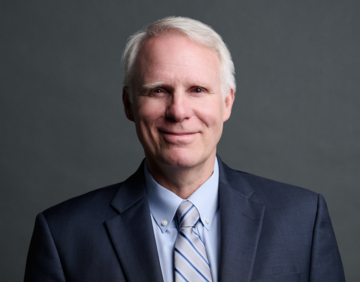
Chronister, dean of the College of Sciences, will share his professional origin story during the installment of the Graduate’s College's My Professional Origin Story series.
In advance of his lecture, Chronister shares a glimpse of his origin story below.
What are a few of the defining moments of your educational journey?
I was born at the University of California, Los Angeles (UCLA) medical center, so that is the origin of my educational journey. The defining factor in my life was being raised by great and caring parents, who appreciated my unique traits and let me enjoy the journey of finding my own path. My father was an incredible social studies high school teacher and my mother worked in HR at UCLA and was a very talented painter.
They were both incredibly bright and creative and their parenting focused on teaching us to discern the difference between right and wrong and helping us to be the best versions of ourselves. My parents showed and explained things to me in ways that enabled me to determine the right path on my own.

Describe a time when a mentor (personal or professional) made an impact on your life.
My parents were not scientists so it took a journey to find my academic path. As a history major in high school, I relished the challenge of being assigned the losing side in debates. Mr. Perlmutter’s AP US history class helped ignite my drive to learn and to apply what I learned.
My parents could only afford 10 weeks of college at the University of California San Diego (UCSD), but that academic experience was transformative: challenging classes, great instructors, exams that challenged me to expand on what I had learned, and learning and using computer code to solve problems. I still remember my freshman physics exam questions 51 years later. I will mention them in the talk.
I also took surfing as a class. At UCLA I couldn’t decide between math, physics, and chemistry so I attempted all three. Unfortunately, the UC system had a max credit limit that could only fit two (chemistry and physics), and I had to throw away my AP scores. Professor Daniel Kivelson’s physical chemistry class taught me how the laws of physics govern all Science, which set me on the course of physical chemistry and chemical physics.
If you could give advice to a younger version of yourself, what would you say?
Experiencing life’s surprises is an important part of life’s journey. Maybe just be willing to accept new opportunities. In graduate school I planned to work for a famous National Academy member, but I changed my mind and joined the group of a new assistant professor because I wanted to be a part of building a new lab from the ground up.
At the science fair banquet, I sometimes take a few minutes to present the participating kids with five examples of Nobel Prize winners who achieved greatness in very different ways: with creativity, simple models, expertise, work ethic, or insight. I like to show young potential scientists that there are many ways to succeed.
Can you share a few words about the photo that you selected to highlight your story?
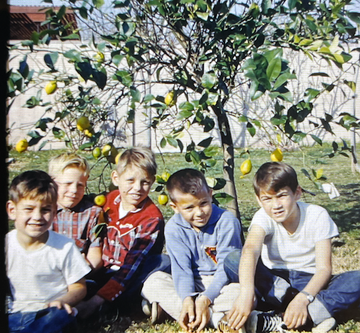
I recently received a text with this picture from the wife of my childhood best friend. Billy would say that he wasn’t allowed to start a fight, but he was allowed to finish them — consequently nobody ever wanted to fight Billy’s best friend. We slowly drifted apart when our academic paths went in different directions. I was heading to college and he started working at an AC installer while in high school.
During my postdoc, 11 years after graduating high school, I learned that Billy had married, owned his home, had four kids, and was now the owner of the AC company — for just a brief period I questioned my academic path. I recently had a great phone call with Billy, 55 years after we last talked. The take home theme for me is that there is no single best path in life — other than knowing right from wrong — like my parents taught me.