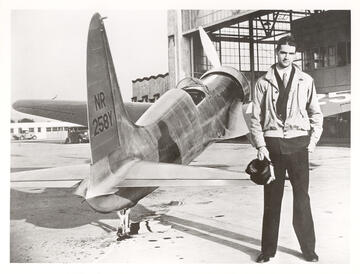
Long before he became one of the most influential — and complicated — figures in Las Vegas' history, Howard Hughes made his name as one of America’s leading aviators, engineers, and industrialists. He designed and flew record-setting aircraft, including the experimental H-1 Racer he piloted to a world speed record of 352.39 mph in 1935.
Today, a replica of that H-1 Racer hangs in UNLV’s William Wells Great Hall, one of the many reminders of Hughes’ connection to the university and the city he helped reshape.
“Hughes was an innovator who looked at problems through an engineering lens,” said University Ombuds David G. Schwartz, a gaming historian and author who has written extensively about Hughes and Las Vegas.
The H-1 reflected that approach. The aircraft incorporated advances in design, including flush-riveted aluminum panels and retractable landing gear, pushing the boundaries of what aircraft could achieve in the 1930s.
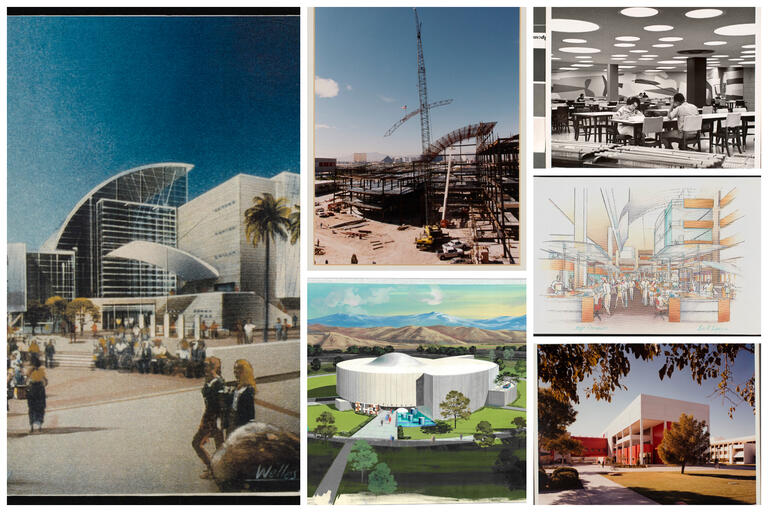
His connection to UNLV is documented in the Special Collections & Archives, where photographs and artifacts preserve pieces of his story.

In 1984, the Howard R. Hughes College of Engineering was named for him, eight years after his death, in acknowledgment of significant donations from his corporation. The college's dean's office is now home to a conference table once owned by Hughes and surrounded by photographic memorabilia of the innovator’s time in Las Vegas.
The Billionaire Aviator Who Brought Credibility to the Strip

Hughes’ arrival in 1966 to Las Vegas was driven partly by a desire for privacy, but his decision to purchase several Strip properties quickly made him one of the most influential figures in Nevada.

Within a few years, he acquired the Desert Inn, Sands, Frontier, Castaways, and Silver Slipper, bringing a new level of corporate interest to an industry long associated with organized crime.
“It is impossible to understate just how big Howard Hughes was to Nevada in the late 1960s,” Schwartz wrote in his book, Something for Your Money.
At the time, Hughes represented something Nevada leaders wanted: legitimacy. Las Vegas was still fighting decades of association with organized crime, and Hughes’ reputation as an industrialist and businessman helped shift national attention toward a new era of corporate investment.

“Mr. Hughes’ involvement here has absolutely done us wonders,” Gov. Paul Laxalt told Esquire magazine in 1969, noting that national questions about Nevada were no longer focused on “the Mafia, the skimming, the underworld,” but instead on Hughes and other corporate investors.
UNLV history professor Michael Green said Hughes’ influence quickly extended beyond gaming and into politics, where he pushed for changes to Nevada’s gaming laws.
“He helped prompt what became the Corporate Gaming Act, which did a lot to make possible the phantasmagorical growth of this area in the past 35 to 40 years,” Green said.
Enacted in 1969, the new law removed the requirement that every shareholder undergo a background check before a corporation could hold a gaming license. For Hughes and other investors, the deck was suddenly stacked a little more in their favor.
Laying the Groundwork for Modern Vegas
Although Hughes acquired thousands of acres of Southern Nevada land and envisioned large-scale development, much of that land was developed after his death.That included the property that would eventually become Summerlin, which was purchased by The Howard Hughes Corp. — now Howard Hughes Communities — after Hughes’ death and developed as a planned community.
Schwartz said Hughes was drawn to Las Vegas at a time when the city offered unusual opportunities for someone willing to shape its future. His real estate holdings gave him a foothold in the region as the city entered a period of rapid growth and development.
Hughes’ interests also extended beyond real estate and into higher education.
Green noted that Hughes provided substantial funding to help establish the University of Nevada, Reno School of Medicine. More than a decade after his death, his estate continued that support by contributing to the construction of UNLV’s Richard Tam Alumni Center.

A Legacy Built Into UNLV
As Las Vegas expanded beyond gaming, UNLV grew alongside the city, developing programs and institutions that reflected its changing needs.
Howard Hughes Communities continues to support UNLV through mentorship, career networking, financial aid, and scholarships for students pursuing various degrees within the engineering college.
That connection between innovation, engineering, and the growth of Southern Nevada remains part of how his legacy is reflected at UNLV today.