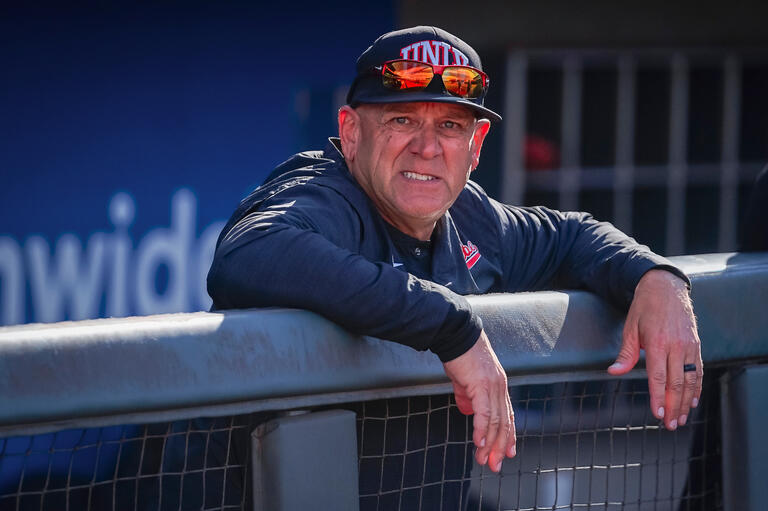
Hunkie Cooper was one of the most dynamic athletes to ever slip on a UNLV jersey, and he went on to become arguably the greatest player in Arena Football League history.
So as one turns the corner into Cooper’s office on the second floor of the resplendent Fertitta Football Complex, it’s reasonable to expect a certain motif.
You know, framed jerseys on the wall. All-conference, All-American and Arena Football League MVP awards on the bookshelf. A pair of Arena Bowl championship rings on the desk. A trio of plaques commemorating his induction into the Arena League, Southern Nevada Sports and UNLV Athletics halls of fame.
But there is none of this. Nor any evidence of Cooper’s six-year tenure as head football coach at North Las Vegas’ Canyon Springs High School (which in 2019 named its field in his honor).
Rather, there’s little memorabilia on display — and not all of it celebrates the on-field accomplishments of the onetime Rebels quarterback who famously played five other positions during his two seasons on campus (1990-91).
Take the two plaques hanging high on a wall above Cooper’s desk. Both honor his charitable work with two organizations that support wayward youth. And both mean as much (if not more) to UNLV’s assistant athletics director for football player development and community service than any football-related honor.
The reason: They’re a reminder that Hernandez James Cooper, the man, has had (and continues to have) a far greater impact than Hunkie Cooper, the athlete.
This explains why, when Athlon Sports released its Top 25 list of NCAA Football player development leaders this summer, Cooper was ranked 11th among those “who invest in the total growth of student-athletes”. He also was one of only two honorees from a university not affiliated with a “Power Four” conference.
In a recent sitdown, Cooper — who returned to UNLV in 2023 after eight years as an assistant football coach at San Diego State — talked about life principles, leadership philosophies, gratitude toward his alma mater, and why the student-athletes he mentors should focus on more than money.
How football builds character

To be considered the 11th best director of football player development — and development of young men — among 138 schools, it’s humbling. But to me, what’s most important is how I present myself to these young men each and every day.
I have 1,825 days to set our young men up for the next 50 years of their life. And there’s a reason I use days instead of saying five years; with years, kids think they have time. Now when I tell them, “You have 1,825 days and you’ve already wasted 700 of them — and you don’t get to buy those back,” it resonates more.
I thank God for the game of football and the lessons it taught me about mental toughness, accountability, availability, durability, responsibility. I take pride in all of those traits.
Things like speed, height and size matter in football. But character and integrity matter more — and those are two things that I will never compromise on. The minute I start compromising on what made me successful, I’m compromising a kid’s career. And I won’t do that.
If the world was a locker room we wouldn’t have all the societal issues we have today. Because in a locker room, you don’t see race. You don’t see religion. You see production. You see trust.
My role right now is making sure that our players are progressing as people and making sure that life after football is accessible to them.
In high school there are unlimited roster spots on the football team. In college, there are 105. In the NFL, there are only 53 — and 90% of those are taken. So you’ve got a better chance of being a doctor or a lawyer or getting struck twice by lightning in Vegas, where it doesn’t rain, then you do becoming an NFL player. So you better get your degree, and you better build relationships.
Keys to success: discipline, structure, and nurturing relationships

My advice to student-athletes is don’t chase NIL money. Chase relationships. Like the ones I had with [hotel-casino operators] Steve Wynn, whom I met at a young age, and Michael Gaughan, whom I met and worked for at a young age. And Don Logan with the Las Vegas Aviators [baseball club]. The relationships you build now will be worth far more tomorrow than any NIL check you receive today.
Some of the best athletes in the world are not in the NFL, they’re not in the NBA, they’re not in Major League Baseball. They’re playing in your local parks. That’s where all the “back-in-my-day” legends are. Because they wouldn’t listen and didn’t have structure. That’s why I believe everything in athletics starts with discipline. You have to have discipline. You have to structure. Then the ability takes over.
Opportunity is great and is what you always look for. And I truly believe there is no such thing as a wasted or missed opportunity. Because the ones you miss, somebody else is going to come along and grab them.
Part of my job is to put these young men in a position to capitalize on a mistake. That’s why I get on their butt when they do something wrong and tell them why it was wrong, and this is how you handle it moving forward. Because when you just get on a kid for screwing up and don’t explain why, then that kid is at a loss and is [more likely] to make that same mistake again.
I tell parents “Don’t text your kid when they get here. Slide a card in their bag or write them a letter. Tell them “I”m proud of where you are and how hard you worked to get to this point. But what you did to get here won’t be enough to keep you here. Now you’ve got to work even harder.”
By the time our student-athletes come through this building, everybody has been telling them for so long how good they are. I’m the guy who says, “OK, let’s be real. That drone that flies down The Strip to show you fountains and fancy hotels? I can take that same drone and fly it six miles to the east and show you 25,000 homeless people. I can show you 300 hotels and gambling saloons, but I can also show you 500 churches. I can show you wedding chapels, but I can also show you shallow graves. So when you get here, you better be who you are.
Money isn’t a motivator for me. Because I’m not from money. I’m from substance. For instance, to see UNLV football in the Top 25 and in the [conversation for] the College Football Playoff and playing in back-to-back-to-back conference championship games — that means more than money to me.
You can pay me for what I do, but you can never pay me what I’m worth.
Follow the right leaders
I learned how to be a good leader by being a good follower. Because sometimes leaders lead the wrong way. That’s why I always try to read the room and figure out who has the skill set, the mindset, the heart, and the willingness to not be liked in order to get the best out of everybody.
The way you lead is more important than who you lead.
My title is assistant athletic director for football player development. And I just installed a wind screen on that fence down there in 110-degree heat. I’ve fixed players’ cars. Recently, we had an important event here and the windows were dirty. So I grabbed a squeegee and a bucket and I cleaned them. Because there’s no job in this building that’s too big or too small for me. And that’s the attitude good leaders have.
I’ve got 105 young men coming in and out of this facility every day. If they see Coach Coop bending over and picking up a piece of paper, it’s not going to be too much for them to pick up paper. That’s leading by example — and not doing it sometimes, but doing it all the time.
As the leader of our family, my mother taught me humility and to serve others. She never had the internet. Never had a car. Never had a cellphone until the last couple years of her life. But walking through the town of Palestine, Texas, my mother impacted more lives than I could ever hope to.
My father enlisted in the military at 18 years old. He fought in World War II and Korea, and was one of the first buck sergeants integrated in the United States military. My [given] name Hernandez comes from the last name of his best friend and fellow soldier who didn’t come home. That taught me about sacrifice.
When you’re the eighth of 10 kids and you grow up in a small town and you lose a father at age 14 and your mother is a maid for 30 years — there’s not a lot of good things expected to happen for such a person. But if you take those excuses and use them as motivation, greatness can come from that.
The lasting impact of good deeds
You know what’s bigger than football? I coached at Bishop Gorman [High School], where I coached [former NFL star] DeMarco Murray. I coached at Canyon Springs High School and had Gatorade All-Americans. But the most important thing is when I get invited to weddings and baby showers. That means I’ve helped extend a generation.
The things you do for yourself die and go to the grave with you. But the things you do for others create a legacy that you cannot outlive. My mom told me that a long time ago. I didn’t understand it at the time, but I sure do now.
Life has never been about me. It’s been about paying it forward. When you can move “self” out of the way and pour it into other people, especially those in need, it’s the greatest reward you can ever get.
I’m glad to be back in this city, and glad to be back on campus. I met my wife [Tiffany Cooper] on this campus 35 years ago, and we’ve now been married for 26 years.
Coming here as a 20-year-old young man from East Texas and being able to get a degree ('91 BA, Criminal Justice) that my mother couldn’t afford — I owe UNLV so much.
The position that I’m in now is a win-win. Because I’m serving my university and young people every single day. I’ve been on vacation for the last month, but I’ve been in this office every day. Because it’s not a job to me.
I love what I’m doing, and I’m here to stay.