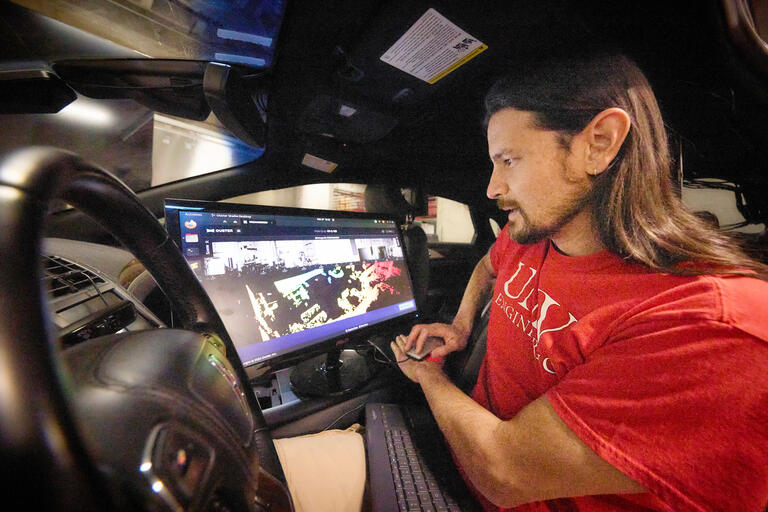
Originally from Nigeria, doctoral student Kingsley Ukandu had admissions offers from five universities in the United States.
“Ultimately, under God’s guidance, I was drawn to UNLV primarily because of the research interests of faculty in the Department of Mathematical Sciences, the diversity of its campus community, and its vibrant campus life,” Ukandu says.
His hard work and passion led him to pursuing both his master's in data analytics as well as a Ph.D. in mathematics, working on both programs simultaneously. He chose this path because of an appreciation for using math and data to solve real-life problems.
“Over time, I came to see that the beauty of mathematics lies not only in the problems we solve, but in the lives our solutions may one day touch,” Ukandu says. “My research in infectious disease modeling lets me live in that connection every day. The thought that something I prove on paper today could one day guide better public health decisions, or even save lives, is deeply fulfilling to me. That’s what keeps me inspired, even when the mathematics gets difficult.”
As a first-generation college student, he credits his success with having the courage to start even when you don’t necessarily know where you will end up. “It means being ready to fail, ready to make mistakes, ready to take unconventional paths, and sometimes, ready to trust your instincts when the road ahead is uncertain. Above all, it means being willing to learn, unlearn, and grow.”
He’s proud of the community he has not only become part of, but has helped to build, and the work he’s doing that has the potential to shape public health decisions in the future.
Tell us about your research.
My doctoral research focuses on understanding how infectious diseases spread, persist, or eventually disappear. For example, during an outbreak, how do we know whether measures like stay-at-home restrictions will actually eradicate the disease? In our recent work, we showed mathematically that restricting population movement, particularly among infected individuals, may not lead to eradication. So, what conditions would guarantee that a disease eventually disappears? And if it doesn't, how will it behave over the next 5, 10, or even 20 years? These are some of the questions I use mathematics to investigate, with the hope that our findings can help inform better public health decisions.
For my master's capstone in data analytics, with a concentration in healthcare analytics, I'm working on heart failure mortality risk prediction to explore how machine learning and explainable artificial intelligence can support personalized healthcare. Let me explain. Imagine two patients diagnosed with the same heart condition. Does that mean they have the same risk of dying? Not necessarily. Their age, heart function, kidney function, and other health factors may differ. So rather than simply predicting whether a patient is at risk, I want to explain which factors drive that prediction.
The goal is to better understand individual risk profiles and support more informed healthcare decisions. While my doctoral research looks at infectious disease dynamics at the population level, my capstone focuses on health risks at the individual patient level. Both reflect my broader interest in using mathematics and data to address real-world healthcare challenges.
What excites you about your research?
The chance to use mathematics to help save lives. According to the World Health Organization, about 1.23 million people died of tuberculosis in 2024 alone, making it the world's leading cause of death from a single infectious agent. Tuberculosis is also one of the diseases my research applies to. Behind every one of those numbers is a person, a family, and a community. Knowing that the models I work on could one day help us better understand and control diseases like this is what makes the work so meaningful to me.
Why should the general public care about your research?
In 2020, much of the world came to a standstill because of an infectious disease outbreak. That's exactly where my work matters to the public. Before a vaccine is developed for a new outbreak, how do we determine which measures could contain or even eliminate the disease? We can't afford to gamble with people's lives, so we need strategies grounded in rigorous mathematical evidence.
My research helps provide that foundation, so that should another outbreak arise, decision-makers aren't left guessing. And at the individual level, my capstone work could help doctors better understand each patient's unique risk, bringing us a step closer to care that's truly personalized.
What are you working on next?
I'm working on a discrete-time SIS patch model with saturated incidence. Too technical? Let me put it simply. Imagine an infectious disease spreading across several cities, and we track it step by step, say week by week. People travel from one city to another, become infected, recover, and can become infected again. The disease I'm studying also has an interesting feature: as the number of infected people grows, the rate of new infections doesn't necessarily keep pace. My ongoing work examines how all these interactions shape the behavior of the disease in the long run. Will it eventually disappear, or will it keep spreading? Still on it!
Tell us about working with your faculty mentor Rachidi Salako and what that has taught you about mentoring other students.
Dr. Salako has a quality I deeply admire. One might assume it's his brilliant mathematical mind, but for me, it's his humility. Brilliance and humility don't always go hand in hand, but working with him has shown me that true intelligence can be quiet, warm, considerate, and patient. He has challenged me to think differently, question my assumptions, and look at problems from perspectives I might never have considered. Beyond mathematics, he's shown me that you don't have to make others feel small to demonstrate how much you know.
That has shaped the way I mentor other students. Let's face it, many students already find mathematics intimidating, and the last thing they need is someone making them feel inadequate for not understanding a concept. Effective mentorship takes patience, empathy, and the ability to meet people where they are. Sometimes, what a student needs most isn't another explanation, but someone who believes they can understand it. That's the kind of mentor I strive to be.
What advice do you have for other first-gen students?
Don’t be afraid to start because you don’t know how everything will turn out. You don’t have to have it all figured out. Ask questions, seek guidance, embrace opportunities, and never allow your circumstances to define the limits of your potential. Remember, you are not just pursuing a degree; you may also be opening doors for those who will come after you. And sometimes, the most meaningful paths in life are the ones we have the courage to create ourselves.
What is a source of pride for you in your academic career so far?
When I think about my academic career so far, what I'm most proud of is the journey itself. The people I've met. The mistakes that made me better. The experiences that shaped me. The students I've walked through tough math concepts. The communities I've helped build. One of my favorite memories is from my time as president of the Society for Black Scientists at UNLV. We'd host events where everyone was just laughing, trading stories, bouncing ideas off each other, and being completely themselves. Those are the moments I think of when I hear the word community. I've always loved bringing people together, especially in spaces where nobody feels judged or worried about getting something wrong. That matters to me as a mathematician, too. People think math is all formulas, but it really takes imagination, and you can't be very imaginative when you're afraid to be yourself.
If my life were one of my disease models, I'd say I'm still working out its long-term behavior. As an international student, I honestly don't have the next move figured out yet, and I'm learning to be okay with that. I've worked hard and come a long way, and I'm genuinely curious to see where the next chapter leads.
What I've learned is that clarity isn't a requirement for moving forward. I'm trusting God to guide my steps as He always has, and I'm facing the future with faith, courage, and a little excitement. To anyone else still figuring things out: not having all the answers doesn't mean you aren't making progress. Give your best today. Tomorrow often opens doors we never saw coming.