The Artemis II moon mission recently stole news headlines and captivated a nation as NASA astronauts achieved historic firsts, including traveling the farthest distance for human spaceflight.

Meanwhile, in Barstow, California, a few days before that lift off, a team of scrappy UNLV College of Engineering students achieved their own historic first with the launch of their ATLAS-1.
It is the Silver State’s first high-altitude balloon that tested CubeSat components. CubeSats are compact, miniature satellites that have made space research more accessible for university students.
The Barstow launch was a rehearsal before the team can launch a similar device into low Earth orbit.
“Having this effort be both a historic first and a technical success was a rewarding testament to the team’s hard work and dedication over the past 10 months,” said Kylee Brahma, a third-year honors mechanical engineering student and team lead, adding that the project gave students direct experience in designing, testing, and operating real flight hardware.
The launch of UNLV ATLAS-1 is a milestone for student-led aerospace research at UNLV. In recent years, several student groups have cropped up to explore hands-on experiences beyond engineering coursework.
Brahma, who originally enrolled as a pre-med major, “knew nothing about aerospace” until she joined the Students for the Exploration and Development of Space (SEDS) chapter as the group’s treasurer.
“I was like, I can help you with your finances and, at the same time, figure out what I want to do in engineering,” said Brahma. “I fell in love with aerospace through that process.”
In Huang Chen’s Fluid Innovation Lab on campus, she also discovered a surprising link between biomedical and aerospace engineering. Chen is exploring ways to make left ventricular assist devices, and other heart pump technologies, more efficient.
“I asked, ‘Where are these innovations coming from?’ And he was like, well, a lot of these were taken from space shuttle engines; we just shrunk them down and we just put them in people,” Brahma recalled. “That was an insane thought to me.”
That led Brahma, and a few recruited students, to aerospace engineering and their ATLAS-1 mission.
“What's cool about it is that a lot of kits for CubeSats are about $10,000,” she said. “And we've created one from scratch — from picking the components to actually doing the code. We've also developed our own frame. And it cost us about $350. We included some tracking devices in there, but other than that, it’s not a very expensive payload.”
Fundraising for Space Research
Next Up: Teams Wants to Launch CubeSat into Low Earth Orbit
In the early morning hours of Saturday, March 28, the team — after days of intensely monitoring outside temperature and wind patterns — set off for their launch location in Barstow, California. Originally, the team wanted to launch from Primm, Nevada, but on-the-ground conditions revealed that it would be easier to recover their payload if they drove further out.
“We're gonna go as high as possible. So we're aiming for at least 30,000 feet,” Brahma said about a week ahead of the launch. She shared her hopes for ATLAS-1 from Huntsville, Alabama, where she is interning at Blue Origin during an “unintentional gap year” to pursue aerospace internships. Her latest stint follows internships at the Ames Research Center and the NASA Johnson Space Center.
“It's been kind of an unorthodox journey for me,” she said, adding that she would be leaving for Las Vegas in a few days to join her teammates for the final preparations at UNLV.
The CubeSat they developed was focused on testing environmental data, including temperature, humidity, magnetism, and acceleration. They also developed an antenna that would connect to their ground station to transmit the data points in real time.
“Preliminary data shows that we recorded telemetry up to 53,000 feet, and extrapolated analysis suggests that we may have reached altitudes approaching 100,000 feet. We also successfully recovered the CubeSat,” she said.
The team were able to pick up the payload — which landed near Primm, Nevada — with a few miles of off-road driving, and a steep, but short uphill hike just to the south of Clark Mountain Peak.
They developed the low-cost CubeSat as a proof-of-concept for an even bigger aspiration: becoming the first student team from Nevada to test aerospace systems in space.
“The HAB launch can show potential sponsors and college leadership that we're serious about doing this,” Brahma said, adding that they are presenting their work at the Small Satellite Conference in Salt Lake City this August.
The team is fundraising to create and deliver a space-ready cube-sat, one that is radiation shielded and can withstand the extreme conditions of space.
“We're workshopping the orbital mission right now to refine it, but the HAB launch is to demonstrate our current capabilities and show that we have built a foundation to start inheriting more expensive equipment,” Brahma said.
So far, Brahma has secured $5,000 from the Nevada Aerospace Hall of Fame — but more support is needed to make their 2027 orbital mission a reality.
“She’s been finding her own funding, which is very impressive,” said engineering professor Matt Pusko, an advisor to Brahma’s three-person team. “She's running this project and I'm helping with my ballooning capabilities. I’m just helping them do their thing.”
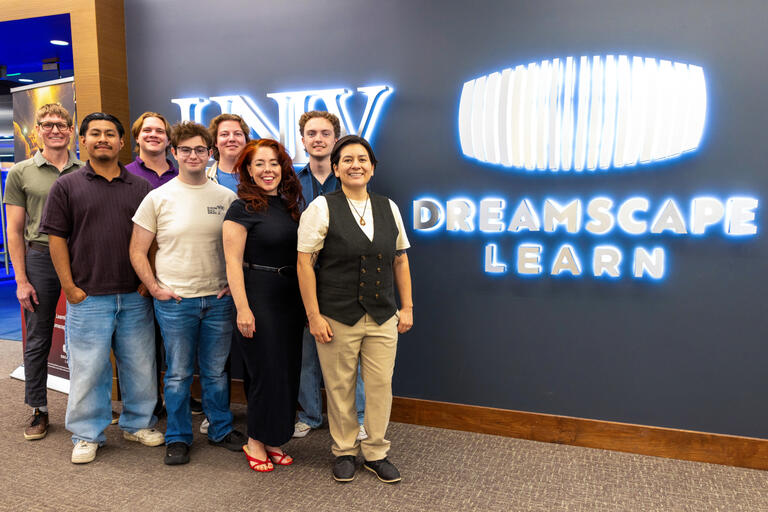
The team also includes mechanical engineering students Leandro Araiza, Christian Lugowski, and Dominic Arellano, and computer science student Noemi Magallanes.
‘An Underdog Story’
A tenacious attitude also has brought success to other student-led aerospace projects at the undergraduate level.
Take SEDS for example. In May 2024, SEDS was the first student team in Nevada’s history to complete a hot fire test with a liquid bi-propellant engine. The feat was notable not only because they used 3D-printed parts to save money on materials and manage the heat in the rocket — named SPARK 1 — but also because the organization came on the scene fairly recently, in 2019. The pandemic curtailed some of their earliest efforts, but by 2024, SEDS had built up a solid membership to solve a variety of rocketry challenges.
“They chose their own topics to pursue,” said Pusko, who also serves as an advisor to SEDS. “They decided to make their own liquid rocket engine — I didn’t push them to do it. They have an interest in rocketry and are actively pursuing rocketry projects outside of the classroom to get hands-on experience now.”
Last year, at the same Jean Dry Lake bed location, the SEDS team launched another rocket more than 10,000 feet into the sky to prepare for their first entry into the International Rocket Engineering Competition (IREC). Out of 143 teams, SEDS scored 52nd overall in the commercial-off-the-shelf (COTS) category for their rocket launch, which achieved an altitude of 8,855. A few of the schools they beat include Embry-Riddle, UC Berkeley, Texas A&M, Illinois Tech, Princeton, and Cornell.

The team is aiming even higher for the upcoming June 2026 competition.
“Our team is a bit of an underdog story,” said Ty Huel, SEDS member and IREC project manager. “The college supports us anyway that they can, but we’re competing against a lot of schools that have departments of aerospace engineering.”
But with strong placements at competitions like IREC, and former members like Rabih Chaar landing jobs at places like Rocket Lab, Brahma and her teammates know that it’s only up from here.
“They get jobs they want, and I don't know if everyone can say that,” said Brahma.
These combined efforts have caught the attention of faculty and college leadership, and has led to the creation of more undergraduate aerospace courses. A propulsion course was added to the class schedule for the first time last fall. The course instructor, assistant professor in residence Skylar Polek, helped the team with their rocket engine design simulations.
Brahma would also like to see UNLV offer a “how to build a cube satellite” course like she’s seen offered at other universities, to teach other generations of students about the work she’s doing now.
“Aerospace courses are starting to be added to special electives again at UNLV,” Brahma said. “And over time, it might lead to an undergraduate aerospace degree."