If you’ve watched a blockbuster in the last two decades, chances are you’ve seen the work of assistant professor Andi Isaacs.
With a resume that includes some of Hollywood’s biggest movies — everything from fan favorites like the Twilight saga and the Pirates of the Caribbean series to critically acclaimed films like The Hurt Locker — Isaacs has been a go-to expert for complicated films.
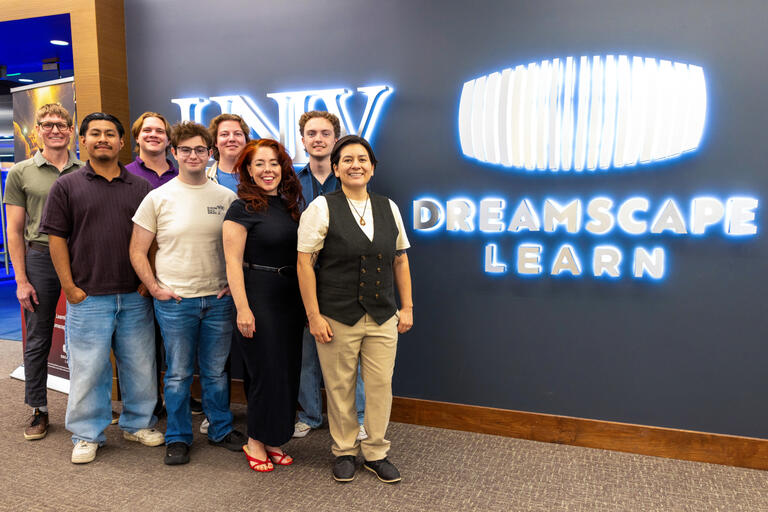
She’s worked with everyone from Tom Hanks to Tom Holland, and now, she’s working with UNLV students to help make their film career dreams come true.
The Course: The Business of Hollywood
Film 333, The Business of Hollywood, equips students in the College of Fine Arts with the practical skills needed to enable their creativity to shine in a competitive industry. They learn the ins and outs of studio production, starting with the roles of each person involved in moviemaking and the chain of events required to bring a story to the big screen.
Isaacs says that students often come to her with a creative background and technical skills, but with few ideas about how to navigate the film industry. “I'm teaching them where to start,” she says. “It doesn't take away from creativity, it adds to it so that [they] can live [their] dream.”
Why is it being taught?
“Film does not hire the same way as every other major,” Isaacs explains. There’s no long interview process, and it often happens on the spot. “You meet someone, you talk to them for about three minutes, and they decide whether they want to work with you 12 hours a day or not.”
Isaacs created the course to help students succeed over the long term in this fast-paced environment. She says, “I want to teach the strategies of having a career in film.”
Who’s taking it?
The course has quickly gained popularity. Isaacs’ first class started with 12 students, and now she teaches 42. She has students from sophomores to seniors, “but it's for every student who wants a career — a paid career — in film,” she says.
How does it work?
Students start by mastering the basics of landing a job: how to write an email, draft a cover letter, and even a good handshake.
“One of the most important things about this course is it teaches entry-level opportunities,” Isaacs says. “Everyone in film starts at the entry level.”
And that often starts by making connections. Earlier this month, students had the opportunity to work at the American Film Market in Los Angeles. The students worked directly with exhibitors, producers, and production companies to learn about the funding and distribution of films, as well as create valuable industry connections.
The course also introduces students to a variety of entry points into film — wardrobe, set production, office work, construction — so they can pitch themselves and their ideas. “Whether you're pitching a movie or whether you're trying to get a job as a production assistant, you have to be able to pitch yourself,” Isaacs says.
At the end of the semester, students complete a group pitch project: selecting a film from the past 30 years and presenting it as if it were their own. Each group includes a producer, director, and writer, who work to sell their concept, complete with a detailed budget and production schedule.
Who’s teaching it?
Isaacs, a New York native, always knew she wanted to work in the movie industry. She got her start in craft services, where she learned every person’s role on set. She later transitioned into production accounting, when a career-defining moment changed everything.
“The president of 20th Century Fox walked by and asked if I had a passport," she recalls. "Three hours later, I was on a plane to Malaysia and was asked to take over a movie that was in huge financial trouble.”
Her success turning around the production instantly made her a studio favorite. She worked at Disney as a production executive, and was then asked to be the head of physical production at Summit Entertainment, a studio that would go on to create 28 movies in six years, and dominate the box office in the 2010s with films like the Twilight saga, RED, Warm Bodies, Now You See Me, and The Perks of Being a Wallflower.
After retiring to Maine, Isaacs began seeking new opportunities. “Living in Maine during a pandemic is like living in a Stephen King book,” she jokes.
She considered teaching at several universities, but ultimately chose to teach at UNLV after being moved by the diversity and the dedication of the students.
“I really think there’s a need to hear stories that we don’t normally hear," she says. "There are so many kids who major in film who are never given practical knowledge about having it as a career. If I have that knowledge, why wouldn't I want to share it?”
What excites instructors the most about teaching this course?
For Isaacs, nothing is more rewarding than to hear that a student landed a job in the industry. Many of her students from the past three years are now working full time in film. “I love being able to help them start their careers.”
What even lay people should know from this course?
The biggest misconception of Hollywood is that it’s an exclusive, locked vault, Isaacs says. She hopes more people will realize that Hollywood is a business like any other industry — and there are endless opportunities for those interested. “Once you get that foot in the door, your ceiling is as high as you want it to be.”
The watch list:
Rather than sharing a watch list, Isaacs recommends watching popular films and discussing them with others. This Thanksgiving, head to your local theater and critique it with your family and friends.