At first glance, the colorful illustrations lining the walls of the West Las Vegas Library look like pages pulled from a beloved children’s book. There are whimsical characters, adventurous storylines, and vibrant scenes bursting with imagination. But behind the A Day at the Library exhibit — running through July 12, 2026 — is more than a collection of stories.
For Assistant Professor-in-Residence Chad Scott, the exhibition is equal parts classroom project, artistic collaboration, and tribute to the public library system that continues to shape communities across Southern Nevada.
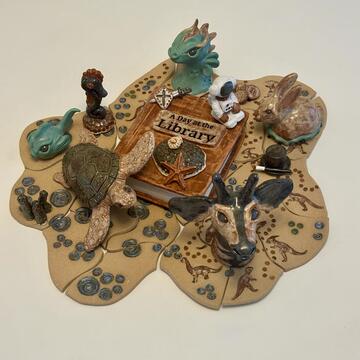
“This was really a letter of appreciation to libraries — not just for books, but for everything they provide for our community,” Scott says.
The exhibition emerged from Scott’s course, EDEL 331: Teaching Elementary School Art. Over the spring semester, future elementary educators focused their original works of literature around one theme: the library as a place of possibility. They partnered with professional local artists to bring their stories to life.
The final result is an exhibition that connects education and public art, as well as future educators with deeper perspectives on teaching and community engagement.
“The majority of students in this class do not plan on becoming art teachers,” Scott says. “They’re future elementary teachers who will teach across subject areas. I want them to think about how the arts can connect to multiple subject areas, including literacy, research, and community partnerships.”
Building Stories from the Ground Up
Scott designed the project in conjunction with UNLV’s Zeiter Literacy Center to mirror the research and collaboration processes students will later use as educators.
The semester begins with a deep exploration of children’s literature focused specifically on libraries. Students analyze books in which libraries served not merely as background settings, but as meaningful spaces central to the story. From there, the students worked in groups to begin imagining their own stories.
For the students, the project was a new kind of creative experience that required them to combine imagination, teamwork, and reflection.
“It was a very new experience — I have never done anything like that before,” says Elementary Education major Kylie Howser. “But it was really fun to work in a group and try to put all of our ideas together. I enjoyed coming up with our characters and each of their looks and personalities.”
They developed detailed character profiles, imagined personalities and dialogue, and mapped out story arcs before ever writing a final draft. Throughout the semester, groups regularly shared progress with classmates, receiving feedback much like researchers presenting and developing ideas in a collaborative academic setting.
Bringing Stories to Life
Once the stories are finalized, Scott invites local artists into the process.
Illustration is not an afterthought, though. Students collaborated directly with Las Vegas artists, many of whom already have strong ties to the Las Vegas-Clark County Library District and its gallery spaces.
Each artist selects a story that resonates with their artistic style and collaborates closely with students on character sketches, storyboards, and large scale illustrations for the exhibit.The collaboration became one of the most memorable parts of the experience for students who saw their ideas evolve from concepts on paper into finished artwork.
“It was really fun,” says Howser. “It was really cool to work with an artist and see him bring our ideas to life.”
For one story, Once Upon a Genre, the students partnered with children’s book illustrator and author Joseph Watson. He created richly detailed illustrations depicting multiple literary worlds colliding inside a library adventure. He says the process of working with students mirrored the collaborative work he does on professional children’s books.
“They knew my style and what I do,” Watson says. “They were willing to see me make some explorations on what they established.”
“Joseph Watson would send us updates of his artwork, and it was so cool to see our ideas combined with his artistic style and blended so well together,” said Howser.
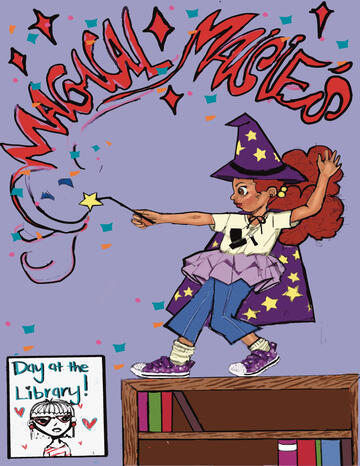
Another story, Magical Maisie, follows a clumsy young magician learning her craft, a concept that painter and portrait artist Q’shaudra James translated into expressive, playful imagery full of movement and personality.
“When visually creating Maise, I took all her characteristics into consideration,” explains James. “She’s creative, optimistic, whimsical, and magical. I had the challenge of taking these broad traits and creating a fully developed person.”
For Elementary Education student Isabella Simpson, who worked on Magical Maisie, the project reinforced the importance of creating stories where children can recognize themselves.
“One of the most underrated parts of becoming an educator is putting yourself into the shoes of your students,” says Simpson. “Creating this book was a great opportunity to do just that. We wanted a protagonist that any child, regardless of background, could see themselves in. Their curiosity, their silliness, and their passions can be seen in this book.”
And for Okie the Okapi, an exploration of a real-world animal navigating a literary world, multidisciplinary artist and former Clark County Poet Laureate Heather Lang-Cassera transformed the narratives of Okie’s story into three-dimensional clay works.
“Something I love about working with students is that I almost always learn something, too,” said Lang-Cassera. “For example, before this project, I knew very little about the okapi, the only living relative of the giraffe. I’ll be thinking about that protagonist, and his real-life counterpart, for years to come.”
Scott says students gained invaluable experience learning with it means to work alongside professional artists.
“They had the opportunity to see what collaboration actually looks like,” he says. “Not feeling like you have to do everything alone, but understanding how different talents come together to create something wonderful.”
The Library as a Cultural Hub
While the library exhibit celebrates storytelling, it also highlights a lesser-known aspect of the Clark County library system: its longstanding commitment to the arts.
Fifteen local libraries throughout the valley house gallery spaces that showcase rotating exhibitions from regional artists. Scott says the LVCCLD art galleries provide critical opportunities for emerging and established artists alike. “I’ve never seen anything quite like it anywhere else,” he says. “The libraries curate and host many exhibitions, creating public access to art in ways that are really meaningful.”
That accessibility is central to the project itself. By placing the exhibit inside the library, Scott hopes that visitors experience the stories in the very environment that inspired them.
“It’s public pedagogy,” he says. “This exhibit is about showing what can happen when universities, libraries, artists, and students all work together.”
Watson hopes that visitors see more than finished artwork on display.
“I want them to see the art of collaboration,” Watson says. “There could be little kids walking through the library looking at those walls wondering ‘How was that done?’ then realizing that children’s books are written and illustrated by real people — and they can do the same thing.”
Into the Classroom
For Scott, the exhibit’s biggest success lies not only in the final artwork, but in what students learn throughout the process. At the end of the semester, students can proudly add to their resumes that they’ve written original children’s literature, collaborated with professional artists, and participated in public exhibitions of their work. The experience they gained through contributions to a community centered creative project will also carry into their future classrooms.
“This changed the way I feel about teaching because it reminded me that different subjects can easily be combined and integrated into one lesson to make it more interactive and engaging for students,” says Howser.


