
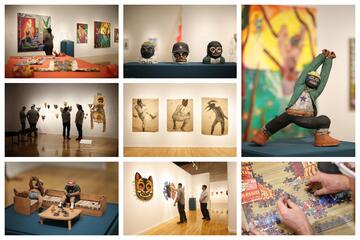
It doesn’t rain often in Southern Nevada, but when it does, it can pour.
For years, those rare rainstorms leaked through the aging roof of the UNLV’s Marjorie Barrick Museum of Art. And each time, employees scrambled to protect artwork while Facilities Management responded to patch the issue.
“It has been raining inside ever since I got here in 2012,” joked Alisha Kerlin, executive director of the museum.
After years of temporary repairs, outside contractors replaced the museum’s roof and rooftop HVAC units this summer. But as contractors removed the old roofing materials, they uncovered electrical wiring and junction boxes beneath the surface.
“Once we discovered how the wiring had been installed, we knew it needed more than simple repair,” said Facilities Management electrician Justin Sechrest. “We had to remove the old wiring and install a new modern system that was safe, accessible, and easier to maintain. It was an unexpected challenge that required additional time and coordination to keep the project moving.”
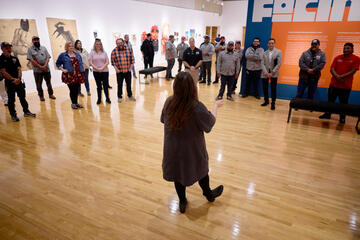
While contractors handled the roof replacement, Facilities Management staff took on the additional work inside the museum to keep costs in check and the project on schedule.
As work continued overhead, ceiling tiles and metal baffles — vertical fins designed to absorb noise — above the gallery began falling. Those baffles were a distinctive part of the museum’s identity, with their shape appearing on its logo.
“We understood how much the baffles meant to the museum, but safety had to come first,” said Facilities Management supervisor Garrett Hedges. “Our team had to figure out how to remove everything while protecting the artwork and keeping the fall reopening on schedule.”
During construction, staff worked from temporary spaces and the museum's permanent collection was moved into climate-controlled storage. Meanwhile, Facilities Management continued working inside the gallery:
- Removing metal baffles and ceiling tiles
- Replacing electrical wiring
- Upgrading gallery lighting
- Painting
- Refinishing hardwood floors
The ceiling tiles, said Facilities Management supervisor Jason Halgas, required a unique approach.
“We had thousands of ceiling tiles to remove, and some were in the areas our lifts couldn’t reach.” he said. “We had to get creative, using long poles to reach the tiles and figuring out the safest way to bring them down. It was physically demanding work, but once we found a way that worked, we made progress pretty quickly.”
The improvements also transformed the museum’s lighting. A new energy-efficient LED system provides even illumination, adjustable color temperatures, and individual controls to accommodate exhibitions and events.
Sechrest worked with Kerlin to select lighting arrangements and demonstrate different color temperatures.
“It’s those little details that mean so much," Kerlin said, "They weren’t just installing lights; they were listening to what we needed and thinking about how the space would work for our artists and visitors. That level of care really stayed with me.
“What meant the most to us was knowing we had people we could count on."
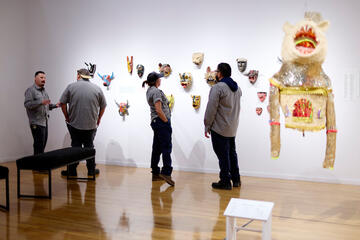
If repairs weren't completed in time for the reopening, the museum could have remained closed for an entire year and it would have loss to the College of Fine Arts' biggest event of the year: the annual Art Walk.
"Facilities Management understood how important reopening was, not just for our staff, but for the community we serve," Kerlin said. "They treated our challenges as their own.”
The project involved every shop in Facilities Management, and crews had to balance the work with their day-to-day responsibilities, said Jeremy Malone, a manager in Facilities Management. “They came in on weekends, put in long hours, and worked together to get it done. I’m incredibly proud of the dedication they showed and what we were able to accomplish as a team.”
Overall, the renovations have done more than improve the museum’s appearance; they have created a safer, more energy-efficient space that will better serve artists, students, and the community as the museum approaches its 60th anniversary next year.
“People will walk into the museum and notice how different it looks, but they may never realize how much work went into making this reopening possible,” Kerlin said. “Their work may not always be visible, but its impact will be felt by every person who walks through these doors.”
Learn more about the Marjorie Barrick Museum of Art and its new exhibitions.


