At 6 p.m., as most UNLV buildings are emptying out, the custodial night crew is starting its workday.
For the next eight and a half hours, crews spread out across campus to clean classrooms, restrooms, conference rooms, auditoriums, hallways, entrances, stairwells, and every other shared space on campus.
Most people never see them doing it, and the invisibility can also obscure how much knowledge goes into the job.
“There are a lot of smart, skilled people here,” said Zone Manager Gilbert Gallegos, who has worked at UNLV for 26 years. “We have some very talented people.”
Cleaning is a Science
Gallegos came to UNLV in 2000 after being laid off from a warehouse job. He expected the position to be temporary.
“I really didn’t think much of custodial work,” he said. “I was surprised by all the skilled people who actually were custodians, because I had the total opposite idea of it, like a lot of people might.”
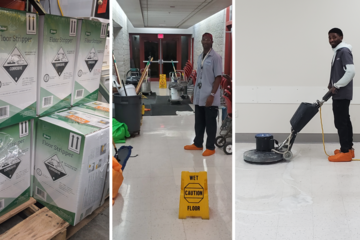
Their crews include people with technical knowledge, specialized skills, and years of experience that aren’t necessarily obvious from their job titles. Custodians operate specialized machines, work with chemicals, maintain different types of flooring, and learn complex processes to avoid damaging surfaces and creating safety hazards.
Within a few years, Gallegos was promoted to supervisor, eventually moving into management. Today, he oversees seven supervisors and their crews on the south side of campus, while Zone Manager Derrick Monroe oversees the north side.
During the summer, the crews’ attention turns to project work, including the labor-intensive process of restoring campus floors before the fall semester.
“This time of year is crunch time,” Gallegos said.
Stripping a floor starts with moving furniture and equipment, sweeping the area, and applying a chemical stripper that breaks down grime and layers of old floor finish. The chemical has to sit for 10 to 15 minutes before custodians use specialized machines to scrub the finish away. Then they remove the resulting slurry with a wet vacuum, followed by repeated rinsing.
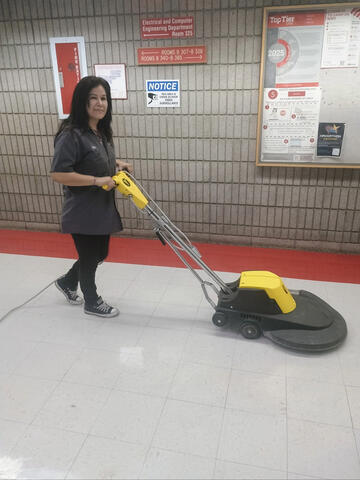
The process is technical and physically demanding. Chemical stripper is corrosive and makes the floor slippery, so handling it requires extensive knowledge and protective equipment. Crew members have to anticipate where the chemical and slurry might travel and create buffer zones around adjoining floors so runoff does not damage an area they have already completed. A mistake could mean wasted time and materials, damaged flooring, and even injury.
Sometimes, one stripping isn’t enough. Older floors with a lot of buildup may have to be stripped repeatedly, because the alternative creates patchy areas of old layers and embedded dirt beneath the new coating.
“Whether the stripping is done well is what makes or breaks a job,” Gallegos explained.
Only after the floor has been properly stripped can the crew begin applying new finish.
The product used by the crews recommends seven complete coats. A coat that dries in 10 or 15 minutes under ideal conditions can take an hour or longer when humidity is higher than normal. Afterward, crews return to burnish the floor with a high-speed machine.
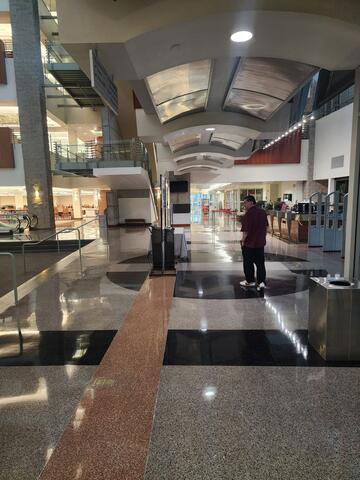
Different buildings require different approaches to maintain their floors, too. A building with carpet needs deep shampooing, for example. Other campus spaces have terrazzo, concrete, or wood flooring, each with its own specific needs.
While the crews are refinishing floors during the summer, they must also keep up with their regular work. Restrooms still need to be cleaned every day, and hallways mopped or auto-scrubbed. Conference rooms, auditoriums, classrooms, entrances, and other common areas remain on normal cleaning schedules.
This constant cleaning improves the atmosphere and acts as a security net for our community’s health. Custodial work on this scale requires an understanding of infection control, and UNLV custodians are trained on the topic. “We push hard on chemical training and preventing cross-contamination,” said Custodial Supervisor Chris Chavez.
For example, spraying a product and immediately wiping it away may make a surface look clean, but it won’t necessarily give the chemical enough time to actually disinfect it—and the time required will change depending on the product and the surface.
Cleaning equipment must be used with an understanding of what it has touched and where it is going next, because something used across multiple areas can spread contamination instead of removing it. A mop used in a restroom cannot then move into a hallway, and so on.
These details are tracked every single day across more than 90 buildings, in hundreds of classrooms and restrooms, and in common spaces all over campus.
“People don’t realize the skills custodians have,” Custodial Supervisor Theresa Castillo said. “Everybody has a skillset somebody else can’t do.”
Night Crew Are the Eyes and Ears of Campus
An employee working during the day will likely spend most of their time in just a few places on campus. By contrast, the night crew’s routine work takes them through almost every space every night.
“We’re like the eyes and ears of campus,” Gallegos said.
This puts them in an ideal position to spot and solve problems before they become emergencies. During heavy storms, crews fill and place sandbags to help keep potential flood water from entering buildings. They check spaces for leaks, including opening office doors they would not normally service that night.
The night crew also stays in close contact with other Facilities Management teams. If a leak, repair, or equipment problem creates a mess, another crew can contact custodial employees for help. Custodial staff do the same when they encounter something that requires a plumber, electrician, or other trade.
During the interview with Gallegos, an active chat conversation was underway about a leak in the Beam Music Center. Employees from different crews were responding in real time and coordinating who was heading to the building.
A standby list of employees respond when issues arise on weekends when only a skeleton custodial crew is normally on campus.
“Caring for the campus is basically 24/7,” Gallegos said.
The Work Disappears When It’s Done Well
For the night crew’s work, success means leaving zero evidence they were ever there. The floor is clean. The trash is gone. The restroom is ready. The classroom has been reset. A leak that could have become a larger problem was caught and repaired. This is an unusual feature of custodial work: when everything is working as intended, most people walk into a clean building without thinking about how it got that way.
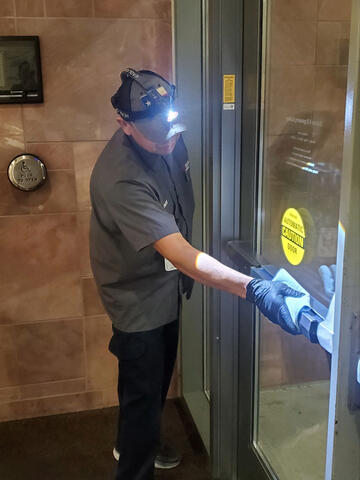
But for UNLV’s night crew teams, getting the job done well is the point. They go out of their way to get the details right even when almost no one is around to see them doing it. One employee wears a headlamp while cleaning windows because otherwise it is difficult to see the glass clearly in the dark.
“He looks like a coal miner every night, just so he can do the windows right,” Gallegos said, laughing. “He wants to do the best job he can.”
This, he said, is the culture of the night crew: People who take ownership of their spaces and of the quality of the work they leave behind.
“We do our best. We work hard for everybody, and we put a lot of effort into making campus look the best it can.”
He paused to think about it more.
“All in all, I love this job. You can write that.”


