
Last fall, the Office of the President completed a long overdue refresh of the executive suite on the seventh floor of Flora Dungan Humanities (FDH). The project addressed aging infrastructure and updated the space with new lighting, flooring, and paint. Enclosed cubicles were replaced with a more open and welcoming layout, comfortable seating was added for visitors, and the exterior glass was redesigned for a more modern entry.
But before interim President Chris Heavey could move back into his office, he admits he had to go through the boxes and boxes of books, awards, photos, and tchotchkes that he’d accumulated over his 33 years (and counting) at UNLV.
That gave him an opportunity to think about what really mattered enough to keep close.
He held onto items with special meaning and mementos of the places he’s visited. There's a stained glass panel featuring the UNLV logo that was created by Vice President of Research Dave Hatchett. He placed a beautifully crafted Chinese folding screen, a gift from when he visited Wuhan University, on a wooden stool made years ago by one of his sons.
The office walls still display his degrees from UCLA and UC Santa Cruz, of course, as well as license No. 367 from the Nevada Board of Psychological Examiners.
“It’s inactive,” he admits, smiling. “My day job has kept me occupied.”
Here Heavey tells us about the meaning behind some of the objects that made it out of moving boxes and back on display.
Photos by Josh Hawkins
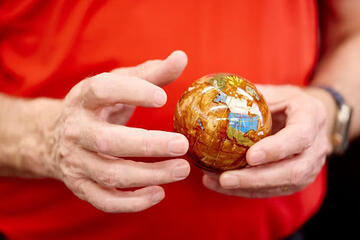
Stone inlay globe
I love maps and globes — they’re reminders of our place in the world and our reach as a university.
I’ve been working on building relationships with international universities, and I’m really excited about how the Sands Institute for Chinese Language and Culture is developing. It opened last year, supported by a $15 million pledge from Las Vegas Sands. We’ve already awarded scholarships to dozens of UNLV students who will begin to study Chinese language and learn about Chinese culture. The goal is for them to become fluent in the language and to provide the kind of internships and mentoring that will make them stand out to future employers looking for people to work in the intersection between the U.S. and China.
The relationship between the U.S. and China has been strained, but as educators we bridge divides to create greater understanding. It’s one great example of how UNLV leverages our city’s natural ties as a tourism and conference destination to have a worldwide impact through our programs.

On the bookshelf
I think back to when I led my first section of undergrads for a psychology research methods class. When they took their first test, some of them really didn’t do well and my first thought was, “Man, how could you miss that? I told you all the answers.” I had made it a point to build personal relationships with each of them, so I found myself taking it personally at first when it seemed like someone wasn't trying very hard.

Then I realized my job was to encourage them no matter what. We don't always know the full story behind any single performance. All we have is what’s in front of us. As a professor, my message became, “You can always do better next time!” I try to remember that lesson whenever I’m frustrated. You can and should stick to your high expectations but also be 100% rooting for someone’s success.
The New Education is really good for framing how faculty should look at our role. It’s not to impart our expertise — because in today’s world students have endless information at their fingertips — but rather to give a guided tour so students can make their own discoveries.
I also like this classic by Carol Dweck on developing a growth mindset — it’s really the antithesis of the old “weed-them-out” mentality and the belief that success comes only from innate talent. I was an early adopter and have bought many, many copies to give away. The idea is that we must meet people where they’re at and help them realize that success comes from believing in and nurturing their ability to master new tasks via effort.
And all of that takes me back to what I’ve been saying more broadly to community leaders: As an R1 university — and the only one in the region — we are uniquely designed to accelerate human potential. Our faculty do that through research and teaching. Our programs feed growth in every sector of the workforce. And we change the trajectory of our students’ lives who, in turn, become powerful contributors to our community and our world.

Family photos and a mug turned into a pen holder
I met my wife, Nancy, working an orientation event when I was a grad student at UCLA. Our first date was for coffee in Westwood, California. Pretty soon after that, we went out for what I’d call a “major date.” We ate at a Mexican restaurant, had a few tequila shots, and went to a nightclub. We’ve been together ever since — married for 33 years and together for 37.
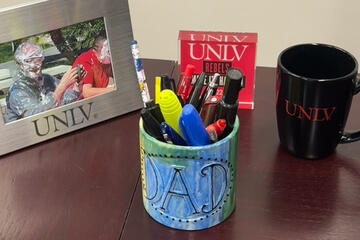
Marty made me that mug for a Father’s Day years ago. I’m so proud of both my boys. Family really is everything. When I was about 10, my parents started getting everyone together for one week out of the summer. They’ve long since passed, but my four brothers and all their kids are carrying on their tradition.
The importance of tradition applies to the Rebel family too, of course. Homecoming, Premier UNLV, taking your picture with the Fremont Cannon — all those moments are what keeps us together through the generations.

Bicycle-themed business card holder and Trek Bicycle shop sticker

I still do some mountain biking, but I’m more of a road biker now. It’s purely for fun. I’m a morning person and it gets me out of the house by sunrise. I like the social aspect too. They definitely know me well at the bike shop in Henderson.
Nancy and I found our house during a bike ride. We wanted to downsize as we became empty nesters and find the home that would take us through retirement. We biked to this beautiful area at the foothills and knew we’d found the right place. We’ve lived our entire married life in the Las Vegas Valley. We built our careers and raised our boys here. I can’t imagine living anywhere else now.

Wall art: UNLV photo by Josh Hawkins
Las Vegas is not supposed to be here. With so little water, it wasn’t habitable. It took a lot of innovation and work to make this a place where more than 2 million people now thrive. And now it’s our turn to keep innovating for the next generation — to build the systems for healthcare, for entrepreneurship, for industry to thrive.

University of Nevada, Las Vegas: A History by Eugene S. Moehring
Gene Moehring — he was a beloved faculty member — wrote this great history book for our 50th anniversary [in 2007] to talk about UNLV’s evolution. It’s strange to realize that I’ve now been here for literally half of our university’s history.
It makes me think of this notion that organizations are very hard to build, right? It’s taken a lot of work by a lot of people to make us what we are today. So now there’s this weight, or rather, this profound sense of responsibility for adding the next chapters.
An effective leader, to me, is someone who will both help the institution thrive now and then be able to hand it off successfully. From my vantage point, I don’t think you can really judge how successful you are as a leader until the next person is doing well.

Wooden jargon generator
This is kind of like a Magic 8-ball, but for buzzwords. When a conversation gets heavy, sometimes I pull it out to break tension. “Synergistically Align Strategy” “Proactively Monetize Deliverables” — yeah, that is not the answer for us today. [Laughs.]
But the thing to remember is: We might not have easy answers to today’s challenges, but we do have smart people who care and we do know what our bigger mission is. I truly believe that, as we work together on that mission every single day, no organization will do more to make this community a better place than UNLV.


