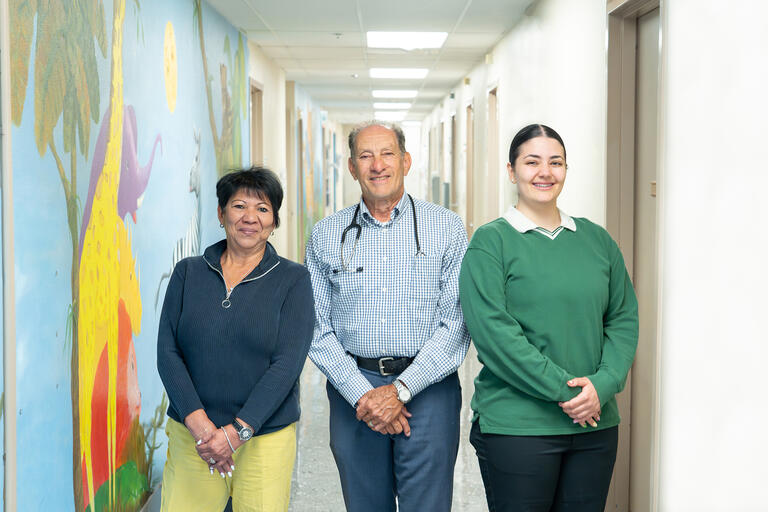
Helping the community isn’t always easy, especially for the staff of UNLV Health Mojave Counseling. The most basic mission of Mojave Counseling is to help people with severe and persistent mental illness. Simply put, it’s our most underserved, most challenged community members in need, and the people of Mojave work hard to help them achieve the highest standard of living that they can. In addition to helping the clients, they help teach students from the Kirk Kerkorian School of Medicine at UNLV, as well as other UNLV colleges, training them to become the next generation of mental health professionals to serve this demanding population.
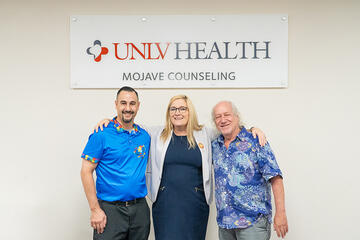
Two of Mojave’s longest serving team members are licensed clinical social worker and agency director Kathleen Wild, and licensed clinical social worker Jason Schwartz, director of community support services. Having worked together at Mojave for almost 30 years, they consider themselves a team in every sense of the word. “Our work together is far more powerful than the sum of our individual efforts,” Wild says.
At the core of it all, though, is helping the mentally ill. “Mental illness is, in and of itself, a traumatic experience,” Schwartz says. “Basically, all of our services have a component of trauma-informed approaches. Sometimes the impetus or the precursors to the mental illness are also traumas. So, you have an initial trauma that can cause or enable the mental illness to occur, and then the mental illness itself is traumatizing. And then the experience of that throughout one's life provides context for multiple traumas. You can talk about various diagnoses from depression, bipolar disorder, schizophrenia, schizoaffective disorder. But what we're really talking about in all of these cases is trauma and how do we treat that? And yes, there's differences in symptom expression, and so that means that there's differences in treatment approach, as well. But underneath it all, there's a commonality and we sometimes forget that.”
What is not talked about is the toll that dealing with this population can take on the staff and service providers of Mojave.
“It's a hard job to begin with,” Wild says. “Working in mental health, there's limited resources, there's high needs, there's a multitude of barriers in treatment. Also, we're human and we connect with clients and, unfortunately, there's deaths involved in our profession. You can see a lot of loss. You're watching your clients go through trauma, people are facing homelessness, they're facing substance abuse issues. Perhaps they have been ostracized from their family. Often, we might be their one main support. So, there is a lot of stress and what they call ‘compassion fatigue’ involved in working in mental and behavioral health.”
Wild continues, “So, one of our goals is to really make sure we're practicing what we preach and to create an environment where staff are supported at every level and that we recognize the toll that this profession can take and that we support each other. That we create an environment where staff are supported when they're going through these issues. And, of course, we're trying to bring resources into the organization to support that, as well.”
You might think that turnover would be high in such a stressful and exacting environment, but the opposite is true. A lot of the staff have worked there for decades.
“I think we do a fairly good job of practicing what we preach,” Schwartz adds, “and so it is a supportive environment. You can operationalize that by how long people have been here. People come to Mojave and they stay. Our mean length of service in the case management department is over 10 years. There's quite a few of us that have been here over 20 years. So, there's a pretty significant number of folks. I think that speaks to the culture.”
The unfortunate reality moving forward is that things seem to be getting harder, not easier. “I'm seeing a shift in a lot of the patients that we're serving,” Wild explains. “It appears like there's more anxiety than there ever was before. We're having people come in with higher needs than in the past. And our needs were always high. I'm not sure if it's post pandemic, kids having been out of school, things like that. But the social problems are not going away. It seems like they've increased, and the level of intensity of needs that we're having in children and adolescents with depression and anxiety, and even our adult population with drug use and homelessness ... it's just really intense.”
While the risks are ever-present for the population they serve, they’re also ever-present for the providers of their care.
“There's been an uptick in violence in healthcare nationally,” Wild says. “Healthcare professionals are at risk for burnout and suicide and physician suicide is a very high risk. So, I feel like it's really important that we recognize that mental health employees are doing more with less in high-risk environments. It's extremely important to me that we don't just talk the talk, that we are doing what we can to recognize that and support them.”
The Mojave Counseling team can be reached at 702-968-4000 or by visiting the UNLV Health website.