
Pop superstar Taylor Swift often pulls from literary and cultural references in her music. For the theme of her latest album, she’s turned to an iconic part of Las Vegas history: the showgirl.
There’s nowhere better to learn about showgirl history than the UNLV University Libraries Special Collections & Archives. On the day of Swift’s latest release, we’re sharing a few pieces from the archives.
Beginnings of the Showgirl
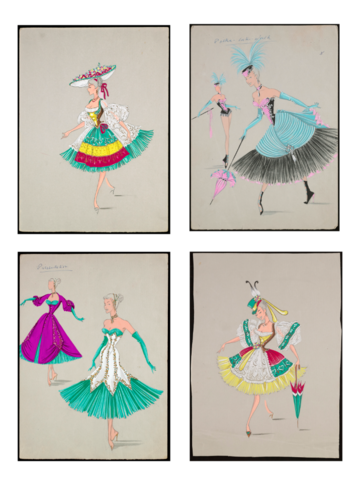
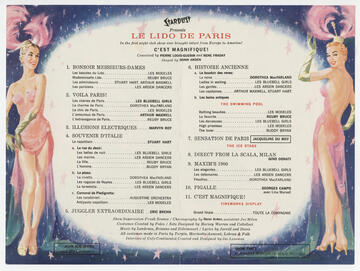
Su Kim Chung, head of Special Collections Public Services and curator for the collecting areas of entertainment and women’s history in Las Vegas, says that while there have always been dancers in Las Vegas shows, showgirls were a new category of performer when they first came from Paris.
“Keep in mind that the original showgirls were all topless,” she says. “It was a real sensation when they first appeared on the Strip in the late 1950s. People think that showgirls are any beautiful woman that appeared as a dancer on the Strip with feathers, fishnets, and rhinestones, but the reality in the world of the big production shows is that they had a very specific meaning.”
The history of the Las Vegas showgirl began in 1958 with the arrival of Lido de Paris, a French production staged at the Stardust Hotel. It was soon followed by Follies Bergère at the Tropicana in 1959 and Casino de Paris at the Dunes in 1963. Since then, showgirls have become an iconic symbol of Las Vegas entertainment and culture.
Evolution of the Showgirl
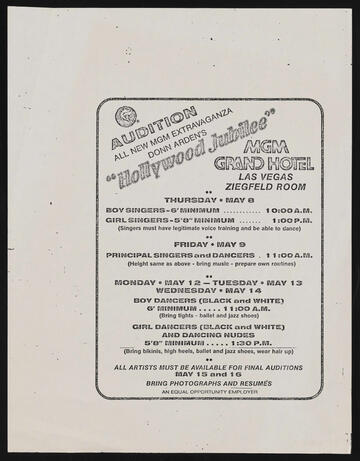
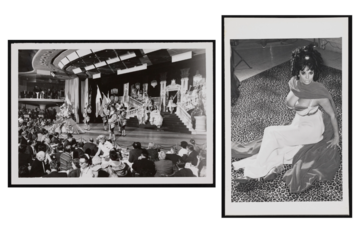
In productions like Lido de Paris, the role of the showgirl was akin to appearing as beautiful moving scenery on the stage while the professionally trained dancers and singers performed. In fact, showgirls often had to meet a minimum height requirement to ensure they were visible on stage. The costumes and elaborate headdresses they wore often did not allow them to move like the covered dancers in choreographed numbers. Instead, they did a graceful and sensual "showgirl walk."
“By the early 1970s, there were three categories of these performers on stage,” says Chung. “You’d have a dancer who was covered, a dancing nude who was topless but had dance training, and a showgirl.”
Over time, these categories began to merge.
Felicia Atkins, one of the most famous showgirls, was rumored to have dated both Bing Crosby’s son and another Vegas icon — “The King” himself.
The Visionaries Behind the Showgirl
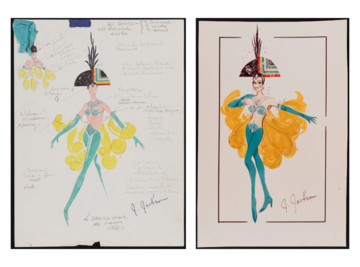
Jerry Jackson’s 1983 costume design process from start to finish for the "Boogie Down” number in Folies-Bergère. (ent000055)
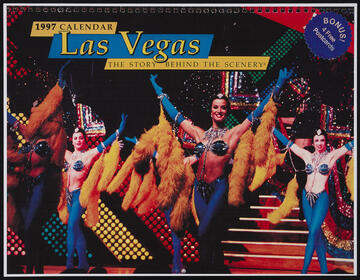
One of the key visionaries of showgirl history was Jerry Jackson, a “quadruple threat” who worked as show producer, artistic director, choreographer, and costume designer. For nearly 36 years, Jackson produced and directed the Folies-Bergère at the Tropicana Hotel and Casino, cementing the lavish aesthetic of Las Vegas entertainment.
Fun fact: Jackson became the show’s costume designer after the previous designer, Nolan Miller, left to create the iconic looks for the TV show Dynasty.
But perhaps the most well known figure behind the showgirl that we think of today was “the master of disaster” Donn Arden, who produced shows like Lido de Paris, Jubilee!, Hello America, Hello, Hollywood, Hello!, and Hallelujah Hollywood. Arden was known for his mastery of placing large numbers of beautiful women on stage in stunning costumes with dramatic sets that featured special effects.
The Life of a Showgirl
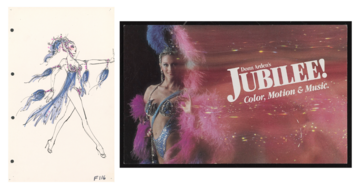
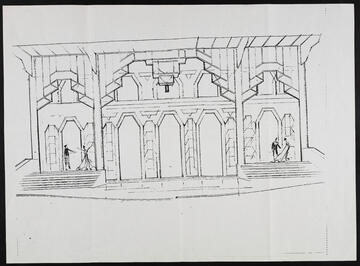

While the showgirl costumes were beautiful, the life of a showgirl was not always glitzy, says Chung. Some headpieces could weigh up to 30 pounds. “It could be kind of rough,” she says. “Showgirls and dancers sometimes worked six days a week, sometimes seven days a week. You did two shows a night, except a lot of times on Saturdays they did three shows a night.”
Still, the spectacle was worth it. The productions in Las Vegas offered performers the rare chance to stay in one city rather than travel on tour. In turn, the productions became an enduring emblem of glamor and an iconic piece of Las Vegas’ history.
“The entire show was the spectacle — was the star,” Chung says, “It was the scenery, the costumes, the beautiful women. Every part, every piece had a part to play in making it this spectacle.”
She adds that performers like Swift would likely have taken on the role of principal singer — rather than showgirl — in these elaborate productions. She would have had a similar look with feathers and rhinestones, but would have also been responsible for carrying the songs and music throughout the show’s many production numbers.
The last showgirl production in Las Vegas ended in 2016, but the legacy of the showgirl lives on in our city’s history, in Special Collections & Archives, and now, in Swift’s own interpretation.
To learn more about the Las Vegas historical resources available to students, faculty, staff, and our community, visit the UNLV University Libraries Special Collections & Archives or consult the digital portal.


