
Nevada Center for Astrophysics News
The Nevada Center for Astrophysics (NCfA) advances theoretical and observational research on astrophysical phenomena such as black holes, exoplanets, and cosmology. Our researchers employ modern computational methods, including large-scale simulations and big data analysis, to tackle fundamental questions about the universe’s origins and evolution. We foster interdisciplinary and international collaboration and engage the community through outreach programs and scientific symposia.
Current Astrophysics News
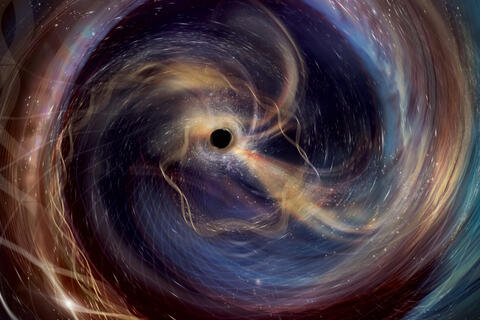
Updated LIGO–Virgo–KAGRA catalog features 161 gravitational wave events between April 2024 and January 2025, including evidence of second-generation black holes and the clearest-ever gravitational wave signal.
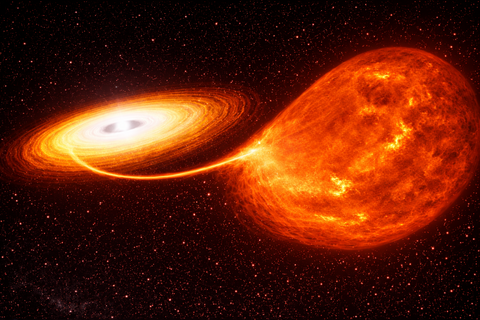
UNLV-led team of astrophysicists resolves decades-old conundrum with new theory on mechanisms driving periodic brightness variations in cataclysmic variable star systems.
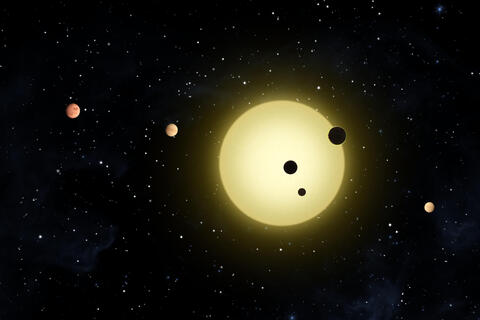
In new study, published in Astrophysical Journal Letters, collaboration of scientists detail recent observations explaining how planets form over time.
Astrophysics In The News
For the first time, scientists have detected two black hole mergers with spins so unusual they may reveal a new generation of cosmic collisions. The twin discoveries, labeled GW241011 and GW241110, were announced by the international LIGO, Virgo, and KAGRA collaborations—teams that have been tuning their instruments to detect the faintest ripples in space and time. Each signal, lasting less than a second, was a final whisper from black holes that collided billions of years ago.
In a paper published in The Astrophysical Journal Letters, the international LIGO-Virgo-KAGRA Collaboration reports on the detection of two gravitational wave events in October and November of 2024 with unusual black hole spins. This observation adds an important new piece to our understanding of the most elusive phenomena in the universe.

In an extraordinary advancement for astrophysics, the international LIGO-Virgo-KAGRA Collaboration has announced the detection of two gravitational wave events from last year that showcase unprecedented black hole spin characteristics. Published today in The Astrophysical Journal Letters, their findings unravel intricate details about black hole mergers, significantly deepening our understanding of these enigmatic cosmic phenomena. These detections open new frontiers in the quest to decode the fundamental physics governing black holes, their formation, and evolution in the universe.
Scientists have "heard" the symphony of two newborn black holes — each created when its respective parent black holes crashed together and merged. One of those collision events, in fact, was the first of its kind.
The international LIGO-Virgo-KAGRA Collaboration reports the observations of two record-breaking events in gravitational wave observations. They were detected in October and November 2024, and they might be a crucial step forward in our understanding of the ripples in space-time and the events that create them.