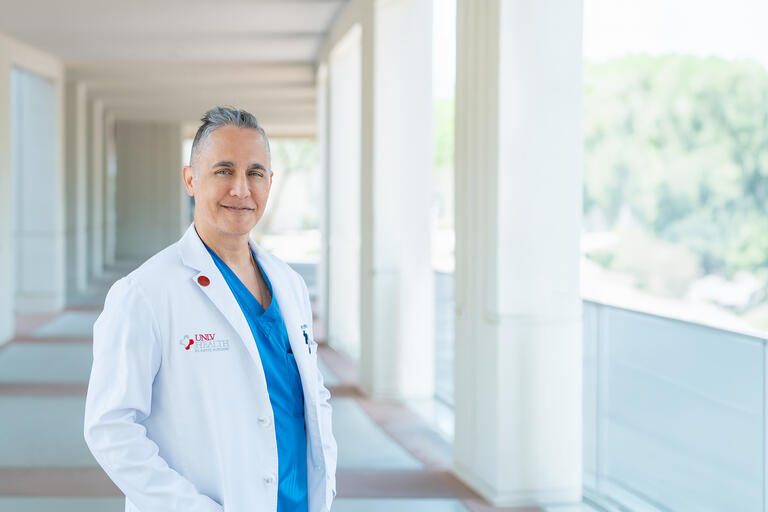
From being a nervous intern in the Kirk Kerkorian School of Medicine at UNLV Internal Medicine Residency program to becoming one of the program’s associate program directors, Dr. Edward Co is set on creating independent, patient-focused physicians.
Originally from Milwaukee, Wisconsin, Co received his doctor of osteopathic medicine from the Lake Erie College of Osteopathic Medicine before going on to complete his residency training at the Kirk Kerkorian School of Medicine, where he served as one of the chief residents. It was during his time as chief resident that the idea of working in academic medicine popped into his mind.
“Transitioning into my chief year allowed me to oversee a new class of interns. I found it incredibly rewarding to mentor individuals who mirrored my own early professional journey – a resident who was initially reserved or lacked confidence. Witnessing those interns mature professionally and clinically over just 12 months was a defining experience for me. It solidified my desire to continue working in academia, where I can continue to contribute to a culture that intentionally cultivates that kind of support and transformation,” Co says. “As I watched residents gaining autonomy in their clinical decision-making, I realized how much I valued guiding a trainee’s progression toward independent practice. This experience served as a jumping off point for my move into academic medicine. I had always been an educator in my roles prior to medical school. My chief year made it clear that teaching is what I wanted to do professionally.”
After completing his residency training, Co chose to continue working with the school of medicine, transitioning into the role of a residency associate program director in the school’s internal medicine residency program, where he established a primary care track. Along with this role, he also serves as the site director of the Veterans Affairs (VA) of Southern Nevada Resident Continuity Clinic within the VA Southern Nevada Healthcare System.
“I credit much of my professional trajectory to the approachable and supportive atmosphere fostered by Dr. Aditi Singh, Dr. Sandhya Wahi-Gururaj, and the UNLV faculty during my training. Their leadership style provided the ideal space for someone with a more introverted personality like mine to grow professionally. This environment didn't just support my clinical training – it actively encouraged me to step into leadership, from class and wellness representative roles to my chief resident year and beyond,” Co says. “Furthermore, I would not have been able to continue growing as a leader after chief year, nor would I have been able to build and launch the primary care track, without the invaluable support of Dr. Marion Tan, chief of primary care at the VA. Together, Dr. Singh, Dr. Wahi-Gururaj, and Dr. Tan have each served as mentors to me throughout my career – shaping not only the clinician I have become, but the leader and educator I continue to strive to be in my current role as faculty and associate program director."
Listening to the residents’ questions and needs is what ultimately led Co to create a primary care track within the internal medicine residency program. “My decision to launch the primary care track was driven by the residents themselves. I noticed an increasing number of trainees at the VA contemplating primary care but looking for more structured guidance. Given the critical shortage of primary care providers nationwide, I saw a clear mission: to create a dedicated pathway within our residency that empowers residents to meet this public health need. It’s about ensuring our graduates feel fully prepared to enter the workforce as confident primary care leaders,” Co says.
Accepting the challenge of building an entire program from scratch, Co worked to get the funding for a primary care track and, after acquiring funding, was able to start it. The program is expected to match its third resident this year.
“The feedback from our inaugural primary care track residents has been overwhelmingly positive. I designed the track so the residents have continuity clinics at both UNLV and the VA. This provides our trainees with a comprehensive breadth of experience, exposing them to distinct patient demographics and differing healthcare delivery systems. Navigating these two different resource models prepares them to be adaptable, well-rounded clinicians,” Co says. “My goal for the program is to create primary care providers that are able to comfortably practice in any type of setting and take care of any type of patient that walks in the door as best they can.”
Since its creation, new changes have been implemented into the primary care track to make it as robust as possible. Most recently, Co is working with colleague Dr. Edwin Avallone – also an associate program director in the department of internal medicine – to introduce point-of-care ultrasound (POCUS) training to the program, which is something not typically offered in other programs.
As for what he hopes residents will learn from him, Co wants his trainees to think of the patient’s perspective as they work.
“One of the most challenging aspects of clinical training is learning to step back from the technical complexities of medicine to prioritize the patient’s perspective. Even a standard treatment plan can be overwhelming for someone unfamiliar with the healthcare system,” Co says. “I emphasize to my trainees that clinical care isn't just about the correct diagnosis; it’s about ensuring health literacy and emotional support. By encouraging my trainees to anticipate and answer questions before they are even asked, we ensure that the care they provide is defined by clarity and empathy rather than just clinical protocols.”
Want to stay updated and learn more about the medical school?
Subscribe to the Kirk Kerkorian School of Medicine at UNLV Making the Rounds newsletter to stay updated on the school’s progress in transforming healthcare in Southern Nevada!