David Cárdenas, dean of William F. Harrah College of Hospitality, will the Graduate College's My Professional Origin Story series at 3 p.m. Thursday, Sept. 11, 2025, in the Barrick Museum of Art Auditorium. It is open to the UNLV community and will also be livestreamed on youtube.
Cárdenas, who started off with a childhood goal of playing professional fútbol in Ecuador, will speak with attendees on all of the twists, turns, and lessons learned that led to him taking on the enviable role as dean of the top hospitality college in the United States.
In advance of his lecture, he shares a glimpse of his origin story below.
What are a few of the defining moments of your educational journey?
This is a great question and very hard to answer. As I look back, I am not sure there is a defining moment, but little twists and turns that shaped my life and academic journey. I think the first one was moving to the United States when I was 14 years old.
At that stage in my life, I wanted to be a professional fútbol [soccer] player. Moving from Quito, Ecuador, with a population of over 2 million at the time, to a rural town in North Carolina with no stoplights and no soccer team (high school or club) was a fundamental transformation for me. I was an unhappy, grumpy teenage boy who thought his life was over, and little did I know it was one of the things that forced me to learn and adapt. I used sports and engagement as my coping mechanism. I tried out for the football and basketball teams.
I joined every club I could and even started a Spanish club at my high school. I was the only Latino in my high school, a school with tense black-and-white dynamics. I could have decided I did not belong in either group, but I was naïve enough to be part of both. This time in my life was transformative and challenging, allowing me to build the confidence I needed to grow.
As I look back, there are many stories from this time that molded me — from my first football game (hitting the game-winning field goal), to being on the basketball team and being the only “white” team member, to joining the student choir and not being able to hold a tune even if it saved my life.
Another defining moment was teaching my first class as a graduate student — how I fell in love with teaching. I was also asked to be a translator for a mission trip to Ecuador, which started my journey into global education.
Describe a time when a mentor made an impact on your life.
The first non-family mentor is from back in high school: Mrs. Nance, my science teacher. She was the one who saw something in me that I did not see in myself and pushed me and believed in me. Unfortunately, she passed away while I was in college from cancer. She was diagnosed in my junior year.
The second mentor who made an impact on my life was Dr. Beth Wilson, my doctoral advisor. She was the one who convinced me to get my doctoral degree and guided me into higher education. Then, Dr. Simon Hudson recruited me to South Carolina and gave me the tools and opportunities to grow as a junior faculty member. Great mentorship can truly change the trajectory of one’s life.
If you could give advice to a younger version of yourself, what would you say?
Thankfully, I quit smoking a long time ago. In hospitality back then, it felt like the only break you got was a smoke break and I picked up a terrible habit. Quitting was hard, and I wish I had never started. Beyond that, I wouldn’t change much. I made my share of bad decisions, but they shaped me and became necessary lessons. Life is a journey, and it makes you who you are. I’m grateful mine led me here — and I’m excited to keep growing at UNLV.
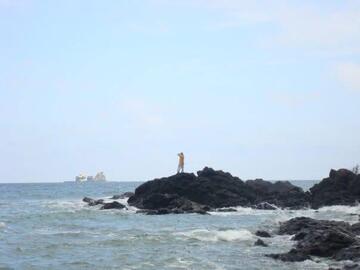
Can you share a few words about the photo that you selected to highlight your story?
It is a picture of me in Ayampe, Ecuador, on my first faculty led international student trip. The picture was taken by one of my students at the time. The trip had a deep impact on me and the community.